 Tripitaka is also known as Tipitaka, is the time-honoured expression for Buddhist scriptures. It contains the texts with assertion of being the words of the Buddha. Initially Tripitaka was handed over to the followers orally. It is well-known as Pali Canon in English. Unlike Theravadins, it also worships a variety of derived literature and commentaries that were composed much later.
Etymology of Tripitaka
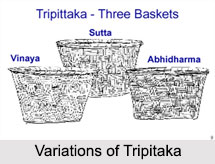
Tripitaka means "Three Baskets" and "pitaka" or "pita" means "basket or box made from bamboo or wood" and "collection of writings". These terms are also spelled with no diacritics as Tripitaka and Tipitaka in academic literature.
History of Tripitaka
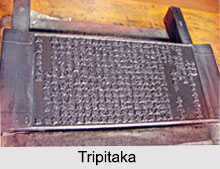 According to the Tibetan historian Bu-ston, states Warder, around or before 1st century CE, there were 18 schools of Buddhism and their Tripitakas were written down by then only. However, apart from for one version that has survived in full and others of which parts have survived, all of these texts are missing to history or yet to be found. According to the Buddhist beliefs, after the death of the Buddha his elder disciples met at the First Buddhist Council to talk about the future of the "sangha". "Sangha" means the community of monks, nuns and the dharma and in this case, Buddha`s teachings.
A monk named Upali recited Buddha`s rules for monks and nuns from recollection. Buddha`s cousin and assistant, Ananda, recited Buddha`s sermons. The legislative body accepted these recitations as the precise teachings of Buddha and they became well-known as the "Sutta -pitaka" and the "Vinaya". The "Abhidharma" is the third pitaka and is believed to have been added in the Third Buddhist Council, ca. 250 BCE. Even though "Abhidharma" is traditionally featured to the historical Buddha, it was composed at least a century after his death by a mysterious author.
Variations of Tripitaka
Tripitaka includes the three main categories of texts that is the Buddhist canon. The three parts of the Pali canon are: the Sutta Pitaka, the Abhidharma Pitaka and the Vinaya Pitaka Even within the Sutra Pitaka it is likely to detect older and later texts.
The Sutta Pitaka: The Sutra Pitaka is older than the Vinaya Pitaka. It includes over ten thousand suttas or sutras related to Buddha and his companions. This deals with the first Buddhist council which was held after Buddha"s death, dated by the majority of recent scholars around 400 BC.
The Vinaya Pitaka: The subject matter of Vinay Pitaka is the monastic regulations for monks and nuns. It can also be called as Book of Discipline.
The Abhidharma Pitaka: Abhidhammapitaka deals with the philosophy and set of guidelines of Buddhism appearing in the suttas. Though, it does not include the methodical philosophical treatises. There are 7 works of Abhidhamma Pitaka.