


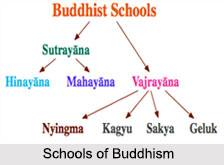
 Schools of Buddhism came into existence with the passage of time. The two primary schools of Buddhism were Theravada and Mahayana Schools of Buddhism. Later, from these two branches several forms of Buddhism came into existence. Though the form of expression in these schools differs but the basic principles remain the same. It was the monastic rules, the culture and the customs of the country where the Buddhist teachings were adopted that influenced the several schools of Buddhism. Most of the Buddhist schools and sects encourage followers to adhere to certain practices and philosophies. Some of these philosophies and practices are common, whereas some unique to the particular school or sect. Schools of Buddhism came into existence with the passage of time. The two primary schools of Buddhism were Theravada and Mahayana Schools of Buddhism. Later, from these two branches several forms of Buddhism came into existence. Though the form of expression in these schools differs but the basic principles remain the same. It was the monastic rules, the culture and the customs of the country where the Buddhist teachings were adopted that influenced the several schools of Buddhism. Most of the Buddhist schools and sects encourage followers to adhere to certain practices and philosophies. Some of these philosophies and practices are common, whereas some unique to the particular school or sect.
Major Schools of Buddhism As Buddhism made progress and spread to different parts of the world, new thoughts and improvisations came to be attached to the existing beliefs and practices. This process led to the development and evolution of different schools or sects. The major Schools of Buddhism are as follows: Theravada School of Buddhism: Having its roots in India, Theravada Buddhism is believed to be the oldest school of Buddhism. It was popularized in Sri Lanka, Myanmar, China and other Asian countries. According to the doctrine of Theravada Buddhism, an individual needs to abide by the basic principles of Buddhism strictly. Moral conduct, meditation and wisdom are the three basic principles of Theravada Buddhism. Mahayana School of Buddhism: The main idea behind Mahayana Buddhism is that anyone can reach the stature of the Buddha by following Buddha Marga. Mahasanghika sect is believed to be the source of the Mahayana Buddhism. This school of Buddhism had a huge impact on China, Korea and Japan. Mahayana school is a huge umbrella under which a number of philosophies and principles are included.  Vajrayana School of Buddhism: This is the tantric school of Buddhism. It is believed that by practicing Vajrayana, a Buddhist follower can achieve enlightenment easily. It is more popularly used in Tibetan Buddhism. When considered on a larger aspect, it is a part of the Mahayana school of Buddhism. It is also commonly referred to as ‘Lamaism’ because at the center of the school lies the Lama. Vajrayana School of Buddhism: This is the tantric school of Buddhism. It is believed that by practicing Vajrayana, a Buddhist follower can achieve enlightenment easily. It is more popularly used in Tibetan Buddhism. When considered on a larger aspect, it is a part of the Mahayana school of Buddhism. It is also commonly referred to as ‘Lamaism’ because at the center of the school lies the Lama.
Chinese Schools of Buddhism: An integral part of the Chinese culture, this school of Buddhism is further divided into 10 more Buddhist schools. Their way of expression may differ but the basic doctrines of Buddhism, such as the Eightfold Paths, Four Noble Truths and others are the same. The Chinese monastic community is an extension of the order of the monks that Buddha had established. The Arahants here are known as ‘Lohans’ but the principles that they abide by are the same. The monks in the monastic community serve the people either by teaching them or by doing social services. Japanese Schools of Buddhism: This school too has 5 sub-divisions. While some of these forms are obsolete today, the Zen School of Buddhism is still one of the popular beliefs. Tantric Buddhism was also a part of Japanese School of Buddhism once upon a time. No matter into how many sub divisions the schools of Buddhism can be classified, none of them break away from the fundamental teachings of Gautama Buddha. Even after centuries of Buddha’s death, these schools abide by the ideals once set up by the Enlightened One. |
| |||



Schools of Buddhism
| Schools of Buddhism are numerous in numbers but the principle philosophy is always the same. |
| ||||||||||||||||||||||||||||

