


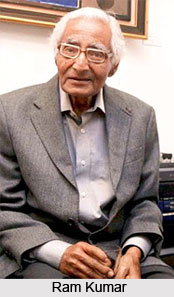
 Ram Kumar was born 1924 in Shimla. He is done an M.A. from St. Stephen's College, Delhi. Ram Kumar took classes at the Sharda Ukil School of Art and thereafter went to Paris and studied under Andre Lhote and Fernand Leger. He paints abstract landscapes in oil or acrylic. He is also an author and writes fiction in Hindi. He has participated in various exhibitions nationally and internationally.
The main concern of the painter is the human condition which is manifested in his early works. His paintings are getting increasing recognition in the art market. Ram Kumar received the Padma Shri in 1972 and the Padma Bhushan in 2010. In its internationalist mood, the post-colonial Indian artists' generation looked towards the early 20th century modernisms of Paris, London and Vienna for inspiration. The generation felt the need to belong motivated towards an interest in building a viable 'Indian' aesthetic, that carried a dynamic relationship to an Indian identity. The quest for an indigenous strain within Ram Kumar did not mean a "superficial inventory of 'native' motifs, offered as evidence of a static and essentialist Indian identity". Instead he tried to demonstrate a painter's inborn nature to ordain the innermost dramas of his culture by preserving the personal identity, even mannerism of his performance. 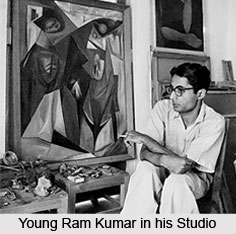 Ram Kumar recent paintings depict another kind of rapprochement as the aesthetic experience appertains. The impulse towards the voluptuary intimates itself even in the sternest asceticism. Ram Kumar was moved by one pole of his mental responsiveness and awareness. Ram Kumar has often pretended to possess an 'inquisitor of structures' (the phrase is Wallace Stevens'), metamorphosing the earth in the dialect of the surveyor's map. This attempt of his depicts a 'topographical code of contour linesand benchmarks constrain the deep saturations of the landscape'. Simultaneously he has always been tempted to vacillate to the other romantic pole of his sensibility. This state can be described as 'taking a passionate and unabashed delight in the physicality of the vista, its capacity for moodiness and unstable beauty, he has celebrated the flush of magnolias in bloom, the gravid slopes borne down by clouds'.
Some exhibitions of Ram Kumar worthy of mention include: * 2005 Pundole Art Gallery, Mumbai; * 2002 Saffronart and Pundole Art Gallery, Mumbai, New Delhi, San Fransico, New York; * 2000 Landscapes from New Zealand, Vadehra Art Gallery, New Delhi; * 1999 Pundole Art Gallery, Mumbai; in 1998 A Gallery, New York; * 1997 Arks Gallery, London; * 1996 Pages from a Sketch Book, Pundole Art Gallery, Mumbai; * 1993 Vadehra Art Gallery, New Delhi; * 1992 Vadehra Art Gallery, New Delhi; * 1992 Pundole Art Gallery, Mumbai; * 1991 Chitrakoot Gallery, Kolkata; * 1990 Pundole Art Gallery, Mumbai. |
| |||



Ram Kumar
| Ram Kumar is one amongst the foremost generation of post-colonial Indian artists. He is one of the abstract painters of India. |
| ||||||||||||||||||||||||||||

