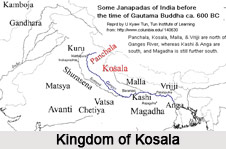
 Kosala was an ancient kingdom in Northern part of India and it fell in the parts of Sixteen Mahajanapadas. Kosala comprised of Shravasti, Kushavati, Saket and Ayodhya. Kosala constituted of the territories of modern Oudh or Awadh, which is located in Uttar Pradesh. The state capital of Kosala was Ayodhya, which was under the command of Pasenadi, also known as Prasenajit- the Kosala King, a contemporary of Gautama Buddha. The southern side it was bordered by the Ganges, the east had river Gandhak encircling it. Magadha was a neighbouring state to Kosala, and there were conflicts between them. Ajatshatru who was the king of Magadha and Prasenjit were in continuous struggle for power, which finally came to an end with the alignment of the confederation of Lichchhavis with Magadha. After Prasenjit, Vidudabha, his son, rose into power and Kosala ultimately amalgamated into Magadha.
Location of Kosala
Kosala is situated to the northwest of Magadha or Maurya Empire and next to Kashi. Kosala was second in the list of sixteen Mahajanapadas. During Buddha`s time, it was a powerful kingdom. By that time, Kasi was under the rule of Kosala. When Bimbisara, the king of Magadha was married to Kosaladevi, daughter of Mahakosala and sister of Pasendi, the village of Kasi was given as the part of dowry.
Kosala in Jataka Stories
There are various Jatakas describe the struggle between Kasi and Kosala, which continued for longer period. Sometimes the Kasi king attacked Kosala, captured the king and ruled over the country. Other time, Kosala king would win over Kasi and annexed its territory.
Kings of Kosala
The important Kosala kings were- Dabbasena, Vanka, Dighavu and Kamsa. Kamsa was given the special title of Baranasiggaha, in memory of his conquest over Kasi. Other kings of Kosala came in conflict with Kasi were Dighiti, Chatta and Mallika.
Sometimes kosala and Kasi entered into matrimonial alliances. When Kosala captured Kasi, its power increased rapidly, until a struggle with Magadha became inevitable. Bimbisara`s marriage was a political alliance and it maintained the peace between Kosala and Magadha. Soon after Bimbisara`s death the war began between his son and successor Ajatsatru and Pasendi. In that fight once Ajatsatru was captured alive, Pasendi spared his life and gave him his daughter Vajira, a marriage that brought political alliances again. Later, after Ajatsatru had conquered the Lichchabis , he seemed to establish an authority in Kosala. In the sixth century BC the Sakyan territory of Kapilavasthu was under the rule of Kosala. Sutta Nipata mentions that Buddha`s birthplace belonged to Kosalans.
River Sarayu and Kosala
The river Sarayu divided Kosala into two parts-Uttara Kosala and Dakshinna Kosala. The localities in the Kosala were- Icchanangala, Ukkattha, Ekasala, Opasada, Kesaputta, Candalakappa, Toranavatthu, Dandakappa, Nagaravinda. Nalakapana, Nalanda, Pankadha, Venagapura, Veludvara, Sala, Salavatika, Setavya, Dronavastuka and Marakaranda.
Kosala in Ancient Scripts
The ancient scripts give a curious explanation about the origin of the name Kosala. It was said that when nothing could make Mahapananda smile, his father offered a reward for one who would be able to make his son laugh. Accordingly, many people accumulated in the court and all their efforts were futile. Finally Sakka sent a celestial actor and Mahapananda showed the sign of amusement.
Kosala and Gautama Buddha
Gautama Buddha spent greater part of his life in Kosala, either in the capital Savatthi or in touring the various parts of the country and many of the Vinaya rules were formulated in Kosala. The Bhikkus got plenty of alms in Kosala though sometimes famine occurred due to drought. Woodlands were also available, where the monks could meditate in solitude, but numbers of monks were never very large in kosala. Bavari himself was the native of the Kosala, though he preferred his hermitage in Dakkhinapatha. After the passing away or Parinirvana, his `Unnaloma` was deposited in the Stupa in Kosala. It was said that the measures taken in Kosala were larger than those of Magadha and thus one `kosala Pattha` was equal to four `Magadha patthas`. In the old scriptures Kosala is often mentioned in combination with Kasi as Kasi-Kosala.