


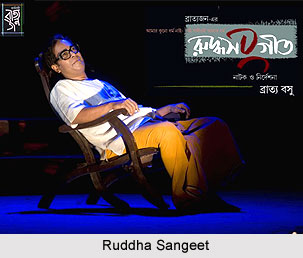
 Contemporary Bengali theatres have come long way post independence period. From its copious tradition, that started as a protest, against the British imperialisms, has slowly but steady taken the turn towards producing some high quality work of art. The socio political and financial issues were clearly illustrated amidst the roopaka and natya of the Bengali theatre. Gradually developed a realistic art form where the unedited realities of life were ideally portrayed. Changes came all over and developed the contemporary Bengali theatre to cater to the need of the society. The cinema was the principal beneficiary of this trend. The theatre did not at first make any comparable or concurrent gain. It was partly because of the higher prices of tickets, and partly because of the shoddy productions in the derelict playhouses. It was also due to the shift in allegiance of the habitual audience to the "other theatre". It took a little time for commercial theatre owners to wake up and set about recovering the patronage they had lost. Star Theatre was the first to hit upon the idea of cashing in on the popularity of the emerging breed of cinema stars. It engaged, among others, Uttam Kumar, the matinee idol of Bengali cinema and Savitri Chatterjee, a very fine actress. It put up Shyamali, a sentimental play about a deaf and dumb girl. People flocked to see their favourite screen idols in the flesh and the commercial theatre had begun the trek back. Shyamali gave the Star enough money to carry out renovations and bolster its conservative instincts. Contemporary Bengali theatres have come long way post independence period. From its copious tradition, that started as a protest, against the British imperialisms, has slowly but steady taken the turn towards producing some high quality work of art. The socio political and financial issues were clearly illustrated amidst the roopaka and natya of the Bengali theatre. Gradually developed a realistic art form where the unedited realities of life were ideally portrayed. Changes came all over and developed the contemporary Bengali theatre to cater to the need of the society. The cinema was the principal beneficiary of this trend. The theatre did not at first make any comparable or concurrent gain. It was partly because of the higher prices of tickets, and partly because of the shoddy productions in the derelict playhouses. It was also due to the shift in allegiance of the habitual audience to the "other theatre". It took a little time for commercial theatre owners to wake up and set about recovering the patronage they had lost. Star Theatre was the first to hit upon the idea of cashing in on the popularity of the emerging breed of cinema stars. It engaged, among others, Uttam Kumar, the matinee idol of Bengali cinema and Savitri Chatterjee, a very fine actress. It put up Shyamali, a sentimental play about a deaf and dumb girl. People flocked to see their favourite screen idols in the flesh and the commercial theatre had begun the trek back. Shyamali gave the Star enough money to carry out renovations and bolster its conservative instincts.
A theatre catering to a large and varied audience has necessarily to be entertaining. Almost inescapably the "entertainment" element gravitates towards the lowest common denominator of audience preference which, given the social conditions of the times, was bound to be for escapism. Responding to such preference the commercial theatre lost no time in shedding its earlier pretence of social milieu and made the unoriginal choice of sex, titillation and vulgarity as the recipe for escapist entertainment. A few theatres were built during the sixties and several more in the last three or four years. But the acute shortage still remains. The audience, actual and potential, has grown enormously and so has the number of small groups struggling to put up experimental Avant Garde plays. They have to make do with makeshift arrangements and remain content with infrequent productions. Rising costs have added to their difficulties and many of them frequently break up or become inactive. It is unfortunate that those who by their talent and devotion won for the drama movement a position of leadership and wide acceptance did not have the foresight to divert a part of their energies for building a number of small modest theatres where off-beat plays could be tried out. Nor did they have the willingness or ability to work together for remedying a situation that threatened their existence. That they were in a position to do so by the late fifties is shown by the commendable ventures of two groups which run two small theatres in south Kolkata 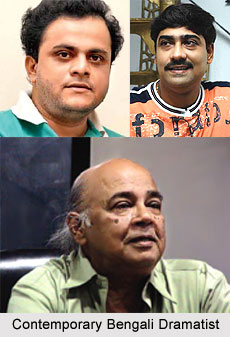 One of them, Theatre Centre, mostly produces playwright-actor Tarun Roy's plays. The author of a large number of competent, well-written plays, Tarun Roy has rendered valuable service by a sustained demonstration of the lesson many groups of the minority theatre are apt to forget, namely, that intimate theatre was not synonymous with amateurish, wild-eyed or modish experiments. The other, Mukta Angan, has served till recently as virtually the only place where less known groups had a chance of testing the worth of their productions before, by and large, an informed audience. The lead given by Theatre Centre and Mukta Angan was not followed up and the opportunity was let slip. Building and other costs being what they are, shortage of theatres is unlikely to be relieved in the near future.
Badal Sarkar tried to come out of the limitations of dramatic and theatrical conventions, which were developed in Bengal. So, he brought the aid of lighting and sets and emphasized on non-verbal ways of communication to break down the city-village divide. He could not bring out much effect but still his impact in the Bengali theatre cannot be denied.  The main hub of Bengali theatre is West Bengal. But with the coming of Television, Cinema and multiplexes, theatre in Bengal has lost its worth as it used to be earlier. The citizens of the state have started running in the busy life and the young generation is losing interest in the theatres. But efforts are not discontinued to revive the theatre culture in the state as well as all over the country. Manoj Mitra, Mohit Chattopadhyay, Ashok Mukhopadhyay, Ramaprasad Banik and Debasis Majumdar are few of the worth mentioned names, who have worked towards the renewal of the Bengali theatre with competence and originality in their productions. But the number of the plays remained small. Moreover, there were no young actors to attract and electrify the audience. Just for the sake of the big and old names like Utpal Dutt, Kumar Roy, Tripti Mitra, Asit Mukhopadhyay, Rudraprasad Sengupta, Bibhash Chakrabarti etc people turned towards the theatre.
Apart from actors, the Bengali theatre is lacking in the other areas like stage lighting, scenography. Tapas Sen is still called up to devise and handle the lighting and Khaled Chowdhury is persuaded to design the sets. But only the scarcity of actors cannot be blamed because most of the theatre groups are yet hesitant to explore into untrodden ways and experiment with budding talents. Again, the case is not same everywhere because now many of the young talented actors are venturing into theatres. This is because many of the educational institutions and Non-governmental organizations in Bengal are now encouraging theatre for various purposes. The schools and colleges organize many theatre and drama competitions among the students on different occasions. The NGOs sometimes appoint the theatre group to communicate any social or health message because people can still relate to this medium. For example, to make people aware of the dangerous AIDS disease, Bengali theatre has played an important role. The political parties also assign some theatre group to spread their messages and to raise their election issues. The corporate houses are also using the theatre groups to promote their services or products. The Bengali theatre's revival has one more reason and that is the theatre groups have now started taking common public issues and problems. They present in such a way that the audience can find interest in it and can relate to their daily life. They now take up the Bengali novels also and present it in English because most of the young generation is now inclined towards that language. Thus both the purpose is served. The younger generation of playwrights, actors and technicians of Bengali theatre are now really trying hard to break the conventional rule and bring out new creative work. But still it is very challenging to do good urban Bengali theatre. It is much easier to do plays with a rustic flavour and with people from villages as actors because it sells in abroad also. The Bengali theatres have now decided to organize a drama festival every year. That means theatre will come out of the circles of the clubs of the city and the theatregoers can expect more of Bengali theatre. Bengali theatre that started as a protest against the British imperialism gained many alterations to achieve today's modish facet and even today Bengali theatre is recognized as a distinct art form. |
| |||



Home > Movies & Entertainment > Indian Drama & Theatre > Regional Theatre in India > Bengali Theatre > Contemporary Bengali Theatre
Contemporary Bengali Theatre
| Contemporary Bengali Theatre with its rich heritage has taken the right direction towards in the field of theatre. |
| ||||||||||||||||||||||||||||

