


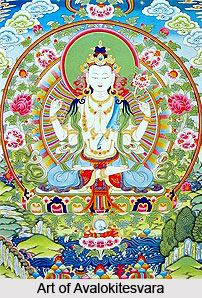
 Avalokitesvara is the bodhisattva of compassion. It is believed that he represents the sympathy of all the Buddhas. As a result he is the most revered of all the bodhisattvas. In different countries he is known by different names. In Tibetan Buddhism he is known as Chenrezig. Here he is seen as the reincarnation of Dalai Lama. While in Mongolia Avalokitesvara is popular as Migjid Janraisig, Xongsim Bodisadva, or Niduber Ujegci the Chinese worship him in a feminine form, Guan Yin. The Buddhist religious iconography represents him holding a lotus in his hand. Hence, he is also known as Padmapani. Avalokitesvara is the bodhisattva of compassion. It is believed that he represents the sympathy of all the Buddhas. As a result he is the most revered of all the bodhisattvas. In different countries he is known by different names. In Tibetan Buddhism he is known as Chenrezig. Here he is seen as the reincarnation of Dalai Lama. While in Mongolia Avalokitesvara is popular as Migjid Janraisig, Xongsim Bodisadva, or Niduber Ujegci the Chinese worship him in a feminine form, Guan Yin. The Buddhist religious iconography represents him holding a lotus in his hand. Hence, he is also known as Padmapani.
Lotus Sutra first mentions Avalokitesvara. He is described as the personification of Buddha's compassion. His name is said to have several meanings. In Sanskrit it literally means the lord who looks down on the world. Others say that Avalokitesvara also refers to the one who observes the sound of the world. As far as his religious significance is concerned he is the most widely worshipped bodhisattva. He looks after the worldly beings and their pain and suffering. Avalokitesvara is the one from whom the female bodhisattva, Tara, emerged. As per the legends Avalokitesvara was crying after witnessing the agony in the world. A lake was formed from his tears and a lotus sprang here. From this lotus emerged the female bodhisattva goddess Tara. Avalokitesvara is particularly important to Tibetans. He had visited Tibet in the 7th century. The natives of Tibet look up to him as the first political and spiritual leader. They considered him the first bodhisattva. He was involved in leading the Tibetans to the path of Pure land from the shackles of pain and suffering. The Tibetans still believe that the present Dalai Lama is his reincarnation. Buddhist religious iconography presents Avalokitesvara in a calm posture. Like the lotus in his hand he too rises amidst this world to relieve the human beings from their sufferings. He is the ideal to be followed by his followers and the later bodhisattvas. His jewels, garlands, sashes, armbands and bracelets denote the material world. It signifies that the bodhisattva will not leave the material world without his followers. He propagated the Amitabha Sutra, which is associated with the Pure Land. His compassion will lead the followers to enlightenment, as he will guide them to break away from the cycle of distress and sorrow. He will help them to follow the Buddha marga. He is also the symbol for purity. Like the lotus he too is born on the soiled world but remains untainted because of his religious principles. Theravada Buddhism looks at Avalokitesvara as one who is masculine in form and under whom Amitabha entered the ascetic life in an earlier birth. On the other hand Mahayana Buddhism represents him as a person who can sacrifice anything to liberate his followers from the trauma of this temporal world. According to Buddhist legends Avalokitesvara had vowed that he would not rest unless he had freed the human race from samsara. Inspite of all his efforts he realized that there was much left to be done yet. While thinking and struggling harder for these poor souls his head split into 11 pieces. Buddha blesses him with 11 heads so that he can successfully complete his mission. Avalokitesvara was now able to find out the needy person easily and helped them. He again faces problem, as he is unable to help so many destitute with two hands. Buddha comes to his rescue once more and blesses him with thousand hands. Avalokitesvara is, thus, considered the perfect example of a bodhisattva as well as a Buddhist guru. |
| |||



Home > Society > Indian Religion > Types of Religion in India > Buddhism > Avalokitesvara - Bodhisattva of Compassion
Avalokitesvara - Bodhisattva of Compassion
| He was the first bodhisattva who is regarded as a compassionate one . |
| ||||||||||||||||||||||||||||

