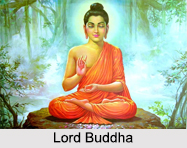
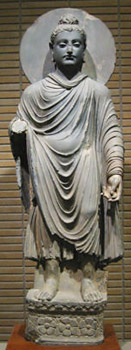
 Buddha was very different from other men in his physical appearance. He had rather impressive physical characteristics. Buddha was Kshatriya by birth and had military training in his upbringing. According to Sakya tradition he required to pass test to demonstrate his excellence to marry a princess. His body was so strong that one of the kings noticed his body stature and offered him the post of general in his army. Buddhists believe that Gautama Buddha had all of the thirty-two signs of a great man.
The Brahmin Sonadanda gives the description of Lord Buddha as ` handsome, good-looking and pleasing to the eye, with a most beautiful complexion. He had a godlike form and countenance, he was by no means unattractive`.
In another scripture the physical appearance of Buddha is depicted as "It is wonderful, truly marvellous, how serene is the good Gotama`s appearance, how clear and radiant his complexion, just as the golden jujube in autumn is clear and radiant, just as a palm-tree fruit just loosened from the stalk is clear and radiant, just as an adornment of red gold wrought in a crucible by a skilled goldsmith, deftly beaten and laid on a yellow-cloth shines, blazes and glitters, even so, the good Gotama`s senses are calmed, his complexion is clear and radiant."
One of the Buddha`s disciple, Vakkali, who later became an arahant, was very much obsessed by Buddha`s physical presence and Buddha reminded him by saying that it was better to know Buddha by Dhamma and not by the physical appearance.
Until the first century CE, Buddha was not depicted as a human being. The physical characteristics of buddha was described in one of the central texts of the traditional Pali canon, the Digha Nayaka in the preaching titled `Sutra of Marks`.
Thirty two characteristics of great man was present in Buddha as well as eighty other secondary characteristics could be identified in him. General characteristics of buddha are- he had an elongated, lengthy body with long arms that spanned equal the body length, long fingers and long hands. His face was elongated with a protruding, well formed nose. Buddha`s hair was fine, black and with soft curls. His eyes were wide and blue or bluish in color. His body was golden colored.
The thirty two signs of the great man that was present in Buddha-
| His feet with a level sole so that feet were placed evenly on the ground. | He had an immense torso, similar to a lion (Sihapuba dhakayo) |
| He had the mark of a thousand-spoked wheel on the soles of his feet. | The furrow between his shoulders is filled in (Pitantaramso) |
| His heels were projecting (ayatapani) | The distance from hand-to hand and head to toe is equal (nigrodhaparima n dalo) |
| His fingers and toes were long (dighanguli) | His neck was smooth and round (samva d dakhando). |
| The skin of his hand and foot were soft.(mudutalahathapado) | He had sensitive taste-buds (rasagasagi) |
| The lines of his palms and soles were netlike (jalahathapado). | His jaws were similar to that of a lion (sihahanu) |
| His ankles were high raised (ussankhapado). | He had forty teeth (Catalisadanto) |
| He had taut calf muscles like an antelope (nimigasadisajangho) | His teeth were evenly spaced (samadanto) |
| He could touch his knees with the palms of his hands without bending (thitakova anonamanto) | His teeth did not have any gap in between (aviraladanto) |
| His sexual organs were concealed in a sheath( kosohitavatguyho) | He had white teeth(Sukadanta) |
| Buddha`s skin was gold colored (suva n nava no) In Lakkhana Sutta it was written that his body was more beautiful than all the gods. | He had a large, long tongue(pahutajivho) |
| His skin was so fine that dust could not attach to it (sukhumacchavi), | He had a voice like a brahaman`s (brahmasaro hiravikabha ni) |
| His body hairs were separated with one hair per pore (ekekalomo) | His eyes were blue. (abhi nila netto) |
| His body hairs were blue black and curled clockwise in rings. (uddhagalomo) | He had eyelashes like an ox (gopa mukkho) |
| He had an upright stance like that of Brahma (brahmujugatto) | He had a white soft bundle of hair in the center of the brow (una loma bhamukantare jata). |
| He had seven convexities of the flesh. According to Lakkhana sutta `the seven convex surfaces/ on both hands, both feet, both shoulders and his trunk`. | His head was like the royal turban (unahisiso). |