


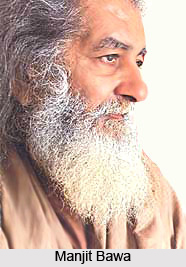
 Manjit Bawa (1941) was a well accomplished name in the field of fine arts, was born in a small Punjabi town of Dhuri in 1941. It was his elder brothers who had encouraged him to pursue further with the practice of arts. Between the periods of 1958 to1963, Manjit Bawa studied fine arts at the School of Art, New Delhi. He was trained under the great painters like Somnath Hore, Rakesh Mehra, Dhanaraj Bhagat and B.C. Sanyal. But it was Abani Sen under whose guidance Manjit Bawa developed his artistic talent.
Later, between the periods of 1964 to 1971, Manjit Bawa had worked as a silkscreen printer in Britain. During that time, he had also received training in fine arts. He tried to capture the concept of Indian mythology and Sufi school of Islam poetry. He started picking up stories from the Mahabharata, the Ramayana and the Indian Puranas. The poetry of Waris Shah, a Punjabi poet and readings from the Granth Sahib holy book of the Sikhs made up the subject matter of his paintings. 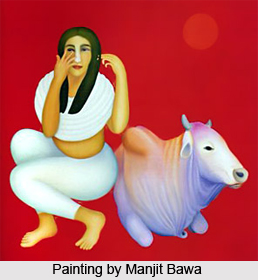 Manjit Bawa's creation can easily be distinguished by their colours. He plays with colours like 'the ochre of sunflowers, the green of the paddy fields, the red of the sun, the blue of the mountain sky'. For this reason he is counted one amongst the first painters who broke down the monotony of the dominant grays and browns. True traditional Indian colours like pinks, reds and violet are the prominent hues of his creation. As he conceives, 'Bright colours are closer to the heart of most Indians, familiar as they are with these shades'. He had painted Ranjha, the cowherd from the ballad Heer Ranjha and Lord Krishna with a flute and is surrounded by dogs and not cows as in mythological paintings. Manjit Bawa's creation can easily be distinguished by their colours. He plays with colours like 'the ochre of sunflowers, the green of the paddy fields, the red of the sun, the blue of the mountain sky'. For this reason he is counted one amongst the first painters who broke down the monotony of the dominant grays and browns. True traditional Indian colours like pinks, reds and violet are the prominent hues of his creation. As he conceives, 'Bright colours are closer to the heart of most Indians, familiar as they are with these shades'. He had painted Ranjha, the cowherd from the ballad Heer Ranjha and Lord Krishna with a flute and is surrounded by dogs and not cows as in mythological paintings.
Nature also plays a significant role in Bawa's paintings. Birds and animals make a constant appearance in his paintings. The flute is a recurring motif in his works. He passed away on 29th December 2008. He was in coma for three years after suffering a stroke. Awards and honours received by Manjit Bawa: * 1986 1st Bharat Bhawan Biennale, Bhopal * 1981 All India Exhibition of Prints and Drawings, Chandigarh * 1980 National Award, Lalit Kala Akademi, New Delhi * 1963 Sailoz Prize, New Delhi |
| |||



Manjit Bawa
| Manjit Bawa was trained under great painters like Somnath Hore, Rakesh Mehra, Dhanaraj Bhagat and B.C. Sanyal. |
| ||||||||||||||||||||||||||||

