Introduction of Cinema in India helped in making people helped potential talents to express themselves through filmmaking. India, with its rich and varied heritage, has had an appealing history in the past. Apart form the history and culture, India has been acknowledged as a talented country with its highest applaud given to its art. Indian Art, in all forms, has been classified into various forms and one of the most popular forms is Indian Drama. Indian drama and theatre is perhaps as old as its music and dance. Its origin was during the Vedic Period.
The birth of Cinema in India can be attributed to the Lumiere brother`s. Only a few months after the Lumiere brothers introduced the art of cinematography in Paris in 1895, cinema made its presence felt in India. The Lumiere brothers` held their first public showing at Watson Hotel in Mumbai on July 7, 1896 and the Times of India glowingly referred to it as the `miracle of the century`. Westerners, who were quick to realize the value of India as a site of filmmaking both because of its natural beauty and its `exotic` culture, were inspired to make films that used Indian scenery and culture. However, this phenomenon did not create much of a ripple. The Indian viewer took the new experience as something already familiar to him, thanks to the art of shadow play and the tradition of story-telling with hand-drawn images accompanied by live sound.
The Lumiere brothers` Cinematography first show was a silent movie for 10 minutes. Six items, each of 17 meters, were included - Entry of Cinematography, The Sea Bath, Arrival of a Train, A Demolition, Ladies and Soldiers on Wheels, and Leaving the Factory played at the Watson Hotel. On July 14, the shows shifted venue - to the Novelty Theatre, Mumbai. Twenty-four items were on, including A Stormy Sea and The Thames at Waterloo Bridge. The shows concluded on August 15, 1896. The first Indian to make a film was Harischandra S. Bhatvadekhar, popularly known as Save Dada. He was a still photographer, a dealer in equipment and an exhibitor of films. His interests led him naturally to the art of cinema. The public reception accorded to Wrangler Paranjpye at Chowapatty on his return from England with the coveted distinction he got at Cambridge was covered by Bhatwadekar. He was the first Indian to produce a film. All he had with him was a projector, but he did not have a camera, so he got one from London and shot only 2 scenes of 3 minutes each, which were titled Do Pahalwanon Ki Kushti and Bandar Ko Nachata Hua Madaari.
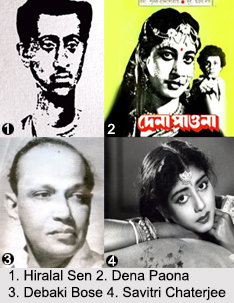
 Next was F.B. Thanawala, who made his debut in 1900. Two of his films, Splendid New View of Bombay (1900) and Taboot Procession (1900) generated great interest. The first film explored some outstanding landmarks in the city of Mumbai, and the second an annual Muslim procession. In 1901, Hiralal Sen made his mark as a film producer with a deep interest in Indian history and mythology. In Kolkata, Hiralal Sen photographed scenes from some of the plays at the Classic Theatre. Such films were shown as added attractions after the stage performances or taken to distant venues where the stage performers could not reach. The possibility of reaching a large audience through recorded images which could be projected several times through mechanical gadgets caught the fancy of people in the performing arts, stage and entertainment business.
In 1905 film production was linked with exhibition. Jamsetji Framji Madan, who had gained a wide reputation in the theatre world of Kolkata, went on to establish the Elphinstone Bioscope Company. In the years that followed, the Madan Theatre began to exercise great influence both inside India and outside. Madan was the first businessman to foresee the imminent business possibilities of filmmaking in India. Not only did he build a vast production empire on the lines of Hollywood but he also imported foreign actresses (Ermline, Patience Cooper and others) "to act in Indian mythological and folk tales, as Indian females were hesitant to expose themselves to the gaze of the film camera. For some time, the Elphinstone Company dominated film production in India.
The first decade of the 20th century saw live and recorded performances being clubbed together in the same program. The strong influence of traditional arts, music, dance and popular theatre on the cinema movement in India in its early days is probably responsible for its characteristic enthusiasm for inserting song and dance sequences in Indian cinema, even today. Film shows became popular thereafter, and on 1st January 1900, another silent movie was released at Novelty Cinema, Mumbai. Tivoli Theatre was the venue for a show of 25 pictures that included such titles as Japanese Dance by the Beauties and Fatima, an Indian Dance. The city of Kolkata held its first film exhibition at Star Theatre on October 2 1898.
 By now, Indian audiences were increasingly being exposed to Western films. Hence, the fascination with longer narratives and the desire to see Indian experiences and characters on screen resulted in the first ever mythological film produced in India by R.G. Tomey`s, which was "Pundalik". The first full-length Indian feature film was Raja Harishchandra (3700 feet as compared to 1500 for Pundalik), made in 1913 and released commercially in May that year, by Dadasaheb Phalke. Phalke had attended a screening of The Life of Christ at P.B. Mehta`s American-Indian Cinema and was inspired to make films himself. He was convinced of the possibility of establishing an indigenous film industry by focusing on Indian themes. In this regard, he said like the life of Christ, we shall make pictures on Lord Rama and Lord Krishna. The film was about an honest king who for the sake of his principles sacrifices his kingdom and family before the gods, who are impressed with his honesty and restore him to his former glory. The film was a success, and Phalke went on to make more mythological films till the advent of talkies, and commercialization of Indian films lessened his popularity.
By 1920, that is seven years after the first Indian feature film was produced, Indian cinema appeared to be established on secure foundations - 18 feature films were produced in 1920,40 films in 1921, and 80 in 1925. As cinema began to grow more and more popular among the masses and a lucrative industry was established, a number of indubitably gifted film directors made their debut; among them Suchat Singh, Dhiren Ganguli, Himansu Rai and V.Shantaram. Many good films made during this initial period were greatly inspired by the two celebrated epics - the Ramayana and the Mahabharata. Many of the directors sought to invest their mythological narratives with a clear social message relevant to contemporary society. The filmmakers associated with this phase in the growth of Indian cinema were Janus-faced. They looked back to the past lovingly and sought to reconnect with tradition; at the same time, they sought to draw on the resources and innovations of Hollywood. Until now all films were silent.