
 Charaka Samhita is the Ayurvedic text obtained from the ancient Indian tradition written by the great Ayurvedic physician Charaka. It is said to be the oldest of the three ancient treaties of Ayurveda. Charaka Samhita has relevance in the modern day practice of Ayurvedic medicine. Charaka Samhita and Sushruta Samhita are famous worldwide as an important source of old Ayurveda practice. Thus this book helps to gather an idea of the ancient medicinal practice.
Charaka Samhita
Charaka Samhita is an ancient Ayurvedic text written by Charaka, which describes all the possible aspects of diseases and its remedy.
Introduction
Charaka Samhita is the Ayurvedic text obtained from the ancient Indian tradition written by the great Ayurvedic physician Charaka. It is said to be the oldest of the three ancient treaties of Ayurveda. Charaka Samhita has relevance in the modern day practice of Ayurvedic medicine. Charaka Samhita and Sushruta Samhita are famous worldwide as an important source of old Ayurveda practice. Thus this book helps to gather an idea of the ancient medicinal practice.Source of Charaka Samhita
The text Charaka Samhita is written in Sanskrit. The term "Charaka" means "wandering scholars" or "wandering physicians" and "Samhita" denotes "collected" or "compendium". The original source of Charaka Samhita is the Agnivesha Tantra based on the teaching of Punarvasu. It is thought that Charaka has edited this work and in later times another Ayurvedic Scholar Dridhabala extended the Charaka Samhita further more. The Charaka Samhita was most probably written in Mauryan era (around 3rd century BC).
Context of Charaka Samhita
 The text contains eight sections having 120 chapters in total. The eight sections are Sutra Sthana (General principles), Nidana Sthana (Pathology), Vimana Sthana (Specific determination), Sarira Sthana (Anatomy), Indriya Sthana (Sensory organ based prognosis), Cikitsa Sthana (Therapeutics), Kalpa Sthana (Pharmaceutics and toxicology) and Siddhi Sthana (Success in treatment).
According to the Charaka Samhita, the successful medical treatment mainly depends on four factors: the physician, substances (drugs or diets), nurse and patient. They all should possess certain traits in them and they are:
The physicians should possess some qualities like clear grasp of theoretical content of the science, a wide range of experience, practical skills and cleanliness.
The qualities that should be present in drugs or substances are abundance, applicability, multiple use and capacity to produce the desired effect.
The nursing attendant should be well aware of nursing techniques, practical skill, attachment for the patient and cleanliness.
The patients should also possess some quality to be promptly cured like good memory, obedience to the instructions of the doctors, courage and ability to describe the symptoms.
Classification of Medicine in Charaka Samhita
 Charaka was a legendary authority on medicine. The science of medicine on the basis of Charaka is widely practiced even now in India. Charaka divides material objects into 3 classes, namely; Mineral, Animal and Vegetable.
Minerals: They consist, of gold, silver and other metals; diamond, emerald and other gems; realgar, orpiment and other ores; and the various sorts of earths.
Animals: They are divided into 4 classes, namely, "Jardyuja" or mammalian, "Andaja" or oviparous, "Svedaja" or those produced from Animal excretions, as parasites, etc., and "Udbhijja" or those produced under ground or from vegetable matter, as for example Indragopa, a sort of red insect. The skin, hair, wool, nails, horns, hoofs, milk, bile, honey, fat, marrow, blood, flesh, urine, faeces, semen, bones and nerves of animals are all used in medicine.
Vegetables: They are divided into 4 classes, namely, "Vanaspati", "Vriksha", "Virudh" and "Oshadhi". Those plants which produce fruits, without first showing their flowers, are called "Vanaspati". Plants which produce fruits from flowers and which have small branches from their trunks are called "Vriksha". Plants which during their growth are supported by other plants are called "Virudh". Lastly, those grasses, etc. which die after maturing their fruits, are called "Oshadhi".
All parts of vegetables may be used in medicine, namely;
• Root, as of "Chitraka".
• Under ground stem as of "Surana".
• Leaves, as of "Vasaka".
• Fruits, as the three "Myrubalans".
• Flowers, as of "Dhataki".
• Extract, as Catechu, Opium, etc.
• Bark, as of "Kureki".
• Wood, as of "Darvi".
• Gum, as Myrrh, Asafoetida, etc.
• Sometimes the entire plant is used as "Kantakari".
Sanskrit writers do not agree in the mode in which they classify medicines when describing their properties. Charaka divides medicines into 50 classes, according to their supposed action on the different organs of the system, or on particular symptoms of disease. These classes are as follows:
1. "Jivaniya"- Medicines which prolong life.
2. "Vrinhaniya"- Medicines which promote nutrition and increase corpulency.
3. "Lekhaniya"- Medicines which thin the tissues, or reduce corpulency.
4. "Bheduniya"- Promote excretions.
5. "Sandhaniya"- Promote the union of fractured or divided parts.
6. "Dipaniya"- Increase the appetite and digestive.
7. "Balya"- Increase strength, tonics.
8. "Varnya"- Improves the complexion.
9. "Kanthya"-Improves the voice, cure hoarseness.
 10. "Hridya"- Promote cheerfulness or relish.
11. "Triptighna"- Remove supposed phlegm which causes a sense of satiety.
12. "Arsoghna"- Cure piles.
13. "Kushthaghna"- Cure skin diseases.
14. "Kandughna"- Cure pruritus.
15. "Krimighna"- Cure worms.
16. "Vishaghna"- Acts as antidotes to poisons.
17. "Stanyajanana"- Promote secretion of milk.
18. "Stanyasodhana"- Improves the quality of milk.
19. "Sukrajanana"- Increases the secretion of semen.
20. "Sukrasodhana"- Purify the semen.
21. "Snehopayoga"- Emollients.
22. "Svedopayoga"- Diaphoretics.
23. "Vamanopayoga"- Emetics.
24. "Virechanopayoga"- Purgatives.
25. "Asthapanopayoga"- Medicines for use in enemas.
26. "Anuvasanopayoga"- Medicines for oily enemas.
27. "Sirovirechanopayoga"- Promote discharge from the nose.
28. "Chhardinigrahana"- Relieve vomiting.
29. "Trishnanigrahana"- Relieve thirst.
30. "Hikkanigrahana"- Relieve hiccup.
31. "Purishasanqrahaniya"- Render the faeces consistent.
32. "Purishavirajaniya"- Alter the colour of the faeces
33. "Mutrasangrahaniya"- Reduce secretion of urine.
34. "Mutravirajaniya"- Alter colour of urine.
35. "Mutravirechaniya"- Increase secretion of urine.
36. "Kasahara"- Cure cough.
37. "Svasahara"- Cure difficult breathing or asthma.
38. "Sothahara"- Cure anasarca or swellings.
39. "Jvarahara"- Febrifuges.
40. "Sramahara"- Remove fatigue.
41. "Dahaprasamana"- Relieve burning or heat of body.
42. "Sitaprasamana"- Relieve sense of coldness.
43. "U`darddhaprasamana"- Cure urticaria.
44. "Angamarddaprasamana"- Relieve pain in the limbs.
45. "Sulaprasamana"- Cure pain in the bowels.
46. "Sonitasthapana"- Styptics.
47. "Vedanasthapana"- Anodynes.
48. "Sanjuasthapana"- Restore consciousness.
49. "Prajasthapana"- Cure sterility.
50. "Vayahsthapana"- Prevents the effect of age.
Recently updated articles in Ayurveda in India
Rasa, Dhatu of Ayurveda
Rasa, the preliminary dhatu of Ayurveda, refers to the matter that is produced after the digestion of food in the human body. Rasa Dhatu provides nour...
Classification of Medicine, Sushruta Samhita
Sushruta divides medicines into 37 classes in his medical text ‘Sushruta Samhita’.
Ayurveda - Traditional Medical System
Ayurveda is an elaborated holistic medical system of India with a rich history of more than 5000 years.

Impact of Meditation
The psychological and physiological effects of meditation have been studied.

Therapeutic Massage
Therapeutic Massage is a therapy to mobilise soft tissues to restore the normal mechanical activities in human body.
Related articles in Ayurveda in India
Gurukul System of Ayurveda
Gurukul system of Ayurveda used to teach the students in a way so that they can become an expert physician.
Origin of Ayurveda
With a history of more than five thousand years, Ayurveda is the most ancient Indian medical science
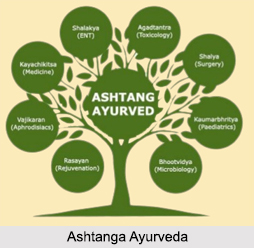
Ashtanga Ayurveda
Ashtanga Ayurveda refers to the eight limbs of Ayurveda. Ayurveda was divided by great Indian seers into destine eight branches.