


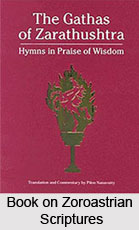
 The oldest Parsi scripture is known as Gatha. Later on it came to be written in Zend meaning commentary and Avesta, which is the language in which it was later written. Thus it is now known as Zendavesta. The oldest Parsi scripture is known as Gatha. Later on it came to be written in Zend meaning commentary and Avesta, which is the language in which it was later written. Thus it is now known as Zendavesta.
Zendavesta is divided in two parts: The first part contains the Vendidad-a compilation of religious laws and stories, the Visperad-that contains litanies pertaining to sacrifice and the Yasna-also containing litanies and five hymns or Gathas in a special dialect. The second part contains prayers and is known as Khorda Avesta or 'small Avesta'. Zendavesta was such a language that could not be understood by the people. Then the Parsi priests translated it into Pahlavi, which is the ancient form of Persian language. French, German and British scholars tried to understand the language of Gatha and Zendavesta .In the process it gradually dawned upon them that the language of Gatha and Zendavesta has a great kinship with Sanskrit language. 
Initially the Western Scholars did not understand the Gatha. Later Katyayana and Patanjai were applied and then the Gatha and Zend-Avesta came to be understood by them. From this it was later assumed that once upon a time the Iranians of the Gatha, Zendavesta and the Indo-Aryans of the Vedas formed one single race of which speaking language related to Sanskrit. In the Zendavesta, from the very beginning deva is a general name of an evil spirit and the Zoroastrianism is against the Devas (vidaevo). Since they are against devas, Zoroastrianism is the religion of Asura (Ahura) or Ahura Mazda. In the older versions of the Rigveda, 'asura' is used in a good sense. Indra, Varuna and Agni are all called asura, which means living as asu means breath. In the later Vedic literature Devas were taken to be creatures of light that were at war with the Asuras. The key to the Avesta is not the Pahlavi, but the Veda. The Avesta and Veda are two echoes of one and the same voice, the reflex of one and the same though- The Vedas. There-fore, they both are the best lexicon and the best commentary to the Avesta. |
| |||



Zoroastrian Scriptures
| Zoroastrian Scripture is known as the Gatha, which came to be written in Avesta language. |
| ||||||||||||||||||||||||||||

