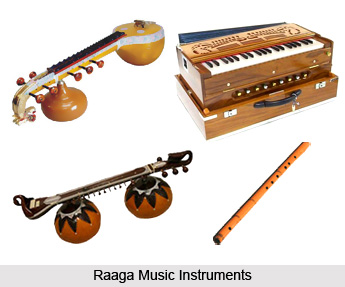
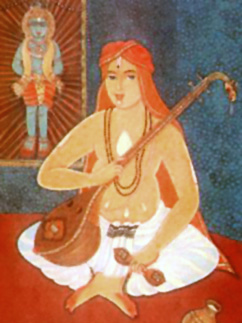
String instruments are those which produce sound by being plucked by way of vibrating strings. This category of musical instruments referred to as `Tata Vadya` in Bharata `s Natyashastra, are found in quite a sizeable number in India. Indian music has a rich tradition of string instruments and this class of instruments are all plucked, bowed or hammered ones. The bowed class appears to be quite old, yet these instruments did not occupy a place in classical music until the last few centuries. In the world of international music, string instruments are usually classified into lutes, harps and zithers. In Indian music, a number of different types of string instruments are used. The chief types used are `Ektara`, Indian sitar, `Surbahar`, `Swarmandal`, `Tambura`, `Veena`, `Sarod`, `Sarangi`, `Rebab`, `Esraj`, `Santoor` and `Sarinda`.
History of String Instruments
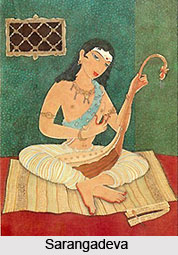
The origin of string instruments are difficult to trace. One of the commonest assumptions is that the earliest stringed instrument was the hunter`s bow. The `Villadi Vadyam` has such a use and its very name (villu:bow) indicates its shape and, perhaps, its parentage. Again, the fact that the early instruments were harps constructed in the form of a bow lends support to this idea; for a harp can easily be imagined as a bow with a number of parallel strings. This close resemblance between the musical instruments and the weapon is recognized in the Ramayana, wherein Havana, proclaiming his prowess as a bowman, likens his bow to a Veena and his arrow to a plectrum. Thus many Indian scholars put forward this idea of the bow as the originator of all the stringed instruments. The earliest types of string instruments are held to be the harps and lyres. Right from the time of the Indus Valley Civilization until the 11th century AD there are a number of visual representations of harps of some kind or the other. Also, fingerboard zithers existed side by side with these even from the time of Bharata. A very early picture of such a zither may be seen in Ajanta; but later sculptures and paintings show greater details. The harps were gradually displaced by fingerboard instruments of various types.

Types of String Instruments in India
Most popular among the various plucked string instruments of India, is the sitar. It has been in use for almost 700 years, developed during the collapse of the Mughal Dynasty. The sitar is currently used in a number for different types of music including North Indian classical music, Hindustani Sangeet, Bollywood music and western and Indian fusion music.
Veena
A popular stringed instrument used in Carnatic music is the Veena. The Veena was often used to accompany the Dhrupad style of singing and this did not allow for much intricacy or embellishment around the notes. Some variations of the Veena are `Rudra Veena`, `Sarasvati Veena`, `Vichitra Veena` etc.
Sarod
Sarod is another popular classical musical string instrument of India. It is used mainly in the performance of Hindustani classical music in India. There are four main strings, six rhythms and drone strings and fifteen sympathetic strings, all made of metal, but it has no frets.
Santoor
The Santoor is a North Indian instrument originating from Kashmir. It has more than a hundred strings, which run across a hollow rectangular box and a pair of slim carved walnut mallets strikes the strings. The Santoor as used in Kashmiri classical music is played with a pair of curved mallets made of walnut wood and the resultant melodies are similar to the music of the harp, or piano.
Ektara
The Ektara is a one-stringed instrument perhaps the oldest of the stringed instruments in the Indian subcontinent. Originally, this instrument was a regular string instrument, which is plucked with one finger.
Surbahar
Surbahar is an instrument also known as bass sitar and is a plucked string instrument of India used in the Hindustani classical music of North India.
Swarmandal
Yet another string instrument of India is the Swarmandal. It is a kind of small harp used for the drone to accompany the vocalists in Indian classical music. It is a traditional instrument used in many Hindu and Muslim rituals.
The rapid spread of a global culture has seen the spread of many musical instruments to and from the country. A number of musical instruments which have originated in India are now used in the world stage in various collaborations with international artists. Conversely there are many string musical instruments in world music which have made their way into Indian music for instance, the `Rebab`. Most popular among the string instruments of the world is the guitar. A number of guitars- bass guitar, rhythm guitar, electric guitar etc are used even in Indian music. Yet another international string musical instrument which has been readily accepted in the field of Indian music, especially Carnatic music, is the violin. Other popular instruments include the mandolin, viola etc.
String Instruments
String instruments have a long tradition in Indian music. The bowed instruments came to be used in Indian classical music only in the last few centuries.