Prasarita Padottanasana
|
Prasarita Padottanasana is a cultural yoga asana translating to the wide-legged forward bend pose and stretches the inner back legs and the spine.
|
|
|
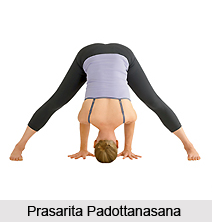 Prasarita Padottanasana is a cultural asana that strengthens and stretches the inner back legs and the spine. Prasarita Padottanasana is a cultural asana that strengthens and stretches the inner back legs and the spine.
Meaning of Prasarita Padottanasana
Prasarita refers to something that's stretched out, expanded, spread with outstretched limbs. "Pada" literally means foot, "ut" means intense, and "tan" (here) means to extend or stretch.
Practice of Prasarita Padottanasana
Stand in Tadasana (Mountain Pose), facing one of the long edges of the sticky mat, then step or lightly hop the feet apart anywhere from 3 to 4 1/2 feet (depending on the height: taller people should step wider).
Rest the hands on the hips. Make sure the inner feet are parallel to each other. Lift the inner arches by drawing up on the inner ankles, and press the outer edges of the feet and ball of the big toe firmly into the floor.
Engage the thigh muscles by drawing them up. Inhale and lift the chest, making the front torso slightly longer than the back.
Exhale and, maintaining the length of the front torso, lean the torso forward from the hip joints. As the torso approaches parallel to the floor, press the fingertips onto the floor directly below the shoulders.
Extend the elbows fully. The legs and arms then should be perpendicular to the floor and parallel to each other.
Move the spine evenly into the back torso so that the back is slightly concave from the tailbone to the base of the skull.
Bring the head up, keeping the back of the neck long, and direct the gaze upward toward the ceiling.
Push the top thighs straight back to help lengthen the front torso, and draw the inner groins away from each other to widen the base of the pelvis.
Take a few breaths. Maintaining the concavity of the back and the forward lift of the sternum, walk the fingertips between the feet.
Take a few more breaths and then, with an exhalation, bend the elbows and lower the torso and head into a full forward bend.
Make sure while moving down to keep front torso as long as possible. If possible rest the crown of the head on the floor.
Press the inner palms actively into the floor, fingers pointing forward. If the practitioner has the flexibility to move the torso into a full forward bend, he or she may walk the hands back until the forearms are perpendicular to the floor and the upper arms parallel.
Be sure to keep the arms parallel to each other and widen the shoulder blades across the back. Draw the shoulders away from the ears.
Stay in the pose anywhere from 30 seconds to 1 minute.
To come out, bring the hands back on the floor below the shoulders and lift and lengthen the front torso.
Then with an inhalation, rest the hands on the hips, pull the tail bone down toward the floor, and swing the torso up.
Walk or hop the feet back into Tadasana.
Some beginners are not able to easily bring their hands to the floor and need a good deal of support in this forward bend to protect their lower back. Try raising the hands off the floor by resting each on the end of a block. Always remember in forward bends to emphasize the length of the front torso.
Effects of Prasarita Padottanasan
The asana strengthens and stretches the inner and back legs, as well as the spine.
Tones the abdominal organs.
The asana calms the brain.
Relieves mild backache.
Therapeutic applications of this asana includes headache, fatigue and mild depression.
Precautions in the practice of Prasarita Padottanasana
In case of Lower-back problems: Avoid the full forward bend
|
|
|
|





