


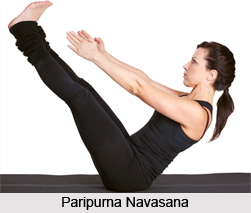
 Paripurna Navasana is a cultural asana that is similar to the appearance of a boat in its final position. It greatly strengthens the muscles of the abdomen, the hip flexors and spine. Paripurna Navasana is a cultural asana that is similar to the appearance of a boat in its final position. It greatly strengthens the muscles of the abdomen, the hip flexors and spine.
Meaning of Paripurna Navasana The literal meaning of the term "paripurna" in Sanskrit is 'complete'. "Nava" means boat. An abdominal and deep hip flexor strengthener, Boat Pose requires one to balance on the tripod of the sitting bones and tailbone, representing the appearance of a boat. Yoga Texts and Paripurna Navasana The Shri Tattva Nidhi, a 19th century Hindu treatise compiled in the princely state of Mysore, describes the Naukasana, similar to the contemporary Navasana. Practice of Paripurna Navasana * Sit on the floor with the legs straight in front. * Press the hands on the floor a little behind the hips, fingers pointing toward the feet, and strengthen the arms. * Lift through the top of the sternum and lean back slightly. While doing this, make sure the back does not round; continue to lengthen the front of the torso between the pubis and top sternum. * Sit on the "tripod" of the two sitting bones and tailbone. * Exhale and bend the knees, then lift the feet off the floor, so that the thighs are angled about 45-50 degrees relative to the floor. * Lengthen the tailbone into the floor and lift the pubis toward the navel. If possible, slowly straighten the knees, raising the tips of the toes slightly above the level of the eyes. If this isn't possible remain with the knees bent, perhaps lifting the shins parallel to the floor. * Stretch the arms alongside the legs, parallel to each other and the floor. * Spread the shoulder blades across the back and reach strongly out through the fingers. If this isn't possible, keep the hands on the floor beside the hips or hold on to the backs of the thighs. * While the lower belly should be firm, it shouldn't get hard and thick. Try to keep the lower belly relatively flat. * Press the heads of the thighbones toward the floor to help anchor the pose and lift the top sternum. Breathe easily. * Tip the chin slightly toward the sternum so the base of the skull lifts lightly away from the back of the neck. * At first stay in the pose for 10-20 seconds. Gradually increase the time of the stay to 1 minute. Release the legs with an exhalation and sit upright on an inhalation. It is often difficult to straighten the raised legs. Bend the knees and loop a strap around the soles of the feet, gripping it firmly in the hands. Inhale, lean the torso back, then exhale and lift and straighten the legs, adjusting the strap to keep it taut. Push the feet firmly against the strap. Ardha Navasana * When in the Full Boat Pose, clasp the hands on the back of the head and, with an exhalation, lower the legs slightly. * At the same time round the back, so that one is now resting on the sacrum (though the lower back is still off the floor). * Stretch the elbows out to the sides and bring the tips of the big toes in line with the eyes. Effects of Paripurna Navasana * The asana strengthens the abdomen, hip flexors and spine. * Stimulates the kidneys, thyroid, prostate glands, and intestines. * It also helps relieve stress and improves digestion. Precautions in the practice of Paripurna Navasana * In case of neck injury, Sit with the back near a wall to perform this pose. While tilting the torso back rest the back of the head on the wall. However, one should avoid this asana in case of Asthma, Diarrhoea, Headache, Heart Diseases, Insomnia, Blood pressure, Menstrual Disorders and Pregnancy. |
| |||



Paripurna Navasana
| Paripurna Navasana is a cultural yoga asana, meaning the full boat pose, and involves balancing the body on the sitting bones & tailbone. |
| ||||||||||||||||||||||||||||

