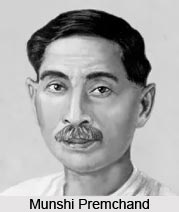
 Munshi Premchand was a legendary Indian writer notable for his modern Hindustani literature. Premchand was such a progressive writer that, in his hands Hindi literature achieved new heights. He highlighted the problems of the common man and held up a mirror to the society of his time. His writings had a lasting impact; he took up realistic issues of the time- communalism, poverty, colonialism, corruption etc. He wrote short stories, novels and many essays. His famous works are Panch Parmeswar, Godan, Gaban, Karamabhoomi, and Manorama among the others.
Early Life of Munshi Premchand
He was born on 31st July 1880 in Lamahi, a village situated near Banaras. He was born as Dhanpatrai and Premchand was his pseudo name. His parents were Ajaib Lal and Anandi. His parents named him Dhanpat Rai while his uncle, Mahabir, a rich landowner, nicknamed him "Nawab". Premchand chose "Nawab Rai" as his first pen name.
Education of Munshi Premchand
His early education was in a madarasa under a Maulavi, where he learnt Urdu and Persian. After his mother`s demise, he found solace in fiction which later turned into fascination. He took the job of selling books for a book wholesaler which gave him the prospect of reading a lot of books. He learnt English at a missionary school. Later in the mid-1890s, he enrolled at the Queen`s College at Benaras as a day scholar.
Works of Munshi Premchand
Premchand wrote in a very direct and simple style and his words weaved their own magic. His protagonists were always the people he observed around him. His knowledge of the human psychology and his appreciation of the ironies of life made him a stellar writer. In keeping with his clean-cut style and lucid manner, reading Premchand is a great pleasure. His prose is precise and his descriptions are succinct.
Premchand at first opted for Urdu novels which reveal the strong influence of Persian literature on his later career in Hindi particularly in the short stories. The romantic love stories usually depict such in which, the course of love hardly flows with smooth vitality, various unusual devices are used to bring lovers together again replete with patriotic fervor and descriptions of Indian and foreign heroes who died bravely for their countries. 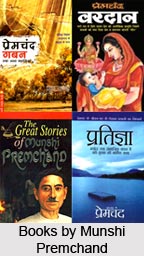 Premchand`s first collection of short stories, Soz-e-Vatan, brought him to the attention of the government. The British collector of Hamirpur District called them seditious and ordered that all copies be burned and that the author submit future writing for inspection. Fortunately, a few copies survived, and Premchand, in order to evade censorship, changed his name from Dhanpatrai to Premchand.
In 1920, Premchand resigned from a government high school and became a staunch supporter of Mohandas Gandhi and joined Bapuji in his Non cooperation movement, whose influence strongly marked Premchand`s work from 1920 to 1932. With realistic settings and events, Premchand contrived idealistic endings for his stories. His characters change from pro-British to pro-Indian or from villainous landlord to Gandhi-like social servant in midstream; the frequent conversions tend to make the stories repetitious and the characters interesting only up to the point of conversion.
Premchand lived in an era of great social turmoil for India. He saw traditional village independence being destroyed by the colonizers. He saw how the traditional system of the Indian Undivided Family was falling apart with the pressures of increased centralization of jobs in urban centres. He also noted the fallout of large-scale urbanization and the consequent materialistic and acquisitioned tendencies it triggered. His stories and novel faithfully record and analyze these tendencies through the trials and tribulations of his protagonists. The reader feels a part of Premchand`s stories. All his fictional characters are real they are living and breathing.
Premchand observed keenly the psychology of a child, brought up in poverty. In his short story Eidgah, the hero, a small boy from a poor family, goes with his relatively well-to-do friends. He has a very small amount of money to spare. Instead of blowing it on fun and toys, he buys a "chimta" for his old grandmother, who used to burn her fingers on the hot iron "tava". Even his novel "Godan" tells the story of a poor man, bound by the society, exploited by the privileged class and his soul-destroying travails. His protagonists are often exploited, but never unjust themselves, and retain their humanity.
The badi bahuria, in "Bade Ghar Ki Bahu", despite longing to eat a halfway decent meal, gives it to the postman, who is actually the bearer of bad news. When the postman tries to decline, she says that she will eat some bathua saag and manage. The protagonist of "Ghaban" is out to impress his newly wed wife. His tale of plight is told with understanding and empathy.
Each novel, each story of Premchand reassures readers that humanity is alive and well. That the circumstances may be grim, but there is a god somewhere, and things are not as bad as they may seem he puts hope midst the grim human canvas. Premchand saw goodness in every human being, and hence described people aptly. The most mean and vicious character will suffer the occasional qualm of conscience. And the most naive character is not without heroism.
Personal Life of Munshi Premchand
Premchand was married at the age of 15 in the year 1895, while still studying in the 9th grade. The girl belonged to a rich landlord family and was older than Premchand.
Munshi Premchand
Munshi Premchand was a legendary Indian writer notable for his modern Hindustani literature. A writer of a very high caliber, Premchand`s writings have a very long lasting impression on the reader’s minds.