Indianetzone.com - Web Portal on Indian Culture & LifestyleArt & Culture  •  Health  •  Movies & Entertainment  •   Society  •  Reference  •   Sports  •  Travel  

  Home >> Society >> Indian Food >> Indian Food
Forum
Forum on Indian Food
Discuss Now
Free E-magazine
Subscribe to Free E-Magazine on Indian Culture & Lifestyle.
Learn More
Interesting Readings
  - Indian State Receipes
  - indian Beverages
  - Indian Street Food
  - Bread, Pizzas & Cake
  - Indian Desserts
  - Chutneys
  - Cooking Tips
  - Indian Food
  - Dry Fruit Sweets
  - Famous Sweet Makers
  - Indian Sweets
  - Indian Spices
  - Culinary Terms
Jimtrade.com : India Business to Business Directory
Business Directory of Indian Suppliers Manufacturers and Products from India.
India`s leading Yellow pages directory.
Indian Food

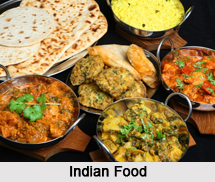
India is a land of diverse culture and ethnicity. This diversity is also reflected in the cuisine of India. Every culture of India has its unique and exclusive style of cooking. Over the centuries, each new wave of settlers in India brought with them their own culinary practices which, with time, blended into the Indian cuisine as it is known today.

Food is an essential part of India`s culture, with cuisines differing according to caste, community, region, and state. Indian cuisine is characterized by a great variety of foods, spices, and cooking techniques. Furthermore, each religion, region, and caste has left its own influence on Indian food.

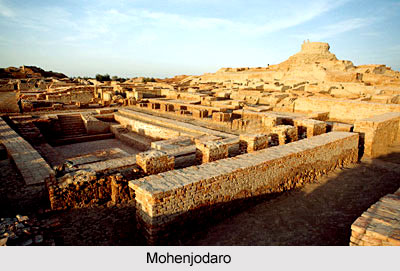
The genesis of Indian Cuisine lie with the ancient Indian civilizations of Harappa and Mohenjodaro. The Dravidians or inhabitants of these civilizations were urban and not agrarian. They had huge granaries to store grain, houses with a drainage system, pathways or roads and public baths. They sowed the seeds of Ayurveda, or Life Sciences, which is the foundation of Indian cuisine. This system was derived after studying the physical needs, mental needs and needs of our psychology and spirituality.

Indian FoodThe people of Mohenjodaro and Harrapa were pushed to the South part of India by the invasion of the Aryans who came from Europe or Asia Minor. It is not very clear where the Aryans originated from but Aryans are to be found in Europe, Persia and India.. The Aryans developed the ideas of Ayurveda further. Many of the texts on this subject were written in the Aryan period.

The Growth of Vegetarianism
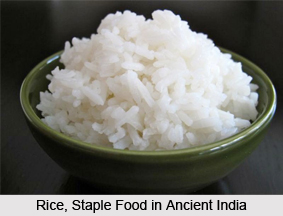
The Harappans, probably ate mainly wheat and rice and lentils, and occasionally cows, pigs, sheep, goats, and chicken. Rice and chicken seem to have come from Thailand, and wheat and sheep from West Asia. Some of the wheat was made into stews or soups, and some into flat breads called chapatis. The arrival of the Aryans does not seem to have changed Indian eating habits.

But by around 300 BC, under the Mauryans, a lot of Hindus felt that animal sacrifices added to your karma and kept you from getting free of the wheel of reincarnation. Animal sacrifices became less popular, and although people didnt give up eating meat entirely, they ate much less of it. And a lot of people became vegetarian.

In the Gupta period, around 650 AD, Hindus began to worship Mother Goddess. Cows were sacred to her, and so Hindus stopped eating beef. And then around 1100 AD, with the Islamic conquests in northern India, most people in India stopped eating pork as well, because it is forbidden by the Koran. People could still eat sheep or goats or chicken, but most of the people in India became vegetarians, and only ate meat very rarely or not at all.

The vegetarian food that Indians ate was mainly wheat flat breads or a kind of flat bread made out of chickpeas, with a spicy vegetarian sauce, and yogurt.

During the Aryan period the cuisine of the Great Hindu Empires concentrated on the fine aspects of food and to understand its essence and how it contributed to the development of mind, body and spirit. After this period the cuisine was influenced by the following conquests from other cultures.

One of the greatest influences on Indias cuisine occurred in the 2nd century B.C. The powerful and benevolent and popular Emperor Ashoka popularized the vegetarian cuisine. Even today a majority of Indians are vegetarian. The two other individuals that helped make India vegetarian are Mahavir and Buddha. (Also the ancient, urban Dravidian civilization may have been vegetarian.)

Islamic rule resulted in a blending of the non-vegetarian fare of the Middle East and the rich gravies that were indigenous to India, creating what is known as Mughlai Cuisine. India was also introduced to kebabs and pilafs (or pulaos). The Mughals were great patrons of cooking. Lavish dishes were prepared during the reigns of Jahangir (1605-27) and Shah Jahan(1627-58). It was in this period that the Portuguese introduced vegetables like potatoes and tomatoes in India.

Every Indian community in India follows different food ethos. Aryan beliefs and practices, however, have influenced most of these.

Aryan Food Beliefs
The idea of food : Food in Aryan belief was not simply a means of bodily sustenance; it was part of a cosmic moral cycle. According to them, the eater, the food that the eater eats and the Universe must all be in harmony.

All food on being digested was believed to give rise to three products. The densest of these is called the faeces which gets excreted; the product of intermediate density is transmuted into flesh, and the third product, the finest and rarest, is called manas, which is thought or mind.

Prasad, which is the left over of food that has been offered to the Gods, is thought to be pure rasa or essence that leaves no residue and maintains mans spirituality. The deep and unique Hindu ethos of food is built on these exalted premises.

The classification of food
Food materials were classified into various Vargas corresponding to the divisions in use today:

At certain auspicious ceremonies, or for men who had taken sanyas, only the latter category of foods was permitted. Thus the starchy yam or water chestnut (singhda) would qualify not as anna but as phala, permitted during a fast. So would flowers (pushpa), roots (mula), bulbous tubers (kanda), leaves (patra), fruits (phala) and some pods or legumes (shimbi). Lentils (masur), qualify as anna, not so chana (chickpea), which is not classed as an auspicious grain. Milk and ghee are ritually pure, especially auspicious and therefore extremely flexible in use as food ingredients. Ghee is quite different ritually from a cooking oil: frying in the former constitutes a superior ritual act, not comparable to frying in vegetable oil.

An outcome of these ritual distinctions is the two major classes into which cooked foods fall, namely kaccha (uncooked) and pucca (cooked).

Cooked and uncooked foods
Kaccha (uncooked) foods are basically foods cooked in water like rice, khichdi and dal. These items of food are considered both exclusive and pure. Boiling with water tends to render any anna or its flour pure.

Once the cooking of a kaccha food starts, usually by setting the rice or dal to boil, the cook cannot leave the food area till the meal has been prepared, served and eaten following ritual rules.

Wheat breads like roti and chapatti were not in vogue in Vedic times, and therefore escaped ritual classification since they do not involve boiling. These items are strictly termed as kaccha foods, even though they are eaten at every meal. Kaccha food are to be cooked afresh for every meal; leftover or stale food, termed as basi or jutha, was likely to have become polluted.

Pucca or cooked foods are essentially those foods that are cooked with fat (course ghee). These are used outside the domestic cooking area. According to ancient practices, cooked foods are essentially those foods whose first contact is with ghee (fat). Thus in preparing halwa, the ghee must first be added to the pan and only then should the anna or phala follow. Sometimes, use of the same ingredients in a different sequence will determine the ritual classification. Thus to make kheer, a pucca food, the rice must first come into contact with ghee, before milk, fire and sugar come in its contact. If this sequence is not followed, and the rice is added to boiling milk, followed by ghee and sugar, the dish will be called doodh bath, and is a restrictive kaccha food. Common daily dishes are mostly affected by such sequences. Pucca foods suffer fewer restrictions and are less liable to pollution, and can be shared outside the family by those of either lower or higher levels of purity.

Polluting the Food
Concepts of pollution are intimately woven into the practices of eating and cooking. The cook should not taste the food while it is being prepared. Also, water should not be sipped from a tumbler, but must be poured into the mouth from above, since ones own saliva is polluting. Water used for rinsing the mouth must be cast out, never swallowed.

Domestic cooking practices
The domestic hearth in a Hindu home was considered an auspicious area of high purity, even of sanctity. The domestic hearth had to be located far from waste disposal areas of all kinds and demarcated from sitting, sleeping and visitor receiving areas. The cook was obliged to take a bath and don unstitched washed clothes.

Eating Rituals and Ceremonies
Food was never to be eaten standing up, lying down, and moving about or from the lap. One had to eat sitting on the ground, alone, facing east or north, and in total silence. Morsels of the meal were to be cast into the fire as an oblation, and prayers offered to various deities and one`s ancestors. Portions of food reserved for Brahmins, serpents, dogs and insects, and laid outside for crows, who were believed to be messengers to the world of spirits. The householder was expected to see to the feeding of his guests and of any pregnant women, infants and aged persons in his household before he himself sat down to eats.

Prior to eating, a few drops of water would be sprinkled on the leaf for purity, and, on the rice that had been served, a few drops of ghee. Every item placed on the leaf had its exact position and ritual eating order. Today these practices have become region specific. The higher male principle resided on the right, therefore, only the right hand was used for eating, reserving the left for baser functions outside the meal.

Festival and Temple Foods
Temples have their own special foods. The Prasad that is offered to the presiding deities in different temples also varies. The Padmanabgaswmi temple in Trivandrum has a special aviyal that uses traditional vegetables, fresh coconut and coconut oil, and no mustard seeds. The Ganesha temples of Kerala have the unni-appam, which are spongy brown fried pieces made of a mélange of rice powder, banana, jackfruit and jaggery.

Some of the most elaborate preparations of temple food are perhaps those at the Jagannatha Temple in Orissa. Everyday one thousand persons manning 750 chulahs and ovens turn out a hundred varieties of dishes using rice, wheat and their flours, grits, urad dal, indigenous vegetables, jaggery and spices, with cow ghee as the cooking medium. The Gods are served ritually five times a day, and pilgrims can eat at the spacious bhoga mandapa (dining area), or buy Maha Prasad at a huge market within the temple walls.

Fasts
Fasts or vratas make special demands on the orthodox Hindu. They are of five kinds. Vara fasts are on weekdays, the Adityavaravrata to Surya is one such example. The tirthivratas occur on certain days of the lunar months eg. Durgashtmi and Krishnajanmashtmi. On certain days of the lunar stations occur the Nakshatra fasts. Masavratas are fasts that occur in certain months, like Karthika, while Samvrata fasts with restrictive eating could even spread out from one ekadashi to the same one a whole year later. Fasts that are commonly observed among Hindus are Ram Navmi, Shivarathri, Sankranthi and the ekadashi, which is on the eleventh day of the lunar fortnight. Fasts do not usually involve complete abstention from food, but only varying degrees of restrictions. Sometimes use of pure ghee is mandatory to induce sattvika (pure) thoughts, and rock salt may replace sea salt in domestic cooking.

In some fasts, plough-grown rice is abjured in favour of wild rice or other wild grains. In others, only restrictive kaccha (uncooked) foods are permitted, in yet others only food left over from previous day. Fruits only is a common form of observance, others take the form of eating only before moonrise or perhaps only after sunset. Modern practices, like fasting on a Friday, or missing the night meal on one day of the week, may tend to be dietic in intention, but do have a ritualistic origin. Some of the famous indian food items are

Salads
Raita
Snacks
Chutneys
Paneer Receipes
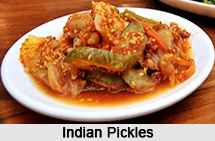
Pickles


Recently updated articles in Indian Food
  • Tamarind
    The pulp of ripe fruit of Tamarind is commonly used as condiment.
  • Aniseed
    Aniseed has a characteristic agreeable odor and a pleasant aromatic taste.
  • South Indian Spices
    South Indian foods are popular for their non-steaming spices like cinnamon, cardamom, ginger, etc.
  • Customs In Hindu Dietary
    In the planning of Hindu dietary deep customs and tradition can be observed.
  • Culinary Of Tamil Nadu
    Tamil Nadu is famous for its extravagant feasts containing lip-smacking culinaries.
Home | Sitemap | Contact Us