





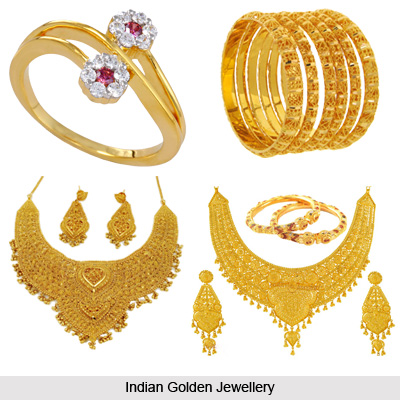
 Gold is one of the valued metals in all over the world and gold jewellery in India has occupied a major position for its antiquity of use and fame. Even gold is used as the base metal for creating different jewelleries since the ancient times as many evidences are found in Harappa and Mohenjodaro. Out of the earth comes a remarkable metal with an unparalleled combination of chemical and physical properties that make it invaluable to a wide range of everyday applications essential to our modern life. Gold was reckoned as ‘tears of the Sun’ and gold was the only metal ore which had been found by the mankind. Also it was said to be the most valuable among all metals. Apart from these, Thousands of common, everyday appliances require ‘Gold’ to ensure perfect performance over a long period of time. This indestructible metal is completely recyclable and virtually immune to the effects of air, water, and oxygen. Gold is one of the valued metals in all over the world and gold jewellery in India has occupied a major position for its antiquity of use and fame. Even gold is used as the base metal for creating different jewelleries since the ancient times as many evidences are found in Harappa and Mohenjodaro. Out of the earth comes a remarkable metal with an unparalleled combination of chemical and physical properties that make it invaluable to a wide range of everyday applications essential to our modern life. Gold was reckoned as ‘tears of the Sun’ and gold was the only metal ore which had been found by the mankind. Also it was said to be the most valuable among all metals. Apart from these, Thousands of common, everyday appliances require ‘Gold’ to ensure perfect performance over a long period of time. This indestructible metal is completely recyclable and virtually immune to the effects of air, water, and oxygen.
Gold jewelleries have been in demand since the primordial age, when mankind learned to use the metal. The use of gold with gem and other stones was started before a thousand years and this past tradition has introduced the trend of using diamond in gold jewelleries and this is one of the most sought after combinations. Earlier kings and queens patronized the gold jewelleries most of which were elaborate gold jewelleries and crowns studded with diamonds. Gold itself never tarnishes; however, the alloys used with gold to strengthen it are susceptible to wear with time and contact with the air. Pure gold (24 carat) will never tarnish. However, pure gold is far too soft a metal to be used for everyday wear jewellery. Whilst 24 carat gold is exceptionally beautiful, the quality of the finished item cannot be guaranteed to last your lifetime. The two types of gold sold are 18 carat (which is three quarters pure) and 9 carat (37.5% pure). The metals used in alloy with these gold items serve purely to strengthen the gold itself (except in the case of rose gold and white gold where other metals are used to change the colouration of the gold). These metals are susceptible to change caused by contact with the air. The 14ct Gold is the most appropriate standard for threaded piercing jewellery, the metal being strong enough to maintain the threaded features even after repeated usage. 18ct is appropriate for general usage, the softness and gentleness soothes the body. Nickel is not used as a stabilizing agent in any product and skilled goldsmiths handcraft all pieces. Recently published data has confirmed that the corrosion resistance of gold alloy decreases significantly as the gold content is reduced. Low gold alloys corrode significantly and release metallic ions directly into body tissues, contaminating the wearer. Gold is yellow in color when pure. It is the most malleable and ductile of all metals. It can be hammered into sheets less than 1/300,000 of an inch thick, and one ounce of gold can be drawn into a 35 miles long wire. Gold is chemically inactive, that is to say not affected by oxygen, sulphur, or acids. It can be dissolved by aqua regia, which is a mixture of 1 part nitric and 3 parts hydrochloric acid. Apart from making jewelleries, gold was greatly used for coinage and in recent times decorative, scientific, and dental purposes. Pure gold is very soft. It is alloyed with other metals to give it different colour appearance and make possible for it to resist wear and tear. Yellow gold is the most accepted for jewelry and is comparatively easy to work. White gold is typically used with diamonds, since its white color harmonizes with the stone. Comparatively white gold is difficult to work because of its hardness and brittle nature. Apart from the white and yellow golds, red gold is often used with yellow for contrast effects and green gold is used for antique jewelry. The recent development and trend of jewellery designs have introduced motley of designs in gold jewelleries. The designers, while creating exclusive pieces out of gold keep in mind about the ethnicity of gold and its tradition in India. Sometimes modern styles are properly blended with tradition to make the gold pieces suitable for modern people keeping the Indian tradition intact. |
| ||||||||||||||||||||||||||||

