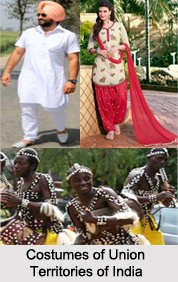
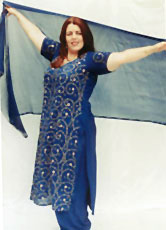
The traditional dresses of Jammu and Kashmir are well known for their embroidery and intricate designs, which reflect the richness of the culture and landscape of the region. Their clothing is designed to counter the cold climate of the region. Most of the garments are made of wool, silk and cotton designed with intricate embroideries.
History of the Traditional Dresses of Jammu and Kashmir
During the ancient period, India was once ruled by many rulers like the Persians, Romans and Greeks, who also had their dominion over the state of Jammu and Kashmir. And thus, their traditional dresses and few customs influenced the Kashmiri people. The advent of the Aryans also caused a shift in the lifestyle of the Kashmiri people. Thus, came forth the traditional dresses of Jammu and Kashmir with a little western influence and a personal touch of their own. According to Hieun Tsang, the Kashmiri people dressed in leather doublets and clothes made of white linen.
Traditional Dresses of Jammu and Kashmir for Men
The traditional "Pheran" is the most popular form of dress among both men and women. Pheran exhibits a lot of beautiful embroidery work comprising of floral motifs.
Pheran: Traditional dress for both male and female in Kashmir. Pheran is basically a loose upper garment gathered loosely at the sleeves which tend to be wide. It is made of either wool or jamewar, which is a mixture of wool and cotton with no slits on the sides. A pheran made of wool is called a loch. The traditional pheran falls gracefully till the feet and was universally worn by both Hindu and Muslim men during the later part of the 19th century. However, in the contemporary times, knee-length pheran is worn; Muslim people wear it loose and stitched to the side while Hindu men wear long pherans extending till their calves. Ankle length pherans are tied at the waist and has intricate embroideries and these flowery designs are made of thin metal threads and are known as Tile in Kahmiri language. It functions as an internal heating system in order to keep the wearer warm during the extreme cold winters.
 Pathani Suit: The Pathani Suit, also referred to as "Khan-dress", is popular among men, especially in Srinagar. Turbans are common among Muslim men. Skull caps are prevalent, especially among the peasants and the Karakuli and fur skull caps with the Pashmina shawls worn by men often are a symbol of royalty.
Pashmina Shawls: The Pashmina shawls are made from traditional woollen textiles which are obtained from mountain goat. Intricate work is done on both sides of these shawls. The special Kashmiri embroidery work, Kasida, is done in such a manner that the patterns appear on both sides of the fabric uniformly.
The Pashmina belts and Kamarbandh are common too. The Muslim men wear lace-free shoes known as "Gurgabis". Brocade, camel hair and cashmere are the main elements that are used in the making of coats and fleece for men.
Traditional Dresses of Jammu and Kashmir for Women
Pheran is the prominent attire for Kashmiri women as well. Traditionally, there are Poots and Pherans, comprising two robes that are placed atop the other. Pheran worn by women usually has Zari embroidery on the hem line, around pockets and mostly on the collar area. Pherans worn by the Muslim women are traditionally characterised by their broad sleeves and reach up to the knees. However, the Hindus of Jammu and Kashmir wear their Pherans long, stretching up to their feet with narrowed down sleeves. Often, the Pherans are wrapped tightly by a piece of creased cloth called Lungi.
Taranga: The headdress of a Kashmiri woman is a brightly coloured scarf or Taranga, that is stitched to a suspended cap and it narrows down at the back, towards the heels. The Taranga is an integral part of the wedding attire among Hindus.
Kasaba: The pheran is accompanied by red headgears known as Kasaba, which is stitched in the form of a turban and is pinned together by ornaments and silver brooches. A pin-scarf suspended from the Kasaba descends towards the shoulder. It is worn by Muslim women as a part of their regular attire.
 Abaya: The abaya is common attire worn by the Kashmiri women. For unmarried Muslim women, the costumes vary to some extent. The elaborate headgears are replaced by exquisitely ornate skull caps embellished with threads of gold, talismans and gems.
Other than these, there are other traditional clothes which are unisex like the suthan and kurta, along-with the traditional dogri suthan, which is wide at the top, roomy at the legs and has numerous pleats at the ankles. However, the modern style of suthan worn in Jammu is a remnant of the tight suthan which was once popular throughout the Punjab region. It is very loose at the top but is very tight from the knees to the ankles. When worn by men, the drawers are called ghuttana. With changing times, the attires have evolved but the traditional clothes of Jammu and Kashmir are a part of the rich cultural history of the state and have not changed much since it was first conceived.