 Constitution of India is considered to be the supreme law of the country as it puts forth the framework of fundamental political principles. It establishes the structure, procedures, powers and duties of the government and mentions the fundamental rights, directive principles and duties of citizens. It is the longest written constitution of any sovereign nation containing over all 450 articles, segregated in 22 parts, 12 schedules and 95 amendments. The English version of the Indian Constitution consists of 117,369 words; there is an official Hindi version as well. However, besides the English version, there is also an official Hindi translation available. The Constitution declares India as a Sovereign, Socialist Democratic, and Republic with a parliamentary form of government.
Formation of Constitution of India
The Constitution of India was adopted by the Constituent Assembly of India on 26th November 1949 and it came into force on 26th January 1950. Dr B R Ambedkar was the Chairman of the Drafting Committee. India became independent from the colonial rule of the British Empire and a need for a competent government arose. However, during the prominence of the British Rule, the Government of India Act 1935 was passed, which was the last Constitution of India during the British rule. The act laid down principles stating and granting autonomy to the Indian provinces. The Government of India Act also provided for establishment of an Indian Federation and the Provincial assemblies including more elected Indian representatives, who in turn could lead majorities and form governments. However, Governors retained discretionary powers regarding summoning of legislatures, giving assents to bills and administering certain special regions. This present constitution of India is modelled on the basis of the Government of India Act.
Constituent Assembly of India
Post the World War II, a new government came to power in the United Kingdom. The new British government announced its Indian Policy in 1946, at the initiative of British Prime Minister Clement Attlee. A Cabinet Mission was formulated to discuss and finalise plans for the Transfer of Power to the Indian leadership; thus, providing India with independence. The main aim of the Cabinet mission was to discuss the framework of the Constitution of India and lay down the procedure to be followed by the drafting body. The Constitution was drafted by the Constituent Assembly and it was elected by the elected members of the provincial assemblies.
Drafting Committee of Indian Constitution
The Constituent Assembly met on August 14, 1947 and various decisions were taken in the committee. The concept of Indian Flag was taken in the assembly meeting. A flag with three colours, Saffron, White and Green with the Ashoka Chakra was selected. Furthermore, the National Emblem of India was decided and it has been taken from the Lion Capital at Sarnath of Ashoka. The Indian Government adapted it on 26th January 1950 when the country became a republic. The Indian constitution was prepared by Dr Babasaheb Ambedkar. In addition to that it was decided to form a drafting committee with Ambedkar as the Chairman along with six other members. A Draft Constitution was prepared by the Drafting Committee of Indian Constitution and submitted to the Assembly on November 4, 1947. The assembly finally took over a period of 2 years, 11 months and 18 days before adopting the Constitution.
Preamble of Indian Constitution
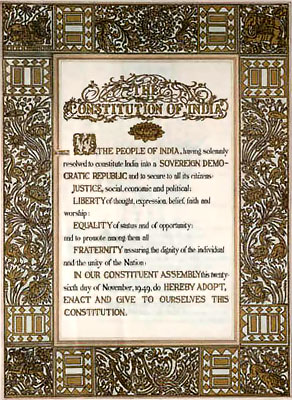
The Constitution of India opens with the Preamble which is like the preface of the constitution. The Preamble is not a part of the Constitution of India as it is not enforceable in a court of law. Nevertheless, the Preamble is useful as an interpretive tool. It is an integral part of the constitution and describes the basic structure of the Constitution of India.
Structure of Indian Constitution
The structure of the Constitution of India comprise of the preamble, 22 parts containing 395 articles, 12 schedules of Indian Constitution, 94 amendments of Indian Constitution, and 5 appendices. The Constitution distributes its legislative powers between Parliament and State legislatures. The residuary powers invest in the Parliament and the centrally administered territories are called Union Territories. The Constitution provides for a Parliamentary form of government which is federal in structure with certain unitary features. The constitutional head of the Executive of the Union is the President. Since the enactment of the constitution has supported for a steady concentration of power to the central government, especially to Prime Minister`s Office or the (PMO). In Article 79 of the Constitution of India it is laid down that the council of the Parliament of the Union will consist of the President and 2 Houses as the Council of States (Rajya Sabha) and the House of the People (Lok Sabha). In Article 74(1), it is stated that the Constitution provides that there shall be a Council of Ministers with the Prime Minister as its head to aid and advise the President. The real executive power is thus vested in the Council of Ministers with the Prime Minister as its head.
Salient Features of Indian Constitution
The Constitution of India is the lengthiest written document. It is flexible as well as a quasi -federal in nature. The Constitution discusses about the Central, State Governments, and Union Territories, their offices, the Supreme Court, High Courts, other Courts, the Election Commission of India and all other Government bodies function. One of the salient features of the constitution of India is its federal character. The Indian Union comprises the Central and State Governments and the Union Territories. There are 28 States and 7 Union Territories. The States of India are divided on the basis of the languages spoken by the people. Another feature of the Constitution is its inclusion of single Citizenship. Though India is a federal country, Indian Citizenship Act of 1955 mentions the qualifications to acquire citizenship rights. It can be acquired by birth, descent, registration, naturalization and other specified ways.
The Council of Ministers of India is collectively responsible to the Lok Sabha. Every State of India will have a Legislative Assembly. However, a few States have an upper House or Rajya Sabha also called State Legislative Council. The constitution also puts it as there will be a Governor for each state and the executive power of the State is vested in him. He is appointed by the President as the Head of the State. The Council of Ministers with the Chief Minister as its head advises the Governor in the discharge of the executive functions.
The citizens of Indian are ensured of certain Fundamental Rights and Fundamental Duties by the Constitution. All Indian citizens are guaranteed 6 Fundamental Rights. Another feature of the Indian constitution is the Directive Principles of State Policy. The Constitution of India provides its Government to take policy decisions and implement them for the welfare of the Indian people. Indian constitution is an extensive document and its features are from Western legal traditions.
The Constitution of India has adopted its characteristics from the British Constitution, United States Constitution, Irish Constitution, French Constitution, Canadian Constitution, Australian Constitution and Soviet Constitution.