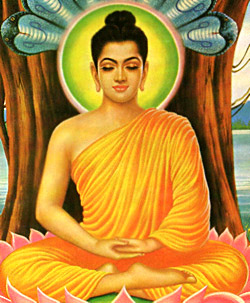
Buddhist philosophy deals broadly with problems associated with metaphysics, ethics, phenomenology and epistemology. Buddhism is a religion and philosophy with approximately 230 to 500 million disciples worldwide, the vast majority residing in Asia. It consists of two foremost schools namely Mahayana Buddhism and Theravada Buddhism. However, there are several other sects besides these. Buddhism is based on the teachings of Gautama Buddha, who lived circa 5th century BCE in ancient India, in parts of what are presently Nepal, Uttar Pradesh and Bihar, on the north eastern Indian subcontinent. While there is disagreement between denominations over Lord Buddha"s teachings, almost every Buddhist recognises some version of the Tripitaka (Three Baskets), though it plays a far more fundamental role in Theravada Buddhism than in Mahayana Buddhism.
Features of Buddhist Philosophy
Since ancient times, Buddhism has utilised philosophy as a means to comprehending moral and what it means to live a meaningful life without repents in the end. Unlike most religions, Buddhism generally has no creator God. Buddhist philosophy does not support the existence of God. Buddhists are of the faith that people are all born with the ability to stand out and be all they can be. Buddhism rejects certain orthodox philosophical concepts. Lord Buddha is believed to have questioned all concepts of metaphysical being and non-being, and this criticism is considered by some to be inseparable from the founding of Buddhism. The system of early Buddhism is one of the most original presented by the history of philosophy. In its fundamental ideas and essential spirit it approximates remarkably to the advanced scientific thought of the nineteenth century. Buddhism is a religious canon that propagates religious tolerance. It promotes the concepts of anicca, anatta and dependent origination. It is important for an individual to rise above the mundane attachments to attain salvation. The ways to attain it are laid down by the founder of this path. His principles, teachings and philosophy are the ways through which one can be liberated.
 Buddhism in India
Equipped with a huge history of evolvement, Buddhism in India was, quite obviously, initiated by Gautama Buddha. His transformation from the resplendent king to a common ascetic, and his thoughts and beliefs that he propagated later, forms the basis of the religion. With his version of the Four Noble Truths, people were hugely attracted to the religious principles of Buddhism. After his demise, in absence of a successor, several Buddhist Councils came into existence, to solve the oral teachings of Lord Buddha. However, with the gradual rise of the religion in Asia, and empires like, Mauryan, or Kushan, Buddhism witnessed an escalating rise amongst the common man and sufficient fulfilment. The later stages, its decline and again sufficient rise during the British era with the Mahabodhi Society, Buddhism is still existing with full splendour.
Tripitaka
Believed to be one of the earliest compilations of Buddha"s teachings, Tripitaka are the teachings or discourses that were penned in leaves and later sewed into baskets. These also state the Pali canon. However, during the initial times, Tripitaka was delivered orally. The first Buddhist Council had decided the contents of the preaching, in the presence of Mahakasyapa.
 Vinaya Pitaka
Included in the Tripitaka section of Buddhist sermons and preaching, Vinaya Pitaka comprises a set of rules stressed by Buddha, which is meant to be followed by the nuns and monks to lead a restricted monastic life. The initiations of Vinaya Pitaka can be traced to the first Buddhist Council, and recited by Upali, Buddha"s oldest disciple. Each section also contained a story of its origin.
Sutra Pitaka
Included in the prestigious Pali Canon of Buddhist scriptures, Sutra Pitaka is known to contain more than 10,000 doctrines of the enlightened being, Gautama. It also states about the exact principles of the Buddhist way of life. It is contained of five niyakas or collections of Pali and Sanskrit sutras.
Abhidhamma Pitaka
Abhidhamma Pitaka can be regarded as a novel scripture compilation among the three pitakas, with its planned group of preaching by the Buddha.
 Containing even more issues on Buddhism, like psychology and metaphysics, this pitaka has the unusual quality of becoming understandable to every layman. Traditionally, abhidhamma is also looked at as the absolute teaching. Buddha is known to have conceptualised this pitaka just after his enlightenment, later delivering it to one of his chief disciples.
Contents of Abhidhamma Pitaka
The most scholarly and comprehensible book amongst the three pitakas, Abhidhamma Pitaka is exclusively separated into seven parts. Each of them deals with diverse and abstract issues, listed in a sutra format. They contain topics like unclassified categorisations of the matika (matrix), mind, material form, the five aggregates, lists of synonyms, debates on doctrine and phenomenon of roots and arising.
Three Marks of Existence
The "Dharma" seals of Buddhist teachings refer to three basic characteristics of the factual, physical world that can be distinguished as the three marks of existence. Each of them is related to humanity in general, other than nirvana. These three comprise anicca or impermanence, dukkha or unsatisfactoriness, and anatta or impersonality. Each of them goes on to explain the drawbacks or the shortcomings of the existing world, which can be averted if one achieves nirvana.
Anicca
One of the foremost important subjects in the day-to-day existence according to the Buddha"s teachings is Anicca, or the doctrine of impermanence. Every kind of physical phenomena of the material world is subject to change, further change, and finally disintegration. This happens because everything is transient, wavering and irregular. A phenomenon that begins is bound to come to an end, and cease to act. A mere human cannot ever control it according to his or her wishes, because he is bound to fall sick and ultimately die. Thus, the Buddhists never believe in the concept of a permanent soul.
Dukkha
Just by merely stating the Sanskrit or Pali term dukkha as suffering is considered as underestimation of the thought that lies hidden in this grim concept of Buddha. With utmost determination one generally likes to acquire the object of desire, and then with time gets bored or dissatisfied with it. A thing that has already been acquired brings happiness, but one yearns for more. And if, at this point of time one is incapable of obtaining it, it brings with it the feelings of depression, fear and dejection. Every kind of ill-feel can only be done away with, if one can attain nirvana by exhaustive practice of meditation.
Anatta
Buddhist philosophy states that attachment to the appearance of a permanent self in the world which constantly changes causes suffering and acts as a hindrance to liberation. Identifying with the temporary aggregates, consciousness at a given moment and the components of the individual body is the reasons behind the apparent ego.
Early Buddhism suggests the outline of Buddhist philosophy is suited to the practical needs of the present day and helpful in reconciling the clash between faith and science. Buddhist thought even in India has an evolution of over a thousand years.