


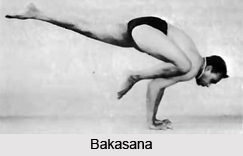
 Bakasana is a cultural asana mimicing the posture of a crane. It strengthens the abdominal organs and arms. Baka in Sanskrit means crane. Just like the bird it symbolizes, this compact arm balance asana induces much poise in the practitioner. Bakasana is a cultural asana mimicing the posture of a crane. It strengthens the abdominal organs and arms. Baka in Sanskrit means crane. Just like the bird it symbolizes, this compact arm balance asana induces much poise in the practitioner.
Practice of Bakasana Squat down from Tadasana with the inner feet a few inches apart. If it isn't possible to keep the heels on the floor, support them on a thickly folded blanket. * Separate the knees wider than the hips and lean the torso forward, between the inner thighs. * Stretch the arms forward, then bend the elbows, place the hands on the floor and the backs of the upper arms against the shins. * Snuggle the inner thighs against the sides of the torso, and the shins into the armpits, and slide the upper arms down as low onto the shins as possible. * Lift up onto the balls of the feet and lean forward even more, taking the weight of the torso onto the backs of the upper arms. Consciously attempt to contract the front torso and round the back completely. Keep the tailbone as close to the heels as possible. * With an exhalation, lean forward even more onto the backs of the upper arms, to the point where the balls of the feet leave the floor. * Now the torso and legs are balanced on the backs of the upper arms. * Squeeze the legs against the arms, press the inner hands firmly to the floor and (with an inhalation) straighten the elbows. Seen from the side the arms are angled slightly forward relative to the floor. The inner knees should be glued to the outer arms, high up near the armpits. 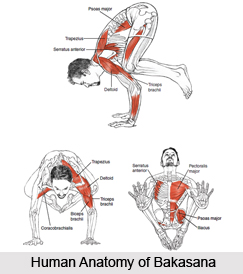 * Keep the head in a neutral position with the eyes looking at the floor, or lift the head slightly, without compressing the back of the neck, and look forward.
* Stay in the pose anywhere from 20 seconds to 1 minute. Release with a slow exhalation and slowly lower the feet to the floor, back into a squat. * Some beginners find it difficult to lift into Bakasana from the floor. In that case it's often helpful to prepare for this pose squatting on a block or other height, so that the feet are a few inches off the floor. If reluctant to lean forward and take the feet off the floor, a partner can help the practitioner learn to balance in Bakasana. Squat in the ready position, hands on the floor, up on the balls of the feet. Have the partner stand in front of the practitioner. While leaning forward he/she will support the practitioner's shoulders with his/her hands, to prevent the yogi from toppling forward onto the face or head. Stay for a few breaths, getting a taste for the balanced position, yet secure in the hands of the partner. Effects of Bakasana: * This pose is good for strengthening arms and wrists . * It Stretches the upper back * Strengthens the abdominal muscles. * Stretches the groin * Tones the abdominal organs * Precautions in the practice of Bakasana The asana should not be practised in case of: * Carpal tunnel syndrome. * Pregnancy |
| |||



Bakasana Yoga Asana
| Bakasana, or the crane pose, is a cultural asana where the practitioner balances on his arms, mimicing the poise of a crane. |
| ||||||||||||||||||||||||||||

