|
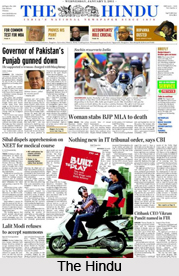 The Hindu is a leading English daily in south India, and is mainly popular in Tamil Nadu. The newspaper began its journey in 1878 and initially it was published weekly. From 1889, The Hindu was published daily. The paper is published from Chennai. The Hindu is published from twelve locations in India, Bangalore, Chennai, Coimbatore, Delhi, Hyderabad, Kochi, Madurai, Mangalore, Thiruvananthapuram, Tiruchirapalli, Vijayawada and Visakhapatnam. The Hindu is a leading English daily in south India, and is mainly popular in Tamil Nadu. The newspaper began its journey in 1878 and initially it was published weekly. From 1889, The Hindu was published daily. The paper is published from Chennai. The Hindu is published from twelve locations in India, Bangalore, Chennai, Coimbatore, Delhi, Hyderabad, Kochi, Madurai, Mangalore, Thiruvananthapuram, Tiruchirapalli, Vijayawada and Visakhapatnam.
A group of six young men led by G. Subramania Aiyer published the first issue of The Hindu on 20th September 1878. Initially it printed eighty copies a week at the Srinidhi Press in Mint Street, Black Town. The paper was published every Wednesday and from 1st October 1883 it was published on every Monday, Wednesday and Friday evening.
In the post independence period the younger generation of Hindu editors have brought commercial success for the paper. They have brought changes to the lay out and design and also constructed modern infrastructure for newsgathering, printing and distribution. Like other Indian publishing houses, The Hindu is owned by Kasturi and Sons Ltd.
The Hindu is a forerunner in many respects namely, in 1940 it was the first to introduce colour, in 1963 it was the first to own fleet of aircraft for distribution, in 1969, it was the first to adopt facsimile system of page transmission, in 1980 it was the first to use computer aided photo composing, 1986 it was the first to use satellite for facsimile transmission, 1994 it was the first to adopt computerized integration of text and graphics in page make up and remote imaging. In the year 1995, it became the first Indian newspaper to bring out an online edition.
On Mondays, the main paper comes with three supplements, Metro Plus, Business Review and Education Plus. On Tuesdays there is Metro Plus, Education and book review. On Wednesday's supplements include the Metro Plus, job opportunities. On Thursdays there is Metro Plus, Science, Engineering, Technology & Agriculture
On Fridays there is a special supplement for children, Young World along with a popular column The Hindu Young World Quiz. On Saturdays there is Metro Plus and Property Plus. On Sundays there is a weekly magazine, which covers social issues, art, literature, travel, health, cuisine etc. Literary Review comes on first Sunday of every month. Quest is a supplement by children for children, which appears once a month.
|





