


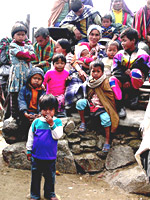
 The Khasi speak of a family of great-grandchildren of one great-grandmother (thus, four generations) as shi kpoh (one womb). Clans trace descent from ancestress or kiaw (grandmothers) who are called ki lawbei-tynrai (grandmothers of the root, i.e., of the clan tree). She is revered greatly and her descendants are called shi kur (one clan). Below this division are the sub clan or kpoh and the iing (house or family), usually made up of a grandmother, her daughters, and her daughters' children. Together these are said to be shi iing (one house). The descent of a Khasi family is traced through the mother, but the father plays an important role in the material and mental life of the family. The Khasi speak of a family of great-grandchildren of one great-grandmother (thus, four generations) as shi kpoh (one womb). Clans trace descent from ancestress or kiaw (grandmothers) who are called ki lawbei-tynrai (grandmothers of the root, i.e., of the clan tree). She is revered greatly and her descendants are called shi kur (one clan). Below this division are the sub clan or kpoh and the iing (house or family), usually made up of a grandmother, her daughters, and her daughters' children. Together these are said to be shi iing (one house). The descent of a Khasi family is traced through the mother, but the father plays an important role in the material and mental life of the family.
Marriage is a purely civil contract. Males are between the ages of 18 and 35 when they marry, while women's ages range from 13 to 18. Although parentally arranged marriages do occur, this does not appear to be the preferred form. Young men and women are permitted considerable freedom in the choice of mates and in premarital Sexual relations. According to Khasi laws, a woman cannot be forced into marriage, she owns the children and properties. A woman may end a marriage at her will with no objection from her husband. Although the youngest daughter is the custodian of the family property, she can make no decision regarding property and other major issues without the consent of her maternal uncles. When the mother has no daughters, the inheritance goes to her sister's youngest daughter. If the sister has no daughters, then the mother's sisters and their female kin receive the inheritance. Men are prohibited from inheriting real property. All property acquired by a man before marriage belongs to his mother. Property acquired by him after marriage belongs to his wife and children. In his wife's house the man is 'U Kpa uba lah ba iai' (a father who is able and steadfast). He is the progenitor, God's instrument to increase his tribe and the clan of his wife and prevent it from extinction. Women are respected and are far from subservient. The woman's husband's family, her children's paternal relations are the' Kha' and always very highly respected. Kha literally means to "give birth". 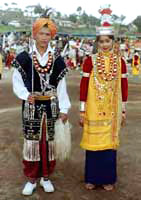 The Jymphong is the traditional Khasi dress worn by the males of the tribe. It is a longish sleeveless coat without collar, fastened by thongs in front. Nowadays, the Khasis have adopted the western dress. On ceremonial occasions, they appear in 'Jymphong' and dhoti with an ornamental waist-band. The Jymphong is the traditional Khasi dress worn by the males of the tribe. It is a longish sleeveless coat without collar, fastened by thongs in front. Nowadays, the Khasis have adopted the western dress. On ceremonial occasions, they appear in 'Jymphong' and dhoti with an ornamental waist-band.
The Khasi traditional female dress is extremely elaborate with several pieces of cloth, giving the body a cylindrical shape. On ceremonial occasions, they wear a crown of silver or gold on the head. A spike or peak is fixed to the back of the crown, corresponding to the feathers worn by the menfolk. The Khasi are monotheistic. They do, however, invoke God by various names according to the need of the moment, as God has all the attributes of goodness and all the power to do well. So they call him "'lei long spah ". Cultivation is the major Khasi subsistence activity and the family farm (managed by a single family with or without the assistance of outside labor) is the basic operating unit in crop production. The Khasi are multioccupational and their economy is market-based. Marketing societies exist to facilitate trade and to provide aid in times of personal need. Crops are produced for consumption and trade. There are four types of land utilized for cultivation: forest; wet paddy land (hali or pynthor) ; homestead land (ka 'dew kyper); and high grass land (ka ri lum or ka ri phlang). The Khasi also engage in other subsistence activities such as fishing (by poisoning or with rod and line), bird snaring (quail, partridge, lapwings, coots, and wild geese), hunting (deer, wild dogs, wolves, bears, leopards, and tigers), and the raising of goats (for sacrifice), cattle (cows and oxen for manure, field cultivation, and dairy products), pigs, dogs, and hens (for sacrifice), chickens and ducks (largely for eggs), and bees (for larvae, wax, and honey). |
| |||



Home > Society > Indian Tribals > Indian Tribal People > North East Indian Tribes > Tribes of Meghalaya > Khasi Tribe > People of Khasi Tribe
People of Khasi Tribe
| The women in Khasi tribe do not participate in administration, legislation and judiciary in the traditional set up. |
| ||||||||||||||||||||||||||||

