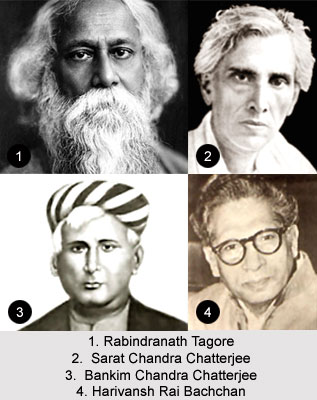
 Steeped in the backdrop of Renaissance in Bengal, the novels of Sarat Chandra Chattopadhya illustrate the socio-political situations and the ethico-moral customs prevalent in the contemporary Bengal. The novels where society always play the part of protagonist, represents the social discrimination, superstitions and immoral practices in the name of religion. Being an optimistic social visionary, Sarat Chandra has induced in his novels the message to imbibe the downtrodden, who are subdued by socio-political repressions reinforced by the ethico-moral and religious customs. The key subject of the novels in most of the cases is the women, as a victim of the rigid patriarchal society. Besides being a fictional representation of the human condition, Sarat Chandra`s novels are at the same time a memorandum to rejuvenate the society, infested with falsity of socio-religious fanaticism and the social echelon. His novels represent a piercing analysis of human love, faith and frailties, which enable the readers to form an idea about the then social picture.
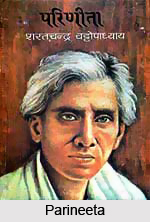
Parineeta: - Parineeta, represents the fake ethico-moral customs and the narrow rural politics, which becomes a blight for the entire women folk in rural Bengal. In the forfeiture and benevolence of the young girl, Parineeta depicts the renaissance spirit, which enables the entire women folk to come out of the folds of the false unyielding customs.
 Pally Samaj: - Pally Samaj relates a sensitive issue of controversial amour of two young individuals, who became the dupe of the narrow rural politics and the grotesque ethico-moral customs. Pally Samaj at the same time is a reflection of the then zamindars, the society created by them and the repression in the name of that society.
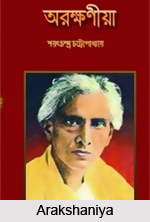
Arakshaniya: - Arakshaniya represents the rural society with a clinched concept that if the girls are not married earlier, she is entitled as "Arakshaniya", who with her family is projected to inhuman torture and repression. Arakshaniya at the same time reveals the silent protest of a victimized girl against the false customs, thus impart the novel a renaissance attribute.
Srikanto: - Srikanto is an autobiographical novel, depicts the society in a somewhat different manner. Here is noted the development of an adolescent mind to its maturity and the society is reflected through the eyes of the writer in his development from adolescence to mellowness.
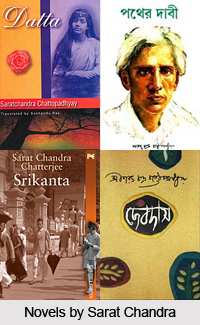 Devdas: - Devdas relates the mellowness of the pubescent passion, which was assassinated by the stiff ethico-moral customs. Depicting the social echelon, based on the socio-cultural difference, Devdas, though does not have any message to wipe out the social problems, it is successful enough to bring forward the social evils of contemporary ethos.
Nishkriti: - Nishkriti is the fictional representation of the ecstasy and agony of the individuals in a joint family. In a social backdrop of 20th century, Nishkriti entirely presents a family drama.
Charitrahin: - Charitrahin is the authentic representation of the patriarchal society, where the women are subdued always . Ironically the novelist here presented the nature of those women who are identified as "Charitrahin" or have been accused of infidelity. In the name of morality and religion the male exploited the women and indicted them as infidel. The drab society is represented through the novel Charitrahin.
Dutta: - Delineating a story of the affair between two young individuals, Dutta radiates the spirit of Renaissance in all aspects. The society and the individuals as the part of the society are the concerning theme of the novel.
Grihadaha: - In the milieu of contemporary social ethos, Grihadaha represents the interrelationship between individuals, their love and faith, entirely controlled by the prevailing socio-cultural and religious customs.
Bamuner Meye: - Bamuner Meye represents a society contaminated with narrow casteism, where love is treated trivial and the generosity of the individuals is treated according to their social position dominated by caste.
Dena-Paona: - Dena Paona delineates a society, which is suppressed by the despotism of the then zamindars. Moreover the dejected condition of the women is also the key theme the novel upholds.
Pather Dabi: - Steeped in the tumultuous socio-political situation of 20th century, Pather Dabi verbalizes, the interrelationship between human beings who aimed to create a new society free from the shackles of British repression.
Swadesh o Sahitya: - Swadesh o Sahitya is a collection of essays, speeches, letters and welcome address relating to the contemporary socio-political condition.
Bipradas: - In the background of the contemporary riotous political condition, Bipradas depicted the social system and a zamindar family as the part of that society.