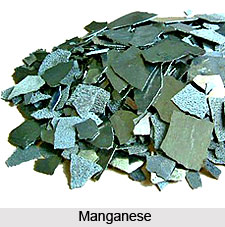
 The word manganese comes from the Latin word magnes, which means magnet, because when manganese is alloyed with other metals like aluminum, copper and antimony, the end product is magnetic. Deep-sea nodules of manganese and other metals are scattered on the ocean floor. They form when the hot waters from hot springs (called black smokers) on the ocean bottom meet the cold, deep ocean water. However, manganese crystals have yet to be found in nature and therefore it is technically not a mineral, although laboratory grown specimens can look like a natural stone. The element manganese is an essential element in people`s daily food consumption and has several industrial uses.
In fact steel cannot be produced without manganese; it is an essential ingredient in the process. Manganese is also used to color glass an amethyst color. That is not so surprising since manganese is the trace element responsible for quartz`s purple variety, amethyst. Manganese coloring ability in minerals is well known and appreciated. Manganese is chiefly responsible for the wonderful colors in rhodochrosite, purpurite, rhodonite, serandite and spessartine to name a few. Unfortunately most manganese oxide minerals tend to be black. Manganese is extracted from the ore minerals pyrolusite and rhodochrosite. Manganese nodules on the sea floor may one day provide an economic source as well.
Manganese is gray-white metal with a pinkish tinge, and a very brittle but hard metallic element. Its atomic number is 25. Manganese is a reactive element that easily combines with ions in water and air. In the Earth, manganese is found in a number of minerals of different chemical and physical properties, but is never found as a free metal in nature. The most important mineral is pyrolusite, because it is the main ore mineral for manganese. Trace amounts of manganese are very important to good health. It makes bones strong yet flexible, and it aids the body in absorbing Vitamin B1. It also is an important activator for the body to use enzymes. As little as 0.00002% Mn in the human body is essential. Studies have shown that a lack of manganese leads to infertility in animals.
Uses of Manganese
Steel becomes harder when it is alloyed with manganese. It has similar applications when alloyed with aluminum and copper. Hardened steel is important in the manufacture of construction materials like I-beams (24% of manganese consumption), machinery (14% of manganese consumption), and transportation (13% of manganese consumption).
Manganese dioxide is used to: manufacture ferroalloys; manufacture dry cell batteries to "decolorize" glass; to prepare some chemicals, like oxygen and chlorine; and to dry black paints. Manganese sulfate (MnSO4) is used as a chemical intermediate and as a micronutrient in animal feeds and plant fertilizers. Manganese metal is used as a brick and ceramic colorant, in copper and aluminum alloys, and as a chemical oxidizer and catalyst. Potassium permanganate (KMnO4) is used as a bactericide and algicide in water and wastewater treatment, and as an oxidant in organic chemical synthesis.