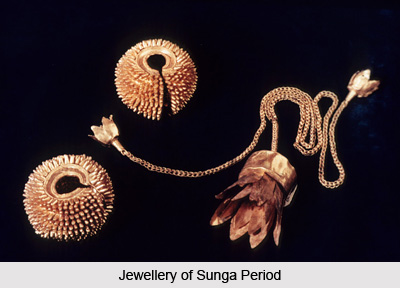
Ear Rings are an essential part of almost every woman"s jewellery wardrobe. They complete a look and frame a face. Earrings are considered as the most commonly used form of fashionjewellery in India that is worn both by men andwomen. But in ancient times, earrings were worn only by women. Slowly as society started modernising towards appropriate civilization, the concept of "self adornment" caught up with the multitude; people started using animal bones and wood as jewellery. In India, earrings changed in outward structure from large dangling ones to medium and small sized earrings that are worn as studs.
History of Ear Rings
The history of earrings in India originated as a tradition since ancient times. It is said that wearing earrings along with the animistic origins of the Shaiva and other Indo-Aryan religions, are of great antiquity. Evidences have been found in the practice of the Kanphata Yogis of India. The Kanphata Yogis are a sub-sect of the Shaiva ascetics. They were named as "Kanphata Yogis" from their practice of "splitting their ears and placing a large earring made ofagate, horn or glass, about two and a quarter ounces in weight, in the ear as a symbol of their initiation". Later on, earrings acquired recognition and were turned into a fashion accessory. They finally grew into a tradition. Earrings were also considered a symbol of slavery.
 Significance of Wearing Ear Rings
According to legend, evil spirits were thought to possess the capability of entering the body through any of its openings and they usually took control of the entire body. In all likelihood, the first ever earrings were worn to block the passageway of these spirits. According to another myth, pierced earrings help to strengthen weak eyes. If the earrings are studded with emeralds, they are particularly effective. Gold earrings are efficacious in curing headaches.
According to a historian"s attribute, the piercing denotes the "desire to punish the ears for overhearing what they should not hear". In turn, the earrings were a solacement for pain and suffering. It was believed that the greater the consolation, the more decorative and expensive the earrings were.
Types of Ear Rings
Today, earrings come in numerous varieties. They can be casual, formal, smart or funky. With time, the design of earrings shifted to more intricate patterns. The major types of modern earrings are as follows:
•Stud Earrings: Stud earrings include a small component that fits through a small hole the earlobe and do not dangle down.
•Hoop Earrings: They are a round or oval loop shape and resemble a ring that goes through the ear lobe and hooks in the back.
•Drop Earrings: It attached to the earlobe as a hoop and below it, a gemstone or diamond part is attached through a chain, jump-ring or similar object.
•Dangle Earrings: These earrings are designed to flow loosely from earlobes to the shoulder side. The major characteristic is its continuous dangling while walking or any body movement; that is the reason of its name.
•Chandelier Earrings: This multi-layered earring design as the name implies looks like the shape of a chandelier and are highly embellished.
•Huggy Earrings: Huggy earrings got its name because it seems like they are hugging the earlobes. They are a kind of hoop earrings only but in a very small size of which the opposite part of piercing almost touches the earlobe end part.
Apart from these major types, the other types on basis of earring the place of wearing. Earrings are one of the most popular forms of jewellery around, worn with pride by women and some men alike.