 Dutta is a novel portraying the contemporary socio-religious conflict underscoring the urban sophistication and rural simplicity. Society as a protagonist presents the bare picture of the human relationship, love and faith, which was frazzled in the diseased society. Dutta represents the poor victims, who are the part and parcel of the desolated society, infested with feudalism. In spite of allowing spontaneity and simplicity, society represented in Dutta, somehow endorsed the narrow rigidity circumscribed by the shackles of social and religious discrimination.
Author:
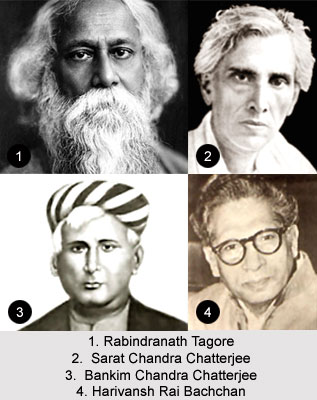
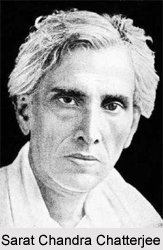
Sarat Chandra, the prophetic visionary is a significant name in the Bengali Literary World. Born in 15th September 1876, in Debanandapur of Hooghly, Sarat Chandra, with his deep insight pointed out the social crosscurrents owing to the religious discrimination, which was reinforced by the pecuniary norms. Having a genuine experience of poverty, Sarat Chandra could easily illustrate the conflict between rich privileged and the deprived poor. Centering rural Bengal as the chief protagonist or theme, Sarat Chandra brings to the surface the socio-cultural difference between urban and rural the social order. Sarat Chandra, being a social reformer, in spirit, through his pen aimed to wipe out the ills from the rugged society of his time.
Synopsis:
Essentially a story of 20th century social milieu, the novel Dutta represents an unequal love affair between, an only daughter -heir apparent of a feudal lord, and a young medical graduate. The story line develops with the silent approbation of Bijaya and Naren completely ignorant of their own emotional attachment, they possess for each other. The novel opens with the death of Bijaya`s father, the erstwhile feudal lord resided in Kolkata, leaving all his property in the village to control by his friend, Rashbehari. After his death, Bijaya shifted to the village to look after his property and ascertained, with utter surprise, the evil design of his father`s friend and his son, to consume the huge property, of which Bijaya is the only heir.
Under this framework, develops the amorous relationship of Bijaya and Naren, a young intellectual doctor and happens to be a fiend of her father. Their emotions, unidentified in the beginning and also the religious difference of Naren, a Hindu Brahmin and Bijaya, an educated Brahma became prominent as the chief hindrance behind their union. Moreover the rural politics and certain social disturbances, inflamed by Rashbehari and his son Bilas, to manipulate the generosity of Bijaya, stood against the spontaneous relation of Naren and Bijaya. Since an optimistic, Sarat Chandra has delineated the triumph of truth, tenacity and spontaneity of human relationship over the social evils and the novel concludes with the reconciliation of Hindu and Brahma religion centering the love between two young souls.
The novel, Dutta entirely deals with the life and activities of Bijaya, the key force of the novel. The novel presents, Bijaya as a dupe of socio-religious conflict, who in spite of being enlightened and educated could not raise an open protest against the evil designs of her uncle and, also against the rural politics. The title truly signifies the spirit of the novel centering Bijaya as the butt of the love triangle. The word "Dutta" implies who is betrothed. The implication of the title lies in the fact when, Bijaya was married to Naren, who was her betrothed.
The novel, Dutta was published serially in the magazine called Bharatbarsha from Poush of [B] 1324 to Bhadra of [B] 1325 and was published in a book for on 2nd September 1918, by GCS. Dotta was translated to Marathi language in 1919 by Pravakar Vase and was called Bijaya. Later Sarat Chandra also wrote the dramatized version of Dotta with the name Bijaya, in 1934. The novel, Dutta highly acclaimed in its time was also translated in many other languages. Krishna Prasad Shastri translated Dotta to Gujarati as Shreemati Vijoya in 1921 and to Malayalam as Narendrababu in 1937 by T.K. Raman Menon.