`Yoga is samadhi`,this statement by itself draws attention to the utmost significance of samadhi within yoga praxis. As a matter of fact, the respective meanings of yoga and samadhi are very close. Incidentally, the literal meaning of "Yoga" is joining or linking of two things. Similarly, Samadhi means "putting together", "integration" or "completion." According to Yoga Sutra, In the context of the training of the mind to reflect one`s spiritual nature both terms signify the identification of the apprehender, the apprehended and the activity of apprehension that occurs as a result of intense meditation upon an object.
Objects that are employed for the purpose of meditation are various. The objects can range most popularly from sound or shabda, to the inner light, to various points in the subtle body such as Ajna (Third eye) or Nabhi chakra (circle of the navel). The process of Hatha meditation In the Gheranda-Samhita suggests three modes of meditation or Dhyana. They are namely Sthula (gross), jyoti- (light) and sukshma- (subtle) dhyana. Sthula Dhyana is termed as such because a an imagination of an object is perceived as real. The procedure involves using creative visualisation to place before one`s mind`s. It can be an image of a Guru or deity some other object such as a lotus centre or chakras in the body.
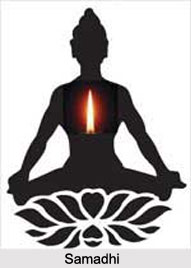
Jyotir or Tejo-dhyana is or exclusive contemplation of the `inner light` of the living self. This light or flame can be contemplated in the Muladhara-Chakra or as the luminous expression the syllable OM in the `brow centre` (Ajna-Chakra). Gheranda explains the third method of Sukshma-Dhyana, which is the meditation of the awakened Kundalini force as she ascends along the royal path and merges with the true Self. Gheranda adds that the yogi achieves success Siddhi in this Sukshma Dhyana-yoga by Sambhavi-mudra. Sambhavi-mudra being described earlier in the text as fixing one`s attention in the `inner eye` and `beholding the Self.
These three types of Dhyana can be seen as progressively more subtle grades of meditation. First an image with a clear form is meditated upon, then the object is simply light, without any perceptible boundaries; and finally one becomes absorbed in the true formless nature of the Self.
All the forms require succession in increased concentration. And each succession furnishes more potent results with regard to the status of one`s self-identity and perception of reality. All these steps are described vivisly in Hatha texts. One of the most refined and powerful examples is that of Nadaanusandhanam (meditating on inner Sound). This mediation practices lead to various degrees of Samadhis. The first distinction to be made concerning the different degrees of samadhi is that between Samprajnata-samadhi and Asamprajnata Samadhi. The distinction is made clear by sage Vyasa in his commentary as `cognitive` and `supra cognitive` states of self-identity.
According to him, Samprajnata Samadhi involves recognizing an object, knowing its nature thoroughly and then becoming one with it. In other term it incorporates "Integral Knowledge", whereas, Asamprajnata refers to a state in which all objective cognition has been transcended, and one has identified himself as Purusha or the supreme object itself.
Degrees of Samadhi
On the opening sutra of the Yoga-Sutra, Vyasa states that `yoga is samadhi`.