Every culture has many kinds of traditional sweets made of different ingredients and those are specific to various occasions and festivals. Generally, these sweets are made of easily available, natural ingredients and fancy or chemical ingredients are not used.
Sweets of Northern India
In the northern part of the country, many festivals are celebrated throughout the year. Predominantly, there are two extreme weathers - summer and winter, which favour the breeding of buffaloes. Therefore, sweets are mainly made of buffalo milk, which is thicker in consistency than cow milk. Good quality khoa or mava are made out of them.
Hence, Mawa Mithai dominates the sweet lovers of northern India. In the winters, sweet carrots are available in abundance. So a sweet dish is made in the winters using fresh carrots, milk, sugar and mava and it is called "Gajar ka Halwa". During the festival of Holi, another popular sweetmeat is made called "gujia". It is very popular all over Northern India but is made differently in every state.
Kheer is also an important sweet dish in the north. It is made during birthdays or on other occasions. Kheer is prepared differently in different states. It is called Phirni in the Jammu and Kashmir region, Payesh in West Bengal, Kheeri in Odisha etc.
Sweets of Bengal
In both Bangladesh and West Bengal, the tradition of making sweets, locally known as "Pitha" still flourishes. They are usually made from rice flour, mixed with sugar, jaggery, grated coconut etc. These sweet meats are typical to a particular season and occasion.
Pithas are usually enjoyed with the sweet syrups of khejurer gur (jaggery made of dates). They are usually fried or steamed; the most common forms of these include bhapa (steamed) pitha, pakan (fried) pitha, and puli pitha (dumplings), among others. Pithas are usually a celebration of the new crop, and often associated with harvest festivals. In Odisha also "Pitha" is a common sweet. They are cooked with coconut, lentil, jaggery, condensed dairy products in crepes.
Sweets of Bihar
In the state of Bihar, gujia is famous and is made with semolina or coconut and dry fruits. Khaja is also a sweet delicacy of Bihar. Refined wheat flour, sugar and edible oils are the chief ingredients of khaja. It is believed that, even 2000 years before, Khajas were prepared in the fertile land on the southern side of the Gangetic Plains of Bihar. These areas which are home to khaja once comprised the central part of Maurya and Gupta empires.
 Sweets of South India
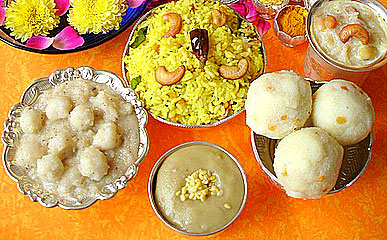
In the south, payasam is a delicacy and is being made from time immemorial. Payasam is prepared by combining milk, coconut extract, sugar, cashews, dry grapes, etc. Paal payasam is a speciality. Malpua is also popular and is prepared from a mixture of powdered rice, milk, ghee (clarified butter), sugar and honey. Pittha is the steam-cooked mixture of powdered rice. Chiwra or beaten rice, served with a coat of creamy curd and sugar or jaggery is also an age old sweet dish. Makhana (a kind of water fruit) is prepared from lotus seeds and is taken puffed or as kheer, prepared with milk and sugar.
Sweets of Western India
In the Western part of the country, every state has its own sweets. Ghari is a sweet dish from the region of Surat in Gujarat. Hence, it is often called Surati Ghari. In Maharashtra, Puran Poli is one of the most popular sweet items in the Maharashtrian Cuisine. It is made from jaggery (molasses or gur), yellow gram (chana) dal, plain flour, cardamom powder and ghee.
Modak is an Indian sweet prepared either deep fried or steamed (Ukdiche Modak). Modak is almost exclusively prepared during the Ganesha Festival around August, when it is often given as an offering to Lord Ganesha, the elephant-headed `Remover of Obstacles` (Vighna-harta). Modak is reportedly his favourite sweet.
Karanji is a deep fried dumpling with a filling of grated coconut sweetened with jaggery and flavoured with powdered cardamom seeds. It is also known as Kanola in some circles.
Khaproli is a sweet dish, highly popular in southern Konkan. The dish consists of a fluffy pancake dipped in yellow sweet juice. Tandalachi Bhakri is a Bhakri made of rice flour. It is the Malvani equivalent of the Maharashtrian Jowari Bhakri or Bajri Bhakri, which is popular across the Deccan.
Popular parsi snacks include Bhakhra (deep fried sweet dough) Dal Ni Pori (sweetened lentils stuffed in a light pastry) and Khaman na Lavda (Dumplings stuffed with sweetened coconut). Some of the popular traditional sweets of Indian are as follows:
 Gulab Jamun- Gulab Jamun is a popular Indian and Pakistani sweet dish which comprises of fried milk balls in sweet syrup flavoured with cardamom seeds and rose water or saffron. It may have originated from eastern India (Odisha and Bengal). Gulab Jamun is pronounced "Gulab Jambuh" in Gujarati and "Pantua" in Bengali. Mixes and finished products are often available in supermarkets, though it is still popular to be made from scratch.
Kulfi- Kulfi is a popular Asian, ice cream made with boiled milk typically from water buffalo. It comes in many flavours, including pistachio, malai, mango, cardamom (elaichi), and saffron (kesar). Kulfi differs from western ice cream and it is richer in taste and creamier in texture. As well, where western ice creams are whipped with air or overrun, kulfi contains no air; it is solid dense frozen milk.
Jhajhariya- Jhajhariya is a delicacy of Indian origin made of corn, milk, ghee and sugar garnished with raisins and nuts. Grated or coarsely ground fresh corn is slowly roasted in small amount of ghee for a couple of hours until it loses most of the water and assumes a dry granular form. This is a labour-intensive step since it involves constant stirring and monitoring. But this pre-processing can be done once a year and the resulting material can be stored unrefrigerated.
The final preparation is done before serving; it involves heating the pre-processed stuff for about five minutes on a medium flame, then adding an equal volume of boiling water, heating for another five minutes and then adding boiling milk followed by further heating, then adding about an equal volume of sugar and raisins. It is good when served hot, but better still after refrigerating.
Jalebi- Jalebi is a sweet commonly sold as a street food in India, Pakistan and Bangladesh. It is made from deep-fried, syrup-soaked batter and shaped into large, chaotic pretzel shapes. Jalebis are mostly bright orange in colour but are also available in white. It can be served warm and dripping or cold, in which case it has somewhat a chewy texture with a crystallised sugar crunch. Jalebi is sold at the Halwai shops and at traditional sub continental sweet makers. The southern Indian look-alike is jangiri.
Ras Malai- Ras Malai is a sweet dish found in the Indian subcontinent consisting of sugary cream-coloured balls of dough and a creamy sweet liquid, the malai that originated somewhere in coastal Odisha.
Chena Murki- Chena murki is a sweet made of milk and sugar. Milk is boiled for a long time, when it condenses, sugar is added and sweet is given round shape.
 Dharwad- Dharwad is famous for its Dharwad pedha, a milk-based sweetmeat. Dharwad, also known as Dharwar, is a town in India`s Karnataka state.
Parwal Ki Mithai- Parwal Ki Mithai is a sweet made of parwal. It is a dry sweet. The outer covering is made of Parwal whereas it has a filling made of milk products. It is rather popular in Bihar, but is also found in eastern Uttar Pradesh and West Bengal.
Mysore Pak- Mysore Pak is a sweet south Indian dish, usually served as dessert. It is made of generous amounts of ghee (clarified butter), sugar and chick pea (besan) flour.
Shrikhand- Shrikhand is a dessert made of strained yogurt. It is one of the main desserts in Gujarati and Maharashtra cuisine. The yogurt is tied and hung until all the water has drained off, the result being a thick and creamy yogurt. Dried and fresh fruit such as mango are also added. Other ingredients include sugar, cardamom powder, and saffron.