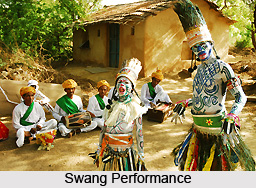
 Swang is a popular Indian folk dance drama practiced in Rajasthan, Haryana, Uttar Pradesh and Malwa region of Madhya Pradesh. Swang flourished with song and it is considered as a rich performance with literary wealth. This dance drama is dialogue-oriented rather than movement-oriented. It focuses on various mythological and social topics. Amateurs or new artists personify this folk drama and it is played either in the open or on the specially created platform.
History of Swang
It is believed that the founder of Swang is Kishan Lal Bhaat. Some artists also give credit to Kavi Shankar Dass, a poet artiste, who belonged to Meerut.
Themes of Swang
Though artists of Naqaals also perform such similar art in Swang, the story is presented with a more interesting way including caustic comments, particularly related to current topics. Most of the dialogues that are used are traditional, but a lot of slick improvisation can also be found in the performance. The body language is a perfect foil that converts all the serious comments of the storyteller into something-stupid yet extremely funny kind of performance. The humour is lusty and seldom appeals to an urban audience at large. The recent themes of this drama are health and hygiene, literacy, AIDS awareness and women`s empowerment. Popular mythological themes comprises of Bharthari, Harishchander, Raja Bhoj, Kichak Badh, Draupadi Chir Haran, Jaani Chor, and Pingla Bharthri to name a few.
Performance of Swang
The play of Swang begins with a Puravaranga, which is an invocation to the goddess Bhavani. For such a play, the stage is constructed in a circular manner and then it is generally performed in the open ground or space. There are very few people in the performance; a single performer performs many roles and the costumes are changed on the stage itself. Male actors play all parts since no women participants are allowed. Even the eunuch or the hijra is another essential character in these plays, which has to perform in all Margi (classical) and desi (folk Sanskrit) plays.
Music and dance is considered as an intrinsic part of this performance. Thus, at the centre, the musicians occupy the place on the stage, often getting up to sing and dance from that place itself. Scholars says that the main difference between Nautanki and Swang is that the Swang is intended to arouse religious sentiments for serious impact and the Nautanki is mainly a presentation of episodes depicting love and valour.