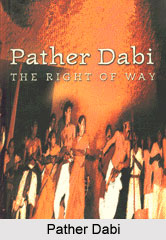
 Steeped in the background of 20th century, Pather Dabi delineates the riotous socio-political ethos in Bengal. The post war society, which was blighted with orthodoxy and untouchability, is the basic theme of the novel Pather Dabi. Very much of its time, Pathers Dabi verbalizes the crosscurrents of a quiescent society, which was suppressed by political oppression armored by social customs. Instead of advocating a blood shed revolution, the novel sermonizes the radical and total transformation of society.
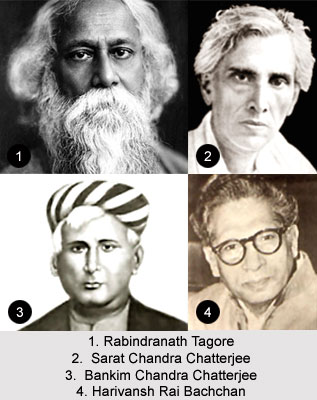
Author: - Sarat Chandra Chattopadhya, a true child of his age visualizes the sluggish society, bounded by narrow and futile moral customs. The social echelon on the basis of class, creed and religion, which was used cynically for political coercion, humiliate the novelist. Sarat Chandra, one of the stalwarts of Bengali Literature, was at the same time a social reformer, aimed to point out the futility of the social customs and conservatism and at the same time the diplomacy of the political administrator in the post war period. Pather Dabi aims at the reorganization and reconstruction of the society murmurs the very spirit of Renaissance.
Synopsis: - Pather Dabi, unlike other novels of Sarat Chandra, which concern about the suppressed women of the contemporary society, put forward the entire society encompassing both men and women as the poor victims of the monstrous society. Pather Dabi, actually a secret society endeavored to bring up a social revolution, thereby to free India from the British shackles. The story centers round the life and activities of Sabyasachi, popularly called doctor, the leader of the organization, a Hindu orthodox Brahmin, Apoorva, a Bengali Christian woman Bharati, Sumitra, the president of "Pather Dabi". A significant part is also played by Ramdas Talwarkar, a friend of Apoorva and an impulsive hero, ready to sacrifice his life for the sake of motherland. The interrelationship between the characters, the ecstasy and anguish of the tormented souls is the theme of the novels.
The conservatism of the traditional Hindu Bengalees, their apathy to the other religions especially the Bengali Christians out of the feeling that they are close to the British and ill treatment based on untouchability and indiscrimination in castes is the fundamental subject of the novel. Pather Dabi, a social reorganization works for the reorganization of the dejected condition of the factory workers. Sabyasachi appears as a super human soul, portraying the spirit of a vanguard of the society pregnant with socio-political repression.
As the very name of the novel relates, Pather Dabi, is a secret organization, which intends the liberation of the motherland through a social resurgence. The organization, though secret, projected as an open protest to the social orthodoxy. The title, Pather Dabi truly signifies the renaissance spirit, which imbibes the urge to wipe out the tribulations from the rugged society of the time.
This novel was first serialized in the Bangbani, the monthly magazine. The book edition of the novel appeared on 31st August 1926 (Bhadra 1333) by Uma Prasad Mukherjee. The novel was banned by the Government in 1927 for `preaching of sedition` under Section 124A of the Indian Penal Code. The Fazlul Hoque Governent lifted this ban on March 1, 1939. Muslim League Government following the Dramatic performance Act debarred the theatrical performance of Pather Dabi and after Independence it was staged in Rangmahal Theater.