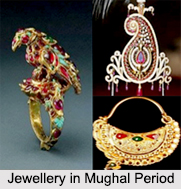
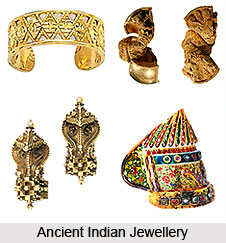
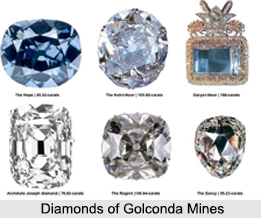
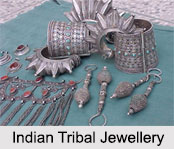
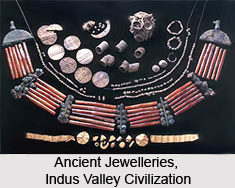
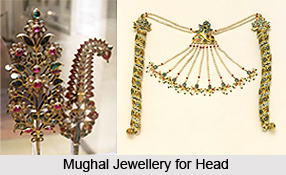
 Mughal Jewellery for head and face is a symbol of grandeur, miniature art, work of metal and gold, and the playing of pearls and diamonds.
Forehead Ornaments
The form of art is a gold set with diamonds and rubies, enamelled on the back, and with baroque pendant pearls from the North India made in the 18th century. This would originally have had a strand of seed pearls with which to attach it to the hair. Another gold set with foiled rock crystal and pearls is found in Punjab (Gujranwala). This ornament, which would be worn along the hairline with the pendant resting on the forehead, however is not enamelled on the back. It was acquired by the Indian Museum in 1855, presumably from the Paris exhibition, and was made in the birthplace of the Lion of the Punjab, Maharaja Ranjit Singh.
Hair Ornaments
This hair ornament is a gold set with rubies, emeralds and diamonds and with strings of pearls and red glass beads from the Northern India in the mid 19th century. This hair ornament was an exhibition piece acquired by the Indian Museum in 1855. It would have been worn with the long coils, terminating in serpent heads, framing the face and the strings of pearls with pendants fanning out over the forehead. This is Gold, worked in repousse, backed with silver and filled with lac found in Bengaluru probably in 1880. This ornament symbolizes the sun god, Lord Surya and depicts the god Vishnu at the centre, laying on the serpent Ananta whose multiple heads fan out over him, his consorts (in this south Indian form) Sridevi and Bhudevi on either side. This hair ornament is gold, worked in repousse, chased and backed with gold and found in Bombay probably in the 1880`s. The ornament is hollow; its cobra hood with multiple heads coils over a sinuously tailed peacock flanked by less flamboyant versions. The flower heads above the cobras are pierced and were perhaps intended to hold pearls. Along each side are attachment rings.
Ear Ornaments
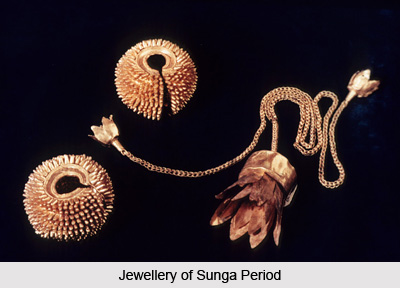
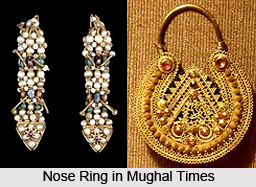 This is a gold filigree and silver set with diamonds; pendants of pearls, green glass and emeralds, strands of pearls and rubies. The considerable weight of these ornaments is only partly supported by the hook, which passes through the ear; the strands of pearls would be looped up and the twisted gold tie threaded into the hair. European influence shows itself in the filigree borders. This ornament was made from hollow gold, with applied geometric elements from Tamil Nadu in the 20th century. This ear ornament would be worn with one or two others of similar size and weight, thus dragging down and distending the lobe to an extraordinary degree. The form had been also produced in silver. These earrings are gold with applied stamped motifs, gold wires and granulation. However, though these ear ornaments are very obviously stylized cobras or nagas, the upper projecting section is the head of a semi-abstract animal (bat) with long ears and fangs. It thus relates to the group of ear ornaments with bizarre animal and bird heads. Another shared feature is the use of geometric motifs. This pair would have been worn with five other ornaments on each ear by sudra women. And here, brass imitations were substituted if gold was too expensive. This earring is made from gold with applied wire, granulation and stamped motifs and this pendant came from the London Colonial and Indian Exhibition of 1886. The richly textured surface of the upper crescent is produced by applying alternate bands of twisted wires and granulation, the grains either being arranged in a single row or in clusters of four, with an additional one on top. On the outside are circles of coiled wires with applied grains. The long pendant, held by a coiled and looped wire, is simpler but no less painstakingly crafted, with its applied plaited wire borders, and wire-and-granule flowers. These pair of earrings is made up of gold `cut work` studs and are set onto plain or twisted wire, with applied small flat discs. Here also the cut facets derive from western cut steel jewellery. This pair is Gold filigree with pendent sheet gold strips, which were acquired by the Indian Museum in 1855 and each section has a filigree frame onto which are soldered gold granules, or circular cushions of spiraling wire surmounted by a slightly larger granule. Each pendent `bell` has small strips of thin sheet gold attached to it which tremble with the slightest movement, causing light to flicker across them. This ornament is pierced gold with `cut work` and this style is almost certainly derived from European cut-steel jewellery of the late eighteenth century, produced in England. The main section of this ornament clips on to the outer curve of the ear.
Nose Ornaments
This nose ring is a gilt metal set with a pearl and with applied wire and granulation from the 19th century. The nose ring is usually worn by married women and, though now seen as quintessentially Indian, seems to have been introduced into the subcontinent from abroad. This is a gilt metal set with turquoise Sultanpur and this is a modest example of Kullu nose pendants, which may reach extravagant proportions and require a complex system of pulley-like supports for their weight. Married or unmarried women in Kullu would have worn this type of ornament.