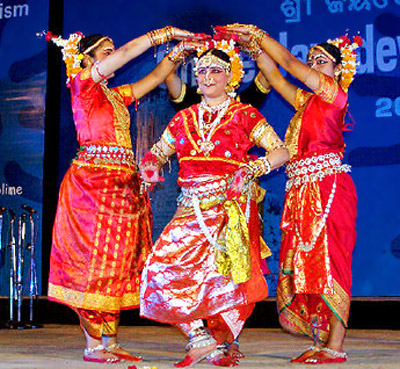
At times, Gambhira Dance is also performed in duet or in-group, depending upon the number of participants. The characters of the dance represent Puranic deities like Shiva, Parvati, Kali, etc. The big drum Dhak is primarily used as the principal accompanying instrument and the song, sung in eulogy of Lord Shiva and the tunes are loud and coarse, giving an added glory to its form. Gambhira songs are assumed to have originated from the worship of the god Shiva, since he is also known as `Gambhir`. In ancient times, Gambhira used to be celebrated as Puja,but in the medieval period, most Hindu communities started celebrating the Puja of `Dharma thakur` (a popular god of the Hindus) on the last three days of the Bengali year. This later on, was known as the `gajan of Shiva`. In the past, Shiva was imagined to be present at the time of actual performance.
The songs of Gambhira originated among the Hindu community of Maldah in West Bengal, completely in its theme formation. After the creation of Pakistan, Chapai Nawabganj in Rajshahi became the main center of Gambhira songs. With time, Gambhira songs have undergone many changes in terms of theme and style of its presentation. Later, Muslims became the custodians of these songs and made many changes in its form, as it was an integral part of their social life and their culture by the time. Therefore, apart from Rajshahi, Gambhira songs are also popular in Nawabganj and Naogaon.
At present, the main characters in the Gambhira are a maternal grandfather and his grandson. The performance is usually structured as a dialogue between them, interspersed with songs for fluent flow, where the dialogues consists of both prose and poetry. The Gambhira reflects contemporary social problems through witty dialogues, songs, dances and jokes. Sometimes it also reflects a generation contradiction in opinions & choices.
The costumes for this performance are very simple, since both the performers wear lungis. The gray-bearded grandfather wears a mathal i.e. straw hat on his head and holds a stick in his hand, whereas, the grandson wears a torn jersey and has a gamchha, a local checked towel that is tied around his waist.
In the past, Gambhira songs were sung in the measures of ektal, trital, dadra, khemta, kaharba but nowadays, the tunes are more influenced by songs from popular Bangla and Hindi movies in terms of music. The Gambhira songs were made popular by Kutubul Alam, Rakibuddin, Biren Ghosh and Mahbubul Alam of Nawabganj in their regions. They tried to introduce many new subjects and characters as its content with interesting and witty dialogues.
More on West Bengal
| Tribes of West Bengal | Bengali Theatre | Temples of West Bengal | Colleges of West Bengal |
| Tribal jewellery of West Bengal | Bengali Language | Districts of West Bengal | Medical colleges of West Bengal |
| Airports in West Bengal | Crafts of West Bengal | Cities of West Bengal | West Bengal Cricketers |
| Monuments of West Bengal | Bengali Wedding | Personalities of West Bengal | Bengali Literature |
| Folk Dances of West Bengal | Bengali Folktale | Museums of West Bengal | Bengali Newspapers |
| Festivals of West Bengal | Bengali Cinema | Universities of West Bengal | Places to See in West Bengal |