Dashavatara Dance
|
Dashavatara is performed to express ten incarnations of Lord Vishnu in dance.
|
|
|
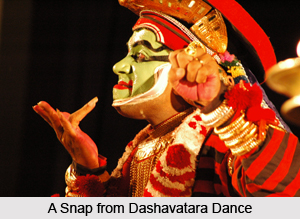 Dashavatara is performed to express ten incarnations of Lord Vishnu in dance or enacted form. The ten incarnation of Vishnu are Matsya (Fish), Koorma (Tortoise), Varaha (Wild Bore), Narasimha (Half Man & Half Lion), Vamana (Dwarf), Parashuraama, Raama, Balaraama Krishna, & Kalki. They form the base of Dashavatara dance. Some people believe that this dance has evolved from "Yakshagana", while others consider it, to have emerged from "Kuchipudi". Many actors believe that Dashavatara is originally a dance form of Kerala and they worship a deity of the Walaval region in Kerala. This dance is also performed in the in the Konkan region from 16th century till date. Dashavatara is performed to express ten incarnations of Lord Vishnu in dance or enacted form. The ten incarnation of Vishnu are Matsya (Fish), Koorma (Tortoise), Varaha (Wild Bore), Narasimha (Half Man & Half Lion), Vamana (Dwarf), Parashuraama, Raama, Balaraama Krishna, & Kalki. They form the base of Dashavatara dance. Some people believe that this dance has evolved from "Yakshagana", while others consider it, to have emerged from "Kuchipudi". Many actors believe that Dashavatara is originally a dance form of Kerala and they worship a deity of the Walaval region in Kerala. This dance is also performed in the in the Konkan region from 16th century till date.
The dance begins with the prayer dedicated to Lord Ganpati, by the 'Sutradhar' who is a stage manager. He also tells the subject of the theft of the 'Vedas' in loud voice & with exclaimed words. 'Brahmin' figures, women actors representing the rivers, actors playing Lord Brahma (the Creator) and Goddess Saraswati (the goddess of learning), and the demon Shankhasur, are some of main characters appear in the play as it goes on.
The dance form is also accompanied by musical background. The overture continues with play for about two hours, and after this the proper drama known as "Akhyana", begins, which is concerned with stories from the epics and mythological convictions, concludes at the time of sunrise. In this dance, the costume of all the performers is very graceful. The facial makeup is generally done using red and white colours, which distinguishes the Dashavatara actors from the spectators.
|
|
|
|





