Production stage in Film Making
|
Production Stage in Film Making is done in five phases; Development, Pre-Production, Production, Post-Production and Distribution. Each stage has a different purpose, with the overarching goal to get to the next one, and ultimately on to distribution.
|
|
|
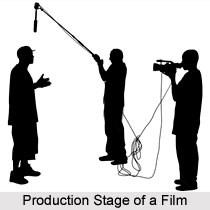 Here the movie is actually created and shot. More crew will be recruited at this production stage such as the property master, script supervisor, assistant directors, production sound mixer, stills photographer, picture editor, and sound editor. These are just the most common roles in filmmaking and the production office will be free to create any unique blend of roles to suit a particular film. Here the movie is actually created and shot. More crew will be recruited at this production stage such as the property master, script supervisor, assistant directors, production sound mixer, stills photographer, picture editor, and sound editor. These are just the most common roles in filmmaking and the production office will be free to create any unique blend of roles to suit a particular film.
A typical day's shooting begins with an assistant director following the shooting schedule for the day. The film set is constructed and the props made ready. The lighting is rigged, the camera and sound recording equipment are set up. At the same time the actors are wardrobed in their costumes and attend the hair and make-up departments. The actors rehearse their script and blocking with the director. The picture and sound crews then rehearse with the actors. Finally, the action is shot with as many takes as the director sees fit.
Each take of a shot follows a slating procedure and is marked on a clapperboard, which helps the editor keep track of the takes in post-production. The clapperboard records the scene, take, director, producer, date and name of the film written on the front, displayed for the camera. The clapperboard also serves the necessary function of providing a marker to sync up the film and the sound take. Sound is recorded on a separate apparatus from the film and they must be synched up in post-production.
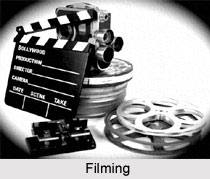 The director will then check to see if the shot was good or not. The script supervisor, sound and camera teams mark every take as either good (G) or not good (NG) on their respective report sheets. Every report sheet records special facts about each take. When shooting is finished for the scene, the director declares a "wrap." The crew will "strike," or dismantle, the set for that scene. The director approves the next day's shooting schedule and a daily progress report is sent to the production office. This includes the report sheets from continuity, sound and camera teams. Call sheets are distributed to the cast and crew to tell them when and where to turn up the next shooting day. The director will then check to see if the shot was good or not. The script supervisor, sound and camera teams mark every take as either good (G) or not good (NG) on their respective report sheets. Every report sheet records special facts about each take. When shooting is finished for the scene, the director declares a "wrap." The crew will "strike," or dismantle, the set for that scene. The director approves the next day's shooting schedule and a daily progress report is sent to the production office. This includes the report sheets from continuity, sound and camera teams. Call sheets are distributed to the cast and crew to tell them when and where to turn up the next shooting day.
For productions using traditional film, the day's takes, known as rushes, (film negative) are sent to the laboratory for processing overnight. Once processed, they return from the laboratory as dailies (film positive) and are viewed in the evening by the director, cast and crew. For productions using digital technologies, shots are downloaded and organized on a computer for display as dailies. When the entire film is in the can the Production Office normally arranges a wrap party to thank all the cast and crew for their efforts.
|
|
|
|





