Introduction
 Music Therapy, also known as "Sound Healing", is a particular process where "sound" is employed in healing diseases. Thus music has frequently been used as the therapeutic agent from the ancient times. Music produces the effect of Yoga through the generation of sonorous sound, which acts upon human organism to awaken and develop the proper function of various organ systems so that it ultimately leads to self-realization.
The music therapy was common in ancient India as self-realization was the ultimate goal of Hindu Philosophy and religion. Various Ragas have been found to be very effective in curing many diseases.
Origin of Music Therapy in India
Music therapy in India has a rich history of its own. The musicologists of India observed the ever engaging and invincible quality of music or sound. Music therapy in India hence stands as the arrangement of sound in definite order to raise varied feelings. These diverse feelings further influence the particular DNA and also excite the hormones.
Effects of Music Therapy
Listening to the music provides wonderful effect to alleviate stress. Music is a significant mood changer and reliever of stress, working on many levels at the same time. A slow rhythmic music is always much effective than a faster one. Indian classical ragas are proved to be very effective. But if one wants to boost up after a day"s fatigue, he/she must listen to some faster music instead of a calm one. One can also chose a familiar music like childhood song or good oldies for the music therapy and relaxation.
 Music of choice has always been a great healer. Music helps in the treatment of the diseases in the following way:
•Music acts as a sedative and thereby can replace the use of tranquillizers or at least can reduce the dosage of tranquillizers.
•Music increases the metabolic activities within the human body. It accelerates the rate of respiration, increases the hormonal secretion, affects the muscular activities and thereby affects the total Central Nervous System and Circulatory System of the listener of the music.
Many experts suggest that it is the rhythm of the music or the beats that has the calming effect on the nervous system without making the person very conscious about it. Therefore music has made its presence felt as an alternative form of treatment hence the very concept of music therapy is wide and engaging. The automatic process of music therapy therefore does a deep central healing while setting the right combination of sounds.
The entire human energetic level is extremely influenced by sounds and the physical body as well as the "Chakra" system responds specifically to certain tones and frequencies. Even the effect of music occurs especially when one is playing or creating music by oneself.
Techniques of Music Therapy
 Music has a healing effect on mind and body. Music is the stress reliever. It is seen that soothing music has many beneficiary effects. Music has a sedative effect also, it reduces the doses of tranquilizers in patients. There are many different techniques of music therapy. It should always be done under the observation of an expert. Many music have bad effects like hard metal, rock etc. One should like the music, which is played during the treatment, and the physician should be concerned about it as taste of music varies from person to person. It is found that if one listens to music forcefully against his/ her will, it will create adverse effect.
•If one wants stimulation after a day`s tiring work, he/she must select faster music than a slow calm music.
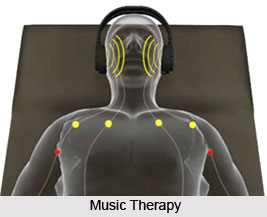
•To relieve stress, one has to take a 20-minute `sound bath`. First one should start some relaxing music in the sound system and then lie down on a couch or floor in the comfortable position. For a deeper experience one can wear headphones for more concentration and to avoid distraction.
•Music of slow rhythm, even slower than natural heartbeat and music with repeating cyclical pattern is found to be most effective in most of the people.
 •One must concentrate on his/her breathing letting it deepen, slower and regular and focus on the silence between the notes of the music. This makes music to rinse over one`s body and the relaxation is more complete.
•When concentrating seems to be tough, one must select music that he/she familiar with like childhood favorite or favorite oldies.Familiarity often introduces calmness.
•Taking a walk with the favorite music in the Walkman is also very useful. Inhalation and exhalation with the tunes of music relieves the stress and produce a combined effect of exercise and meditation.
•The other effective way is to listening to the sounds of nature like ocean waves or the calmness of a deep forest can reduce stress. One can take walk for 15-20 minutes near the seashore or a quite patch of wood or otherwise can buy tapes of these natural sounds.
Music therapy is utilized in hospitals, nursing homes, psychiatric health centers and in schools. In hospitals music is played to relieve pain along with anesthesia or pain edication, elevate patient`s mood and fight depression, promote movement for physical rehabilitation, calm or sedate a patient, to induce sleep, counteract apprehension or fear, lesson muscle tension for relaxation and reduce tension of autonomic nervous system. Music is also used to treat elderly people by increasing and maintaining of their social, physical, mental or emotional functioning. The sensory and intellectual stimulation of mind through music can enhance a person`s quality of life. Music therapy is very useful for the persons with mental sickness as it helps in positive change of mood and emotional states, resolving emotional conflict. Thereby music helps to get control over one`s life leading to stronger family value. Music therapists are often hired in schools to provide their services listed on the Individualized Education Plan for mainstream learners. Musical therapy strengthens nonmusical areas like communication skills and physical co-ordination skills, which are important for the daily life.
Adverse Effects of Music Therapy
Music therapy is all about music therefore. An extensive research reveals that any given piece of music system produce many physiological responses. But many of the music have bad effect on health like hard rock, heavy metal etc.
Though, it should always be remembered that every body have their different taste of music. So listening forcefully of a relaxing music, which the patient does not like, might enhance taste instead of alleviating it.
Music Therapy for Curing Diseases
 Music is the gift of god in human life, which has the power to communicate with everybody. Music is a great stress reliever and can easily identify with the emotions and inner feelings of human being. Music Therapy is an idea of alternative medicine, which is very useful in curing particular diseases. The psychological and communication problems like depression and autism can be cured by music therapy. Many old age diseases like Pakinson`s, Alzheimers, Dementia can be fought with Music Therapy. Music Therapy is a naturopathy that is very safe otherwise and does not have any side effects.
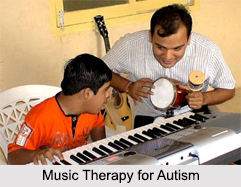
Autism Music Therapy : Autistic children have lack of communication and verbal problem which makes them confined in personal world. Music therapy assist the autistic child to improve speech ability by simple echolalia or a question answer form which enables the children to develop their speech ability gradually.
Music Therapy in Depression : Music is a great stress remover. Music Therapy is useful to alleviate depression as well as it reduces the tendency of self-isolation as music has a healing property over the emotional setback.
Music Therapy in Alzheimers : Alzheimer is an old age disease that can be cured safely by Music Therapy. Case studies have shown that the Alzheimer`s patients treated with music therapy have increased level of epinephrine, nor epinephrine, melatonin etc. in their blood tests.
Music Therapy in Parkinson`s and Dementia : Parkinson`s and Dementia are certain old age diseases those can be fight with music therapy. There are some reports of movements and walking in Parkinson`s patients when they undergo the Music Therapy with rhythmic and faster music. Dementia patients generally develop different tastes for music compared to their young hood. Music therapy can recover their memory by use of any old and familiar music.
Neurological Music Therapy : Music has neurophysiological and neurochemical effect that has direct effect on brain and the nervous system. The new improved NMT is the answer to the age-old neurological problem.
Music Speech therapy : Music therapy can initiate speech and verbal communication in some young patients.
Hymn and Chime Music Therapy : Old Vedic hymns and Indian classical music are used in music therapy. Chinese Chime is a musical instrument, which is used for therapeutic purpose.
Music Therapy for Stress
To relieve stress one can take a 20 minute "Sound Bath". One must lie in the couch or floor in a comfortable position with the liking music playing in a sound system. One can even wear headphones to concentrate more on the music. The focus should be on breath and concentration should be given on the gaps of the tones. The music should be allowed to wash over the body and mind so that it can bring complete relaxation. Listening to natural music like waves of sea or falling of raindrops is also helpful in relieving stress.
A single music is not good for everyone. Different people have different taste of music and it is important to like the music to get its full beneficial effect. There are some common guidelines to maximize the effectiveness of the music.
Music Therapy in Pakinson`s and Dementia
 Music Therapy holds a promise for those who are affected by age-related disorders like Alzheimer`s , Perkinson`s and Dementia. The Music Therapy is an effective cure not only for memory loss but also for the people who have movement disorder.
Research reveals that Parkinson`s patients after the music therapy regained some ability to organize and perform movements that were lost because of the disease. There was certain selected music that evoked such results. The music must be rhythmic and powerful to assist them in movement of their body and limbs. While selecting the music, the therapists normally go for the familiar music to the patients, based on their personal taste and preference. Normally the music therapists become aware of the patients` likings and disliking before they go for music therapy and choosing appropriate music dose for them.
Recent researches has found that the rule of music therapy might vary with the patients of dementia as they might develop new tastes and choices, which may be unmatched and unexpected compared to their original tastes and this arise all on a sudden.
Dementia is characterized by loss of reasoning abilities, language skill and memory and there is no reason for the sudden transformation of the patients. It is often found that patients of dementia start liking the music, which they once used to hate at their young ages.
According to the doctors this change in behavior could be due to various reasons. The first reason might be the change in one`s attitude toward novelty at their old age. Secondly in such patients, certain portion of the brain could be damaged affecting their perception in pitch, timbre, rhythm and acquaintance. Another study reveals that dementia can bring out artistic talents in people who never had them before. This artistic talent includes music and drawing, which flourish while the dementia worsened. With the help of a therapist the dementia affected artistic nature can be encouraged to learn and play musical instrument.
While treating Dementia patients by music therapy, caution should be taken as certain types of music can cause agitation in them. Music can arouse both positive and negative memories. The therapist`s endeavor should be to play such music that can bring positive results in such patients. So to cure the patients of dementia through music therapy needs close observation by the therapists.
Autism Music Therapy
 Music therapy is a unique application of music, which is used for personal betterment and positive changes in human lives. Music therapy has a wide use, which cures the exceptional children, adolescent and adults by developing social, emotional and cognitive learning. Music therapy has a healing effect on autistic children also as it helps to improve the communication as well as speech therapy.
Autistic children are those who do not behave or interact in the expected manner. Instead, the child stays in his or her own world, which is characterized by repetitive routines. The autistic child has odd and peculiar behavior, communication problem and total lack of social awareness. The child having autism is generally withdrawn and aloof and cannot respond to the external stimuli. Many of the autistic children do not speak at all, some other autistic children speak in rhyme or echoes other person`s words or use peculiar language.
Music is effective in case of autistic child because almost everybody responds positively to at least some kind of music. Music is non-verbal form of communication and a natural reinforce, which provides motivation for practicing different nonmusical skills.
An autism music therapist must be fully trained with a full curriculum of music classes, along with selected courses in psychology, special education and anatomy as well as field experience in music therapy. Music therapy is particularly helpful for those autistic children whose world is confined in the non-verbal, non-communicating nature of medium. Parallel musical lessons are designed to support the objectives of the child as observed by the therapist or instructed by the parents, teacher or other professional. An autism music therapy professional must observe the particular child`s need to socially interact with others. Musical games like passing a ball back and forth along with music or playing sticks and cymbals with other person can be used to encourage their relations and communications. The autistic children avoid eye contact so eye contact is encouraged with imitative clapping games in front of eyes or with some activities that draws attention or any instrument is played near the face. Music is played to enhance social bond that leads to playing music while in a group of other children in a circle.
Music Therapy in autism is particularly effective in the development and remediation of speech. There is severe deficit in communication among autistic children that sometimes include nonexistent or impersonal speech. This speech can vary from complete mute to grunts, humming, pharyngeal sounds to cry and screaming. Musically chanted vocalization with some consonant vowel combinations, sophisticated babbling, interspersed with vaguely recognizable word-like sounds, or some unfamiliar jargon etc.are the characteristic of the autistic children.
Higher-level autism might include echolalia or pronominal reversal while some children might progress to appropriate phrases, sentences and longer sentences with repetitive monotonous speech. The autistic children are easily attached to music, which often seen in the mainstream public schools that autistic child attending music classes.
Autistic children are unusually sensitive to music. Some have perfect pitch while others are seen to play instruments with keen musical perception. This makes easy to adapt the music therapy for the autistic children and the therapists found their duty easier. Some children have unusual sensitiveness to certain musical sounds. An autistic child after playing xylophone bar would spontaneously sing up the harmonic series from the fundamental pitch. Syllable sounds were paired with careful structuring and the child began incorporating the easy consonant-vowel sounds into the vocal play. First the therapy begins with easy notes and tunes played in the xylophone but the therapist gradually include more complex verbalization, which the child slowly starts to imitate.
There are instances in which few autistic children can sing though they are incapable of speaking. Music therapists work systematically on their speech through vocal music activities. In the music classroom songs with simple words, repetitive phrases and even repetitive nonsense syllables can assist the language of an autistic child. The process is facilitated even further by meaningful word phrases and songs presented with visual and tactile cues. One such teaching is giving the child the object while singing:
Do you eat an apple? Yes, yes.
Do you eat an apple? Yes, yes.
Do you eat an apple? Yes, yes.
Yes, yes, yes.
and
Do you eat a pencil? No, no.
Do you eat a pencil? No, no.
Do you eat a pencil? No, no.
No, no, no.
The teacher sings this simple question answer song with a familiar melody in full rhythm and harmonic accompaniment. To teach an autistic child the noun and verb phrases, a large doll was given to him/her and the teacher sang:
This is a doll.
This is a doll.
The doll is jumping.
The doll is jumping.
This is a doll.
This is a doll.
Later, words were substituted for walking, sitting, sleeping etc. In the presented songs the bold words are faded out by the Music Therapists gradually. As all the phrases were repeated, the child could follow it through echolalic imitation to respond accurately. When the music was completely eliminated, the child could learn how to verbalize the entire sentence in response to the questions "What is this?" and "What is the doll doing?"
Some other autistic children could learn it more easily when entire song contains both the question and answer. The following phrases are sung to a children with the tune of `twinkle twinkle little star`, the words were faded out in the backward progression. The primary objective of the child is attention to the environmental sounds and the song structure assisted the child in responding in a complete, grammatically correct sentence:
Listen, listen, what do you hear? (music played on tape)
I hear an ambulance.
(I hear a baby cry.)
(I hear my mother calling, etc.)
Eliminating the monotonic speech is another difficult challenge for autistic children. This can be achieved by singing songs which are composed to match the rhythm, stress, flow and modulation of the sentence followed by gradual fading of musical cues. Parents and teachers can help the child to remember the rhythmic aspect of the speech by singing the song again and again to the child.
The autistic music therapy needs to compose special kind of songs, which are repetitive in nature. Even in the higher-level elementary vocal method books, repetition of simple phrases is very common. For the music therapy of the autistic child, the ability to put words together is much vital for the beginning.
Music Therapy in Alzheimer
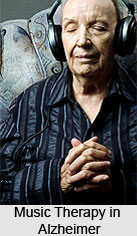 The idea of applying music therapy to cure Alzheimer`s patients is comparatively recent. The research studies reveal that music therapy has a positive effect on emotional matters and mood and memory. However, generalization of data is quite difficult, as it needs extensive study and numerous positive results. Based on the application of the rehabilitative technique on Alzheimer`s patients and on the recent researches on relationship of music with neuroanatomy, a quest is on process to identify the therapeutic effect of music on Alzheimer`s patients.
A music therapy program on twenty male Alzheimer`s patients revealed that it raises melatonin levels, bring improvement in general behavior and solve the sleep problem.
In a particular study, the Alzheimer`s patients underwent music therapy for 30-40 minutes, 5 days a week for one month. Then their blood samples were taken before the first session, at the end of the four weeks of therapy, and 6 weeks after the study`s conclusion. The doctors and the researchers checked the levels of melatonin, epinephrin,norepinephrine, prolactin and serotonin. These are brain chemicals which affect mental state.
The research revealed that the levels of melatonin, epinephrine and norepinephrine in blood had risen significantly at the end of the fourth week therapy program. Moreover, melatonin levels remained higher after six weeks i.e. at the end of the program. But by that time the epinephrine and norepinephrine levels had returned to their original readings. Serotonin and prolactin were not affected by music therapy. In addition to the hormonal changes, the Alzheimer patients who participated in the study also became more active and cooperative and slept better.
The doctors and the music therapists mention that the relaxation with music that calms one down is very benefecial indeed. To prompote a sense of calmness and well being, one can listen to the favorite music while eating, before sleeping and at the time of relaxation. Music therapy is safer for the Alzheimers or any other patients than the psychotropic medicines. Like meditation and yoga, it can help to maintain the hormonal and emotional balance, even during the period of stress and disease. Music theraoy helps the Alzheimer`s thus in a number of way. Music therapy helps in recalling memory while increasing the positive mood. In stress reduction and in decreasing the agitation level music therapy has an immense value.
There are many hindrances like cultural and methodological problems that prevent to demonstrate the efficacy of Music therapy on Alzheimer`s despite the consistent effect of music on personal and social behavior. The neurophysiological and neurochemical effects of music therapy have less information and this results in the application of the music therapy based on assumption only. The supposed positive effect of music therapy on Alzheimer`s patients is enough to justify its application. The methodological problem is related to the evaluation of outcomes. There are only little or no standardized instruments that can measure and evaluate the results. The studies that investigate the effect of music therapy were characterized by less specific indicator like cognition, behavior etc. The aim of the study on Music therapy in Alzheimer`s is to organize the present knowledge with a systematic approach so that future research results can be applied more promptly.
Music Therapy in Depression
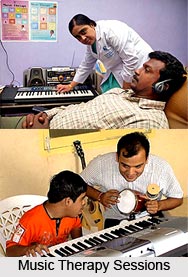 It cannot be denied that music has a strong relationship with our feelings and emotion. Music therapy to cure depression is still a subject of study though its effectiveness is already proven. Music is a powerful form of expression that delivers messages by combining rhythmic sound and words.
Depression is a mental state that is characterized by a pessimistic feeling, a sense of inadequacy and a hopeless lack of activity caused due to changes in brain chemicals which results from various reasons. Thus, depression is a serious medical condition and clinically known as `major depressive disorder`, which needs medical treatment to compliment other therapies. In order to use Music Therapy to cure depression, it is very important to choose right kind of music for the treatment of bipolar depression.
Music therapy is considered as a cost effective service because it can be done even from home. The patients can listen to music under the supervision of the therapist over a week. A self-administered program is definitely cost effective. This is very profitable to those who have little or no access to healthcare professionals.
The research on relationship between music therapy and depression suggests that the therapists should be extremely careful with the application of the music. However, soothing music always proven to alleviate depression. There are various ways in which the music therapy helps to recover from depressive disorders.
Music Therapy often helps to overcome self-isolation. Self-isolation is often common in case of sudden loss of hearing or sight, which leads to great stress and eventual loss of memory that ultimately results in isolation. Music has a definite message, which positively engages patients that assist them to open their mind gradually. Music provides platform for communication, especially to those who have lost their verbal communication. Musical therapy includes prompting or echolalia of the sound they can recognize. One can gradually be able to get rid of self-isolation by continuous interaction with music therapists and family members. Guided medication along with music therapy is very beneficial in case of depression or self-isolation.
Music therapy in depression is very helpful as it has direct relationship with brain waves, breathing and heart rate and on state of mind. Research has shown that music with strong beats can stimulate brain waves as it resonates synchronously with the beat. The faster beats bring sharper concentration and more alert thinking while the slower music produces a calm, meditative state. Also, it has been found that the change in brainwave brought by music also enables the brain to shift speed more easily on its own need. Thereby, music has long lasting benefit on state of mind even after one has stopped listening to music.
Music brings change in brainwaves, which in turn creates alterations in bodily functions. This also produces changes in physiological activities controlled by autonomic nervous system, such as breathing and heart rate, which can also be altered by Music therapy. Slower breathing and heart rate removes stress and brings relaxation that is very much necessary to cure depression. Even the damaging effect of chronic stress can be altered that makes life free of depression.
Music is also used to bring a more positive state of mind, preventing anxiety and depression. This is helpful in managing stress response. It also enhances optimism levels and creativity. Thus, music therapy plays a direct role in managing depression.
Neurological Music Therapy
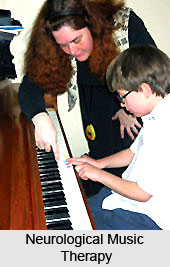 Neurological Music Therapy (NMT) is the research-based treatment for the patients having neurological disorders, which include autism and many other diseases. This treatment is based on utilizing the physiological mechanisms that is involved with music perception and creation of music.
Research shows that most individuals having autism respond positively to music. Their genuine interest for music makes it easier for them to undergo Music therapy. Music is a very basic human response that works with able as well as in case of disables. Music therapists meet their clients and allow their treatment from the very beginning. The malleability of music makes it acceptable to every individual. The structure and sensory input of music is its inherent quality, which establish a relationship with the listener.
Individuals who have autism spectrum might display "qualitative impairments in social interaction and communication" and often manifest "restricted repetitive and stereotyped patterns of behavior, interests and activities." Music therapy is able to typically address the characteristic of autism.
Music therapy can stimulate clients to reduce negative response and increase participation in more appropriate and socially acceptable ways. It also reduces the self-stimulatory responses. Music therapy can enable those without language and verbal communication to participate in a non-verbal communicative way. Music therapy also assists in the development of verbal communication, speech and language skills. Both children and adult affected with autism reciprocate in shared-play, turn taking, listening and responding to another person. Music therapy allows the individuals with autism to develop identifications and appropriate expression of their emotions; because music can coordinate both the hemispheres of brain. Music can stimulate cognitive functioning and used for remediation of speech and language skills. Music provides concrete multisensory stimulation in auditory, visual and tactile senses.
The rhythmic component of music acts on sensory system of the individual having autism. As a result, auditory processing and other sensorimotor and motor skills can be controlled under music therapy. Many people with diagnosis on the autism spectrum have innate musical talents,Thus music therapy brings out their talents in a successful manner. Emphasis is given on internal strength, which in turn is utilized to address each individual`s personal need.
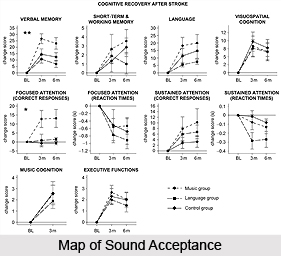
Recently the brain research is done in a more extensive fashion and study of music cognition and perception has encouraged research into biomedical applications of music. Music therapy can stimulate cognitive, affective and sensorimotor process of the brain and these functions can be transferred for non-musical therapeutic treatment also. Biomedical research in music concentrates on motor therapy, speech and language therapy, pain management and cognitive rehabilitation in the areas like memory, executive function and attention.
An important data base research is on the way of beginning to move neurological music therapy to the status of evidence-based treatment. The speech training is based on shared parameters of vocal production between speech and singing. It can be accessed to facilitate speech in rehabilitation. The common forms of communication such as signs and symbols as forms of meaningful expression in music and language can support language development and the recovery of communication functions.
A specific neurological music therapy protocol teamed with the apt guidance of the professional neurologic music therapist further aids in treating the speech and communication problem while answering to the common neurosis problems.