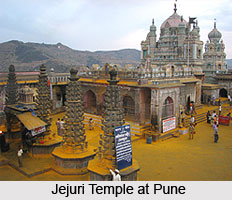
 Jejuri is one of the popular pilgrimage centres of Maharashtra, located 38km from Pune and 60km from Sholapur. It houses a temple dedicated to Lord Khandoba. Khandoba, popularly known as "Khandobachi Jejuri", is one of the major Gods worshipped by Dhangars. Dhangars are the oldest tribes in Maharashtra. The God of Jejuri-Mhalsakant or Malhari Martand is popular amongst the Dhangars. It is believed that Khandoba, is the God of Sakamabhakti i.e. it God who fulfils all the desires of his devotees.
Jejuri is mainly a city and a municipal council in Pune. Jejuri Temple of Khandoba is situated on a small hill, so can be seen from the approach road. It is famous for the main temple of God Khandoba. It is one of the most sacred temples in Maharashtra. Besides the warrior communities of Maharashtra, Dhangar (shepherds), farmers, Brahmins and other people of other religious background visit Jejuri to receive the blessings of Khandoba, to continue in their lineage of family tree.
Since the Jejuri Temple is situated atop a small hill; one has to climb a series of almost 200 steps to reach the sanctum sanctorum. The climb is not too difficult as it offers amazing views of the picturesque locales to the sides that one does not even come to know when the 200 steps come to an end. If the weather permits, one can catch a glimpse of Saswad and Dive Ghat. While climbing, people can also enjoy the number of "Deep Mala" - Light Stands of Stones. In fact Jejuri is famous for its popular old Deep Mala. They are said to have been built by Aurangzeb.
Structure of Jejuri Temple
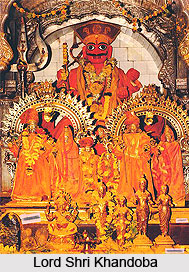 The Jejuri temple can be divided into two parts - Mandap and Gabhara. The two bells at the entrance, the majestically crafted idols of Khandoba, Mhalsa and Manimalla along with various weapons of historical importance such as the Sword, Damru and Paral enthrall the worshippers" en-route the main chamber. The idol of Shri Khandoba enshrined inside the temple is simply beautiful. There is even a competition held on Dussehra festival involving handling the sword to the highest point of reach for a maximum period of time at the Jejuri temple. The unique architectural lineages as the "vimana" (crest) with the minaret-like structures at the four corners along with the arches of the "sabhamandapa", suggests a strong Islamic influence. A number of curious rituals are conducted at the venue, and in the background one can see the huge expanse of the Malhar Sagar (reservoir) formed on the Karha River. The magnificent depressions of the Peshve and Ahilyadevi Holkar Talab (pond), which are man-made tanks, measuring a kilometer in diameter, form a serene backdrop.
Khandoba - The Dhangar Deity
Khandoba, the deity of Jejuri, is a fighter God of the Marathas. It is one of the two primary main deities of the Maharashtrian community, along with Vithoba at Pandharpur, most others being Goddesses. Khandoba, also known as Khanderao, Khanderaya, Malhari Martand and Mallu Khan is a regional Hindu deity, worshipped as Bhairava, a form of Shiva, mainly in the Deccan plateau of India. He is the most popular family deity in Maharashtra, the patron deity of Deshastha Brahmin, warrior, farming and herding castes, the hunters and gatherers of the hills and forests. He is shown astride a horse and has an angry warlike look.
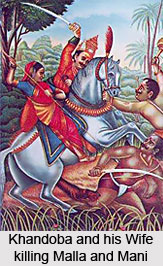
The cult of Khandoba has linkages with Vaishnavas and Jain traditions, and also assimilates all communities irrespective of caste, including Muslims. Khandoba is sometimes identified with Mallanna of Andhra Pradesh and Mailara of Karnataka. The worship of Khandoba developed during the 9th and 10th centuries from a folk deity into a composite God possessing the attributes of Shiva, Bhairava, Surya and Karttikeya Skanda. He is depicted either in the form of a Lingam, or as an image riding on a bull or a horse. The foremost centre of Khandoba worship is Jejuri in Maharashtra. The legends of Khandoba, found in the text Malhari Mahatmya and also narrated in folk songs, revolve around his victory over demons Mani-Malla and his marriages.
Historical Importance of the Jejuri Temple
 The Muslims tries to destroy the temple repeatedly. Even Aurangzeb made an attempt to destroy the temple a second time in 1690. His attempt was however thwarted when the Mughal soldiers disturbed a hornet`s nest, during their attack. The hornets so harassed the besieging Mughal soldiers, that Aurangzeb was forced to retreat and spare the temple in peace. An infuriated, but god-fearing Aurangzeb is said to have offered one hundred and twenty-five thousand silver coins to the God Khandoba.
Historically Jejuri also holds importance because it is in this very place that Shivaji met his father Shahji to discuss war strategy against the Mughals. In that time period, Jejuri was one of the major hill forts in the South region.
How to reach Jejuri Temple
Jejuri is situated 48 km from Pune in Maharashtra State. This place can be reached by both road and rail from Pune. Number of State Transport buses ply from Pune. It can also be reached by Express trains from Pune Railway Station.