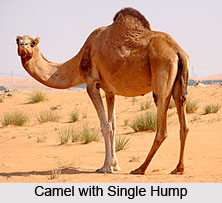
 A camel is a large animal which bears distinctive fatty deposits known as "humps" on its back. There are two species of camel including dromedary camel which has one hump and bactrian camel which has two humps. Both the species of camel have been domesticated. They provide milk, meat, hair and wool. They are also used for transporting human and bearing loads. The unique feature of a camel is that it can travel long distances across hot, dry deserts with little food or water.
Indian Camel
The camels found in India are single-humped which are also known as dromedary camels. They are usually 6 feet long and weigh around 700 kg. The long-curved neck, the deep-narrow chest and the large mouth are the other features of the Indian camel. Indian dromedary camels have a thick growth of hair on the throat, shoulder and hump which is longer than the rest of the body. The average lifespan of a camel is forty to fifty years.
Habitat of Indian Camel
Camels are found in the desert, dry arid regions of the country especially in Rajasthan.
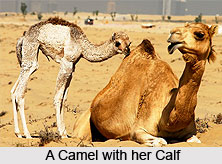 That is why they are also called "Ships of the Desert". They are also spotted in the Kaziranga and Desert National Park. The camels are gregarious and can be seen wandering in groups. In each group, there is one male member who dominates the rest of the members. The rest of the members comprises of females, sub adults and young ones. When moving in a group, the female member leads the group while the dominant male directs the group from the back. Indian camels attain maturity at four to five years of age. They give birth to one offspring at a time and the gestation period is nearly fifteen months. The calves can start walking within two hours of birth. The mother takes care of the young ones till two years after which they can live on their own.
Diet of Indian Camel
The Camels are herbivores and consume thorny plants, dry grasses, grains, wheat, oats, dried leaves and seeds. They can go without food for 3-4 days as their humps contain fat. The camels use the hump as reservoir of fatty tissues. In times of need, the tissues are metabolized and the camel receives energy. The size of the hump varies from camel to camel depending on its nutritional state. In times of starvation, the hump can reduce in size and become almost non-existent.