Great Hornbill, Bird - Informative & researched article on Great Hornbill, Bird
  Indianetzone: Largest Free Encyclopedia of India with thousand of articles Flora & Fauna


in  
Art & Culture | Entertainment | Health | Reference | Sports | Society | Travel
Forum  | Free E-magazine
Flora & Fauna : Indian Birds l Indian Animals l Indian Flowers l Indian Reptiles l Indian National Parks l Indian Shrubs l Indian Tress l Bird Sanctuaries in India l Indian Herbs l Indian Plants l Indian Medicinal Plants l Indian Flora and Fauna l Indian Biosphere Reserves l Indian Wildlife Sanctuaries l Indian Fruits l Indian Wildlife
Home > Reference > Flora & Fauna > Indian Birds > Great Hornbill
Great Hornbill, Bird
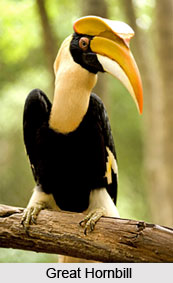
The scientific name of the Great Hornbill is Buceros bicornis and it is the largest member of the hornbill family.

Great HornbillThe Great Hornbill is also known as the Greater Indian Hornbill and is the largest member of the Hornbill family. Other than India it is also found in the Malay Peninsula and Sumatra, Indonesia. The Great Hornbill has a long lifespan extending over fifty years.

This large bird is nearly four feet tall with a sixty-inch wingspan. The tail weathers are as long as thirty-six inches and weighs approximately six pounds. The most striking feature of the hornbill is the bright yellow and black helmet on top of its massive bill. As such the helmet is of no use although they are believed to be the consequence of sexual selection.

The female hornbills are smaller in size than the males and have blue eyes instead of red.
Female hornbills seek shelter in the hollow of large tree trunks and the entrance is sealed with faeces, wood bark and dirt. She is confined to the nest while the chicks are growing and relies on the male hornbill for food. She lays one or two eggs at a time and the incubation period is for thirty-eight to forty days.
The Great Hornbill feeds on fruits. It also consumes small mammals, birds, lizards, snakes and insects. The birds usually form monogamous pair bonds and live in a group, which consists about two to forty individuals.

The bird has been ranked as a near threatened species owing to its hunting and lose of habitat. It is a state bird of Kerala.
(Last Updated on : 17/12/2008)
  More Articles in Indian Birds
 
Birds Common birds in India Chakravaka
Sarika Indian Roller Great Hornbill
Hill Myna Black crested Bulbul Greater Flamingo
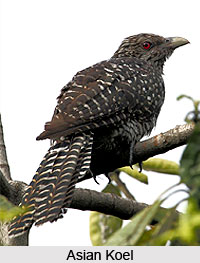
Black Francolin Black Necked Crane Asian Koel
Asian Paradise, flycatcher Green Imperial pigeon Hume`s Pheasant
Great Indian Bustard Blood Pheasant Emerald Dove
White throated Kingfisher Sarus Crane Himalayan Monal
Goshawk Sooty Tern Peafowl
Endangered Species in India Babblers Bee Eaters
Weaver Birds Woodpeckers Waders
Warblers Quails Thrushes
Partridges Iora Flycatcher
Stork Bats Peacock
Recently Updated Articles in Flora & Fauna
  • Indian Tress
    Indian trees are correlated with the immortality and wisdom of the country. The various species of trees are used for several purposes as well as they have medicinal value.
  •  
  • Uses of Rose
    Uses of rose, including rose petals, leaves and the hips, are included cosmetics, culinary practices as well as alternative medicines since antiquity.
  •  
     
  • Natural Vegetation in India
    Natural Vegetation in India includes the Tropical Rain Forests, the Tropical Deciduous Forests, the Temperate Forests and Grasslands, the Alpine and Tundra Vegetation
  •  
  • Indian Birds
    Indian birds are of many types and can be seen throughout the country. Some birds are found only in certain specific regions.
  •  
  • Indian Fruits
    Indian Fruits are of various types and rich in nutritious ingredients. They are considered as the most popular fruits all over the world.
  •  
    E-mail this Article | Post a Comment
    RSS Feeds
    Forum
    Forum on Flora & Fauna

    Free E-magazine
    Subscribe to Free
    E-Magazine on Indian Crafts
     
     
    Great Hornbill, Bird - Informative & researched article on Great Hornbill, Bird
    Sitemap
    Contact Us   |   RSS Feeds
    Copyright © 2008 Jupiter Infomedia Pvt. Ltd. All rights reserved including the right to reproduce the contents in whole or in part in any form or medium without the express written permission of Jupiter Infomedia Pvt. Ltd.