 Located at the village of Verul, near Ellora caves, Ghrishneshwar Temple is an important place of Hindu pilgrimage and is chiefly dedicated to Lord Shiva.
Ahalyabai Holkar, a Maratha Princess, who reigned from 1765 to 1795, receives the credit of building it, is the splendid example of medieval architecture. It is one of the twelve Jyotirlingas where Lord Shiva is the presiding deity. This Jyotirlinga is said to be self-oriented. It is the last Jyotirlinga, without which the journey to the Jyotirlingas is considered incomplete. The walls of the temples are exquisitely sculptured. The temple is considered an important Brahmanical religious centre.
Ghrishneshwar is also known as Ghushmeshwar. The emergence of linga is explained in the Shivpurana. Legend associated with the temple is that on the mountain of Devagiri, there lived a Brahmin Sudharm with his wife Sudeha, teaching Vedas. They were not in peace with themselves because they did not have any child to continue in their legacy. So, failing in all her attempts to conceive one, Sudeha married her sister Ghushma (in some places mentioned Kusuma), to her husband Sudharm. On the advice of her sister, Ghushma used to make 101 lingas and worship them.
In the nearby lake the lingas used to be discharged. Gradually with the blessings of Lord Shiva, Ghushma became a proud mother of a healthy and pretty baby boy. Sudeha, seeing her sister`s piety towards the Lord, was engulfed with jealousy and envy, in the process, murdering the son, in cold blood.
A very aggressive and horrified Ghushma (Kusuma) continued her ritual worship for Shiva. On such an occasion, when she was immersing the lingam in the lake, she saw her son coming up miraculously restored to life. Lord Shiva granted her the wish to be presiding eternally in that spot, (in the form of a Jyotirlinga) in her name and forever benefit the village folk. Thus the name Ghushmeshwar came into vogue. There are various versions of the name itself, like- Kusumeswara, Jyotirlinga, Grushmeswara Jyotirlinga and Grishneswara Jyotirlinga.
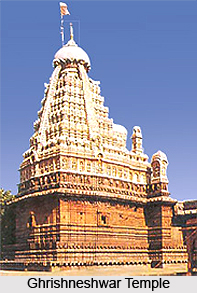
The Ghushmeshwar temple is constructed of red basalt, presenting a characteristic look. The architecture also represents the local style and departs very well from the contemporary Islamic styles. From first look, Ghrishneshwar Temple consists of a `garbha griha` (sanctum sanctorum), `antarala` (antechamber) and a `sabha mandapa` (pillared hall). Decorative friezes and sculpture depict a pantheon of Indian Gods including Brahma, Vishnu, Ganesh, the marriage of Shiva and Parvati, celestial beings, even Maratha heroes. The huge Ghushmeshwar temple is measured 240 x 185 feet, is still as fresh as when it was built. Twenty-four exquisitely carved stone columns, thereby taking the load of the main hall, balance the temple. This particular aspect of god`s luminous energy is manifested only in 12 temples.
The exterior surface of the wall portion is built vertically as well as horizontally with short depth projections. The horizontal moldings were utilized for carving different motifs. The most striking feature of this creation is the five-tiered `shikara` rising in diminishing height. The high wall portion of the sanctum enhances the height of the shikara. It is adorned in the crown by a couchant bull at each corner along with a monkey behind it. The shikara is ornately decorated with geometric motifs.
Ghrishneshwar is the presiding deity of the locals and Verul (Ellora) was under Maloji Bhosle, the grandfather of Chhatrapati Shivaji. The traditional custom inside the temple premises is that- the male visitors will always have to take off their upper garments before entering the main hall. The main puja is conducted on Mondays, and a large fair is organized and attended by large number of devotees on Mahashivratri.
Ghrishneshwar Temple is located at a distance of 30 kilometres from the main city of Aurangabad, close to the Ellora Caves. The nearest airport as well the railway station is Aurangabad. One can take a taxi/cab from the main city to reach the temple. Accommodation can easily be chosen from the several options available in hotels.