


|
Ancient History of Kerala There is not much known to the historians regarding the ancient history of Kerala since very less is available in written form. Whatever remains is in the form of conjectures and myths and one of the myths is the Legend of Parasurama. The ancient History of Kerala is primarily steeped into myths and legends. According to the geologists, the land of Kerala was elevated from the sea due to a seismic activity, either gradual or sudden. 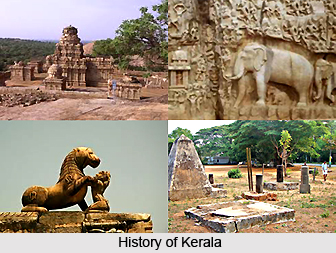 Besides the legends, the first arrival in Kerala can be identified today only with regard to the burial practices followed by them. Although there are no records, sensible assumption is that those people spoke an archaic form of Tamil and built strange burial monuments of granite. The historians have assumed a time bracket in between the tenth century BC and fifth century AD for these people. It is evident from the grave relics, which includes daggers and iron tridents that these megalithic builders had emerged out of the Stone Age to the Iron Age without moving through the Bronze Age.
Medieval History of Kerala Medieval history of Kerala was shaped with the decline of the Chera dynastyand the rise of several independent states, including Kozhikode, Kolathunadu and Venad Kochi. In the medieval age, (16th century onwards) Calicut came out as a prominent sea port and attracted British, Dutch and Portuguese traders to found their posts here. However, the first to have control over the trade of spice in Kerala were the Arabians. The fight between Cochin and Calicut helped the Dutch to form their trade settlements in Kerala and they lastly forced out the Roman Catholic Portuguese from the land. However, the Dutch were unable to continue in the state ahead of the 18th century due to the dispute within the Mysore rulers. Then the British arrived, who proved to be very much successful and cemented the colonial rule in India. Tipu Sultan had some disputes with the British, and four Anglo-Mysore wars took place across southern India in the later parts of the 18th century. The British ceased their treaties of auxiliary alliance with the rulers of Cochin in 1791 and with the Travancore rulers in 1795, and therefore the two states became the princely states of British India, preserving local autonomy and in return used to give a fixed annual tribute to the British Raj. South Kanara district and Malabar district became the parts of the Madras Presidency of British India. Modern History of Kerala The modern history of Kerala contains the prelude to India's independence, the rise of Communism and the formation and development of Kerala as a modern state of India. Kerala was formed by the merging of three political units; the kingdom of Travancore, the princely state of Cochin and the district of Malabar. The rise and growth of a substantial monarchical power possessing immense wealth and power of the landlords and foiled the efforts of foreign domination which proved to be the turning point in Kerala's modern history. Travancore laid the founding stones of a firm centralized administration by suitable administration and severe punishments. After India's independence in 1947, Travancore and Kochi were integrated to form the province of Travancore-Cochin on 1st July, 1949. The Madras Presidency formed the Madras State of India. |
| |||



History of Kerala
| History of Kerala can be interpreted from the inscriptions of Ashoka, Mauryan Emperor. History of Kerala is as interesting as its wide-ranging geographical features that make the land a place of versatile appeal. |
| ||||||||||||||||||||||||||||

