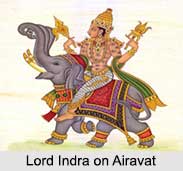
 Lord Indra, the Indian God of Rain, is believed to be the leader of all the Devas. He is also the God of War and the greatest of all warriors. Lord Indra is looked upon as the strongest of all beings and ruled thunder and storms. He is the defender of the good against all evils. In Hinduism, he is recognized as the thunder god and storms as he owns a celestial weapon called Vajra. As he brings water to the earth thereby causing fertility he is also regarded as the creator God.
Iconography of Lord Indra
Lord Indra is depicted as a fair-reddish complexion with either two or four very long arms. He was born as a full grown four armed young man from his mother`s womb. Sachi, also known as "Indrani", is his wife and his attendants are called "Maruts". Jayanta, Midhusa, Nilambara, Rbhus, Rsabha and Kambha were his sons and Jayanti and Devasena were his daughters. When he is not using chariot he rides the divine elephant Airavata, who has four tusks and looks like a mountain. Indra is known by several names like Sakra, Vajri, Purandara, Meghavahana and Swargapati.
Legends of Lord Indra
One of his most important deeds is the slaying of the demon Vritra. As per the legend, Vritra took the form of a dragon and took all the water from the world. When Indra heard this he vowed to give back water. Before the battle begun he drank Soma in order to attain power. Indra chased Vritra and after a fierce battle he was able to destroy him. Water fell from the sky when Indra split him open. This made Indra, the God of Rain.
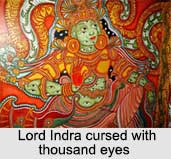
Lord Indra was no more interested in wealth and honour. So, he decided to lead a simple life and became a hermit in order to attain wisdom. His wife was helpless and asked Brihaspati the priest to change her husband`s mind. Brihaspati taught Indra the qualities of spiritual and worldly life. Indra learned to pursue wisdom while fulfilling his duty as a king. It is believed that Indra"s weapon, Vajra, is made from the bones of a Sage Dadhichi.
Indras in Manwantaras
According to Markandeya Purana, each Kalpa has 1 Indra. It is also stated that there are 14 Manu period and 14 forms of Lord Indra. They are:
1. Swayambhuva - Yajna, an incarnation of Vishnu
2. Swarochisha - Vipaschit
3. Auttama - Sushaanti
4. Tamasa - Shibi
5. Raivata - Vibhu
6. Chakshusha - Manojav
7. Shraddhadev - Purandar (Present Lord Indra)
8. Savarni - Bali
9. Daksha Savarni - Adbhut
10. Brahma Savarni - Shanti
11. Dharma Savarni - Vish
12. Rudraputra Savarni - Ritudhaama
13. Ruchi or Deva Savarni - Devaspati
14. Bhaum or Indra Savarni - Suchi