


 The rules of tennis are simple to learn, but the game is "complex". Tennis is an easy sport that is played between two players. This is called single tennis. While there is also a mode of tennis played in between two teams of two players each. This is called doubles. Each player uses a racket that is strung to strike a hollow rubber ball covered with felt over a net into the opponent's court. The main criterion of the game is to play the ball in such a way that the opponent is not able to play a good return. The rules of tennis are simple to learn, but the game is "complex". Tennis is an easy sport that is played between two players. This is called single tennis. While there is also a mode of tennis played in between two teams of two players each. This is called doubles. Each player uses a racket that is strung to strike a hollow rubber ball covered with felt over a net into the opponent's court. The main criterion of the game is to play the ball in such a way that the opponent is not able to play a good return.
Tennis Courts in India The tennis court is rectangular - 78 feet long and 27 feet wide. The court is divided into two equal halves courtesy a net suspended from a cord or metal cable whose diameter shouldn't exceed 0.8 cm. The ends of the cord are attached to the top of two posts, the diameter of which should not exceed 15 cm. Also, the posts should not be more than 2.5 cm above the top of the net cord. The Centres of the post are 3 feet outside the court on both sides while the height of the posts is such that the top of the cord or metal cable is 3 feet 6 inches above the ground. A tennis court has sidelines plus a baseline at the end. A line that is 21ft from the net and parallel to the net decides the service area. As per the rule, if any ball hits the line, it counts as in. Different Forms of Tennis in India There are two main forms of the tennis: Singles and Doubles. The opposition players stand at the two ends of the net and use a racket to hit the tennis ball. The players have to try and hit the ball back into the opposition's court before it bounces for a second time. The ball has to be hit above the net but should land inside the opponent's court. In case none of the above happens, the other player wins a point. The players have to try and win maximum number of points, games and sets so that he or she ends up victorious. In order to win a set, the players need to win six games and lead by two clear games. E.g.: You win a set if you are leading 6-4 or 7-5. In case the score line is 6-6, then a tiebreak is held to decide the result of the set. In women's tennis, there are best of three sets while in most men's tournaments, matches are best of five affairs. (In some select tournaments, even men's games are best of played over three sets). Singles Tennis in India 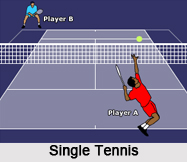 One of the players serves first and the other returns. Opponents swap serve interchange ends after every game. A toss of a coin takes place to decide who serves first and who returns. The player who wins the toss has the following options: One of the players serves first and the other returns. Opponents swap serve interchange ends after every game. A toss of a coin takes place to decide who serves first and who returns. The player who wins the toss has the following options:
* To serve first and let the opponent choose the ends * To receive first and let the opponent choose ends The winner can decide which half of the court he/she wants to start the match from. In such a scenario, the opponent has a choice to serve or receive. The winner of the toss can also ask the opponent to decide whether he/she wants to serve or receive. Doubles Tennis in India The court for doubles tennis is wider as compared to singles, where any of the two players can hit the ball. The serve is on a rotational basis, which means a player serves every fourth game. The chronology of serving and receiving can be changed after a set comes to an end. The partners of server and receiver have the option to stand at any place on the court during the course of a serve. At the time of the game, it is better though for the four players to stand at each side of the court. Tennis Officials in India Tennis officials have the responsibility of keep a tab on the score line and adjudicating whether a ball is in or out. A senior umpire sitting on a chair adjacent to the net announces the points won. He has the authority to overrule decisions made the other officials. The line judges make a decision whether a ball is in or out. He sits outside the court and keeps a close watch at the court lines. Since the last two decades, an electronic machine has aided the line judge. This is chiefly because players have begun serving at a speed of 100mph. A net-cord judge establishes whether a serve has clipped the net and must be called a let. In case a player picks up a squabble with the officials, he can either be penalized or disqualified depending on the nature of the wrangle. For major disagreements, the match referee can be brought into play. Referee otherwise watches the game from the stands. * Rule 1- The opponents stand on opposite sides of the court. The player who delivers the ball to start the point is called the server. The player who stands opposite and cross-court from the server is the receiver. * Rule 2- The right to serve, receive, choose your side, or give the opponent these choices is decided by a toss of a coin or racquet. If the choice of service or receiver is chosen, the opponent chooses which side to start. 
* Rule 3- The server shall stand behind the baseline on the deuce court within the boundaries of the singles court when playing singles and within the doubles sideline when playing doubles. See court dimensions. All even points are played from the deuce court and odd number points played from the advantage court. The server shall not serve until the receiver is ready. Serves are made from the deuce court to the opponent's service box on the deuce court. Advantage court to advantage box. If the server misses his target twice, he loses the point. If the ball hits the net and goes in the correct service box, another serve is granted. If the server steps on the baseline before contact are made, the serve is deemed a fault. * Rule 4- The receiver is deemed ready if an attempt is made to return the server's ball. The receiver can stand where he likes but must let the ball bounce in the service box. If the ball does not land in the service box, it is deemed a fault and a second serve is given. If the ball is hit by either opponent before the ball bounces, the server wins the point. * Rule 5- The server always calls his score first. If the server wins the first point, he gets a score of 15. Scoring is done like a clock. See example below. Love means zero in tennis. The second point is called 30. The third point is called 45 (now-a-days known as 40) and game is won when the score goes back to love. If the score is 40-40, also known as deuce, one side must win by two points. Advantage-In means if the server wins the next point, he wins the game. Advantage-Out means the receiver has a chance to win the game on the next point. * Rule 6- After the game, the opponents serve. Games equal 1. The first to win 6 games, by two, wins the set. The first to win 2 sets wins the match. If the score is 6-6, a tie-breaker is played. This is scored by one's. The first team to score 7 points winning by two wins the set. The tiebreaker continues until one side wins by two. Hence, the game-Set-Match. * Rule 7- If the ball goes into the net, or outside the boundaries of the court, the player who hit that ball loses the point. If the ball hits the net during the point and goes into the opponent's court, the ball is in play. A player loses the point if he touches the net, drops his racquet while hitting the ball, bounces the ball over the net, hits a part of the surroundings such as the roof, or a tree, the ball touches him or his partner, he deliberately tries to distract the opponent. * Rule 8- A let is called during the point if a ball rolls on the court or there is a distraction from someone besides the players on the court. * Rule 9- A ball that lands on the line is good. * Rule 10- If players serve out of turn or serve to the wrong person or court, the point or game will stand and order will be resumed following the point or game. The above rules are the official Code of the International Tennis Federation. |
| |||



Rules of Tennis
| The rules of Tennis in India are simple which one of the chief reasons why it is such a famous sport. The All Indian Tennis Federation regulates these rules in Indian tennis. |
| ||||||||||||||||||||||||||||

