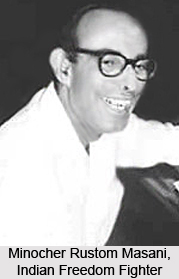
Minocher Rustom Masani was popularly known as Minoo Masani.He was born on November 20, 1905.He graduated from the prestigious Elphinstone College in Bombay. After that he moved to England and studied at London School of Economics and Lincoln`s Inn. Minocher Rustom Masani came back to India and started legal practice at Bombay court. After few days he gave up practice and joined the Indian Freedom Movement. For his active participation he was imprisoned several times by the British Government. Minoo Masani formed the Congress Socialist Party along with Jayaprakash Narayan, Achyut Patwardhan, and Yusuf Meherally and served as the Joint Secretary of this party. He was elected as the Mayor of Bombay Municipal Corporation in 1943.
At the young age Minoo Masani was an ardent follower of the communist leader of Soviet Union but the brutality of Stalin compelled to change his views. He started opposing the communism and refused to accept communist members in the Congress Socialist Party. Minoo Masani did not succeed to persuade the party members in this matter and walked out of the Congress Socialist Party along with Ram Manohar Lohia, Achyut Patwardhan and Asoka Mehta. Later communist members were excluded from the party. During this time Minoo Masani wrote famous article `Socialism Reconsidered` opposing the Marxist doctrine. After that he plunged into Quit India Movement led by Gandhiji and left the job of Tata Company. He was imprisoned in Nasik jail where came into close contact with some great congress leaders. In 1946 Minoo Masani was selected as the member of Constituent Assembly, which earlier was known as Indian Legislative Assembly. He was also the member of Fundamental Rights Sub-Committee and Union-Powers Committee. Minoo Masani contributed a lot in drafting the Constitution of India.
Minoo Masani started thinking about socialism in a different way. He propagated the idea of mixed economy, which was appropriate for Indian democracy. He also wrote an article "Plea for a Mixed Economy". Minoo Masani represented India in the UN Sub-Commission on Minorities. He fell out with Prime Minister Nehru over the issue of the treatment of the minorities in the Soviet Union and Eastern Europe. At that time his bestseller book was withdrawn from the market. In 1948 Minoo Masani was sent as the Indian ambassador to Brazil. During cold war Soviet Union helped to establish a number of institutions to cater the Soviet interests around the world. On the other hand several organizations (like Congress for Cultural Freedom in Paris) were founded to oppose Soviet ideology. Minocher Rustom Masani established Indian Committee for Cultural Freedom along with Jayaprakash Narayan, Asoka Mehta and A.D.Gorwala.The member of this Indian Committee for Cultural Freedom were open-minded scholars, writers, artists and scientists. He also established Democratic Research Service with the help of home minister Sardar Vallabhbhai Patel to eradicate separationist ideology in India.
In 1957, Minoo Masani was elected as the member of the Lok Sabha from Ranchi in Bihar. As a member of Lok Sabha, he gave full effort to implement the mixed economy and tried hard to resist statist policies. In 1959 he accompanied to C.Rajagopalachari and established Swatantra Party. As a general secretary of this party Minoo Masani used his organizing capability to spread Swatantra Party all over the India. In 1967 election the party earned 44 seats in the Lok Sabha as the single largest opposition party. Swatantra Party also became the main opposition party in the Rajasthan and Gujarat legislative Assemblies.
In 1970 when Indira Gandhi`s popularity sidelined all the parties Swatantra Party also became on the verge of extinction. At that time Minoo Masani resigned the party and bade adieu to the active politics. He was a noted parliamentarian. As the leader of opposition party and member of different committee appointed by the lower house he raised his voice in proper time and delivered valuable speeches. Later these crucial speeches were accumulated and published as a book named `Congress Misrule and Swatantra Alternative". As an opposition leader Minoo Masani thought that opposition should not stand as an obstacle on the way of Government`s right move. He was the founder editor of Freedom First. Through this paper he criticized Mrs. Gandhi`s `Emergency`. In 1978 Janata Party won the election and Minoo Masani was appointed as the Chairman of the Minorities Commission but due to disagreement with the party he resigned from the post.
Minoo Masani was the supporter of Individual liberty. He was awarded the patron of the Liberal International. In the year 1968 he established the Leslie Sawhny Programme of Training for Democracy to let young people know the duties of good citizen and economic issues of the country. Minoo Masani wrote two books for the young generation of India -Our India and its sequel We Indians. In 1981 he wrote his autobiography. Minoo Masani passed away on May 27, 1998.