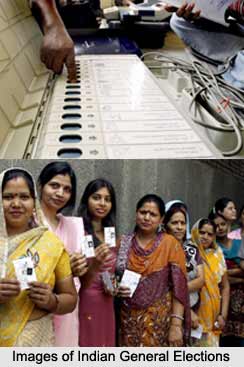
 In 1947, India attained her independence and in 1950 became a Sovereign Socialist Democratic Republic. With this the Indian Constitution came into force, which introduced the Universal adult franchise where every citizen of India (above the age of 21 which was later reduced to 18) was given the right to vote to choose the Government of India. Since then, elections have played an integral part in Indian politics. Elections in India have come a long way and each time has displayed the power of the individual in a democracy.
In India, elections are a very elaborate process, which involves a series of processes from announcement of election dates by the Election Commissioner of India, casting of votes by the citizens, to the announcement of results and submission of the list of successful candidates to the executive head of the state. This marks the end of the election process after which a new government is formed.
The first general election in India after independence was conducted in 1951, for 489 constituencies representing twenty-six states. During that time, few two seats and even three seat constituencies prevailed but after 1960 the system of multi seat constituencies were discontinued. Till the early 1970`s Congress dominated Indian politics. After the emergency was pulled off, in the 1977 elections the Congress was defeated by the unlikely coalition of all the major parties. In the elections of 1980, the Congress Government came back with a sweeping victory.
The 1990`s were a decade of instable coalition governments. It was a weak phase in Indian politics when governments were formed and broken. The Indian General Elections of 1996 did not give a proper verdict. BJP was invited to form the Government and Atal Bihari Vajpayee formed a cabinet. But this Government lasted for thirteen days. After this, non- BJP, non-Congress parties formed the United Front government. This Government lasted for two years with two Prime Ministers, H.D.Deve Gowda and I.K. Gujaral.
The 13th General Elections was held few months after the Kargil War. With this in 1999 the National Democratic Alliance (NDA) was formed with BJP being the leading coalition partner. Atal Bihari Vaijpayee became the Prime Minister of India thus ending the instability at the Center.
The 14th General elections were held in 2004, where 543 members were elected. The BJP led Coalition NDA was defeated after the Indian National Congress was able to put together a majority. A coalition government was formed which was called United Progressive Alliance. Dr. Manmohan Singh became the Prime Minister of India.