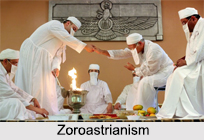
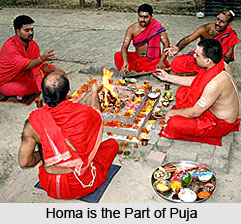
 Homa or homam are pujas performed for a particular deity by invoking Agni, the god of fire. Thus, Homa or Havan is fire worship. Fire is visible divine energy, which is thought to be the mediator between human and gods. Homa is performed in a receptacle or `Kund` in which a fireplace or `Vedi` is made with bricks. The HomaKunda should be decorated with colorful flowers, leaves, grainsand beans. Wood is used as fuel for Homa, which is burnt easily without creating much smoke. In India, the wood from mango tree is most often used for Homa. The Homa wood should be completely dry and cut in small sizes to fit the Kunda.
For Homa Samigri is used which is a combination of thirty-six herbs. This Samigri when used some ghee and honey are also added to the herbs. The Samgri purifies the air and its chemicals burn to emit beautiful smell, like incense.
It is said that when Lord Brahma created man, he also created Homa for man`s livelihood and attainment of his spiritual desires. The Homas form the essence of all `Karma`s prescribed in Vedas.Homa is derived from Vedas, though according to `Purusha Shuktham`, Vedas originated from Homa. Both the Vedas and the Homasare eternal truth having no beginning or end and are `Apaurusheyam` i.e. not created by humans.
The goal of all Homas is the prosperity of people at large by protecting the environment.The sun is the ultimate source of all energy and fire is a small part of sun`s energy. According to Veda`s any offering to the fire means offering to Sun god. Thus, the undesirable materials is destroyed through Homas and environment is enriched with energy by Homas. Thus the ancient text proclaim truly that "Such Vaidika Karmams are result-oriented, and meant to lead to Sreyass or spiritual attainments".
There are different types of Homas. Each Homa is performed strictly according to scriptures. The homas are conducted by fully learned and experienced Vedic Scholars. The ingredients are required for these Homas are also different. Each Homa is performed after a specific praying or `Shankalpa` for the specific belief or benefit. After each Homa the Pundits utter Vedic prayers.