Hindu marriage rituals form an integral part of the wedding ceremony. Hindu marriage ceremonies include the following of a series of rituals and it is celebrated as a grand festival to make it memorable and colourful. A number of rituals take place as per the custom of Hinduism in the Hindu marriages and each ritual is considered important. Hindu marriage rituals include the participation of the bride and bridegroom along with their relatives and families and these marriages are considered as significant part of marriage.
Hindu marriage rituals includes exchange of garlands, `Pidi Sutrudhal` or throwing colourful rice balls after taking them around the couple in order to keep the evil forces away from the newly married couple. As per the Vedas there should be mutual trust and loyalty between the married couple, which are the essentials for a happy marriage life. According to Rig Veda there are eight types of marriages namely `Braahmam marriage`, `Praajaapathyam marriage`, `Aarusham marriage`, `Daiveekam marriage`, `Asuram marriage`, `Gaandharvam marriage`, `Raakshasam marriage` and `Paisaasam marriage`.
One of the most important marriage rituals is the chanting of mantras from Rig Veda. The 85th Sooktham of tenth mandalam of Rig Veda describes the marriage of Soman with Suryai, which is thought to be the basis of marriage rituals those are followed in Hindu marriage ceremonies. However, the marriage rituals vary widely depending on family, caste and geographic locations.
Several pre-marriage rituals are performed in Hindu weddings. Some ofthem are mentioned below -
 Sangeet Sandhya: Sangeet Ceremony is the musical entertainment arranged in the evening by the groom`s family where the members of the two families are introduced to each other.
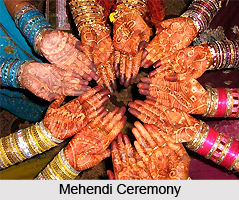
Mehendi ceremony: In Mehendi ceremony the bride`s hands and feet are decorated with Mehendi which is thought to be very auspicious. It is said that the darker the colour of the Mehendi, the more is the happiness in the life of the bride.
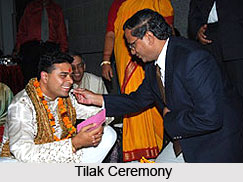
Tilak Ceremony: Tilak Ceremony is said to be the auspicious marking on the forehead made with kumkum or vermilion powder and turmeric powder. The male members of the bride`s family make Tilak on the groom`s forehead and offer him gifts.
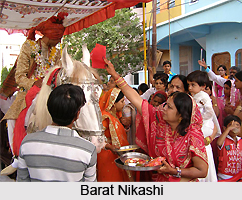 Barat Nikashi: Barat Nikashi is the ritual when the groom leaves for the wedding riding on a beautifully decorated horse or elephant. Elders from his family make Tilak on his forehead. The groom`s sister feeds the horse or elephant with sweetened grain. The Barat is headed with music and dancing participants. At the venue of wedding the procession is welcomed with a song called `Talota`. Finally the groom knocks on the door of the bride with the sword and enters.
Mamara: Mamara is a common tradition to both the bride and groom`s side where maternal uncle along with his wife and family arrives with much enthusiasm and bride or groom`s mother receive them with a traditional welcome. The clothes brought by uncle are worn by the family during the wedding.
Apart from these pre-marriage ceremonies, there are several other post wedding rituals in Hindu marriage ceremony. The main rituals during Hindu wedding ceremonies are mentioned below -
Vara Satkaarah: Vara Satkaarah refers to the greeting of the groom and his friends and relatives. In this ritual the priest enchants few mantras and the groom is welcomed by the bride`s mother by applying `Tilak` of vermilion and turmeric powder on his forehead.
Madhuparka Ceremony: This ceremony talks about conferring of presents offered to the bridegroom by the bride`s father.
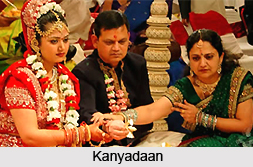 Kanyadaan: During the marriage, Kanyadaan is the ritual which is performed by giving the hand of the bride by her father to the hand of the groom amidst the chanting of sacred mantra.
Maalai Matral: Maalai Matral or exchanging garlands is another important ritual of Hindu marriage ceremonies. The bride and the groom exchange their garlands which symbolises that they have two bodies with one life from now on.
Other significant marriage rituals include `Homa`, which is the sacred fire ceremony and it ensures that all auspicious things replace the negative forces in an atmosphere filled with purity and serenity. `Pani Grahan` is the ritual in which the groom has to take the right hand of the bride in his left hand to accept her as her better half and legal wife. Next ritual is `Pratigna-Karan`, in which the couple were tied the knot and they walks around the sacred fire and take solemn vows of loyalty, steadfast love and life-long faithfulness to each other. Moreover, in `Shila Arohan`, the mother of the bride assists her to step onto a stone slab which signifies her entry to a new life. Later on `Laja Homah` is performed in which puffed rice is offered as oblations to the sacred fire where bride`s palm rests on the palms of the groom. Then the couple are said to take `Parikrama` or `Pradakshina`. It is also known as `Mangal Fera` in which the couple circles the sacred fire seven times, which is granted as the legal ceremony by Hindu Marriage Act as well as most important among all customs. Then during Saptapadi, marriage knot is tied one end of the groom`s scarf with the bride`s dress. It is followed by seven holy steps taken together by the bride and the groom representing sustenance, strength, wealth, happiness, progeny, harmony, mutual understanding and long life respectively.
Later on, `Aashirvadah` is given by the elders of the family of both the bride and the groom. Then the next ritual is the Jaana Vaasam which is the celebration on the evening of the day before the marriage, which is the formal reception of the groom to the bride`s place. Vidaai is regarded as the most emotional ritual in marriage ceremonies. It symbolises that the bride leaves her parents` home and her new life in her husband`s family. After this ceremony, the newly wed couple visits a temple for seeking blessings for their new life. Dwar-Rokai, Griha Pravesh (where the groom`s mother welcomes the bride with traditional aarti), and Mooh Dikhai are the Hindu marriage rituals followed in the groom`s place.
Apart from these main rituals there are many other local rituals in Hindu marriage ceremonies. Like for instance, in Oonjal or Swing, the couple is seated on the swing which signifies that they have to be strong though there will be upward and downward motions of life. In another ritual the groom`s family`s eldest members go to the bride`s house, where Lord Krishna`s deity is decorated and aarti is performed. This ritual is termed as `Biradh Morcha`. Hence, these are some of the main Hindu marriage rituals followed religiously by both the families.