 The Eastern Group of Temples at Khajuraho includes Parsvanath Temple, Adinath Temple, Ghantai Temple, Hanuman temple, and Brahma Temple. They are briefly described below:
Hanuman Temple: On the way to the Jain temples is a recently built, whitewashed shrine that shelter one of the earliest inscribed images of Hanuman in India. This 2.5 m. (8.2 ft.) high image of the monkey god, which is still worshipped today, is coated with red lead. It has a short dedicatory inscription dated AD 922.
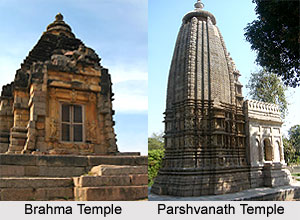
Brahma Temple: This temple is situated in a picturesque location, on the banks of the Khajursagar tank. It presently enshrines a four-faced Shiva-linga, Brahma Temple because of which the temple was wrongly attributed to Brahma.
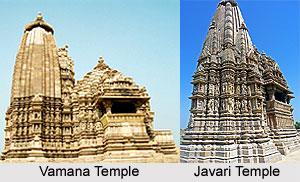
Vamana Temple: Vamana Temple is situated in the middle of a field. The Vamana, built between AD 1050 and 1075, enshrines an icon of the Dwarf incarnation of Vishnu. This is a significant temple as there are not many temples in India that are dedicated to this incarnation of Vishnu. Khajuraho, however, was a major centre for the worship of Vamana, proved by the recent excavation of a brick complex which has yielded exquisite statues of Vamana.
Javari Temple: The name `Javari`, given to the adjacent Vishnu shrine, is a local variation that derives from the `javara` (millet) grown in the surrounding fields. This small temple was constructed between AD 1075 and 1100. It has an ornate torana (gateway).
 Parshvanatha Temple: This is the largest of the Jain temples. The temple was originally dedicated to Adinatha, the first Tirthankara, but the present image of Parshvanatha was installed in 1860, when some renovation work was undertaken. This site has beautiful figure sculptures on its exterior wall. It is a sandhara temple with an inner ambulatory and a simple ground plan. This temple has no balconied openings but only perforated windows. The temple was built between AD 950 and 970, in the time of King Dhangadeva.
This Jain temple contains images of Krishna, Rama, Balarama, Vishnu, and Shiva on its exterior wall. The gatekeepers on the doorway represent the Jain Indra and Upendra. The Jain goddesses are seen in the niches of the juncture wall. A sculpture of the Parents of Jina is placed in the mahamandapa. The door lintel of the sanctum has figures of the Jinas, while that of the main hall contains the Yakshi Chakreshvari, the guardian Yakshi of Adinatha.
Adinatha Temple: This temple, with only its sanctum and vestibule still remaining, is situated to the north of the Parshvanatha shrine. It is a single spire temple and the crisp decoration of chaitya-arch designs on the spire creates an interesting light-and-shade effect. On the walls of the temple, there are beautiful apsaras in classical dance postures. They are decked with ornaments in their hair, ears, arms, and waist. There are numerous Jain Yakshis, namely, Padmavati, Chakreshvari, Ambika, Manasi, and others in the niches of the walls. The door lintel bears the sixteen auspicious symbols that Jina`s mother dreamt of at the time of conception.
Ghantai Temple: A lane in the Southern part of the village will lead one to Ghantai. This tenth century Jain monument is known by its local name because of the `Ghantai` (bell) Ghantai motifs on its pillars. The surrounding area is rich in mounds and contains remains of ancient structures. Its ground plan is similar to that of the Parshvanatha temple, but its walls have collapsed, and only the pillars of its porch and hall have survived along with an ornate ceiling, lintel, and doorway. The gatekeepers and river goddesses wear rich ornaments.