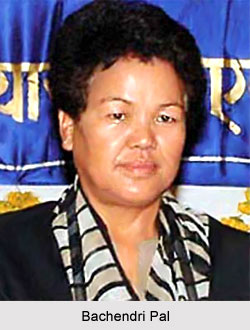
 Bachendri Pal is the first Indian woman to climb the summit of Mount Everest. Pal is a well known Indian female mountaineer who is 5th in the world to scale the Everest peak. She conquered the Mount Everest peak on 23rd May, 1984, at 1.07 p.m. as per the Indian Standard Time. She stood atop Mount Everest, also known as Sagarmatha in Nepali. Bachendri`s accomplishments as a mountaineer, empower and encourage women of all ages in India and across the world as well.
Early Life of Bachendri Pal
Bachendri Pal was born in the year 1954 in a village in Nakuri, in Garhwal, in the newly formed state of Uttarakhand. She was the third child amongst the five, in a family with a modest and average lifestyle. Bachendri was pretty stubborn and protested cultural customs of preferring male child. Bachendri was very active and mischievous from her childhood for which she was frequently punished in school, but still she did well in studies and did excellent in sports as well. At the age of 12, Bachendri Pal had her first mountaineering experience, when during a picnic, she and her schoolmates scaled a high peak of 13,123 feet. As it became dark and they could not climb down, they spent the night at the peak without any food or protection. The memory of this experience heightened her love for the mountains.
Even after facing many constraints, Bachendri Pal carried on her education and completed it successfully. Her parents sent her to college on being influenced by the principal of her school. Bachendri was the first girl of her village to complete graduation. During her graduation days, she also achieved the first position in a rifle shooting competition. Bachendri Pal studied to become a teacher and received a Bachelor of Education degree and a MA degree.
Career of Bachendri Pal
Bachendri Pal was aiming to become a professional mountaineer. Although her family and relatives discouraged her, still she was determined to be a mountaineer. It was then she joined the Nehru Institute of Mountaineering (NIM) and was declared to be the best student. Bachendri climbed Gangotri I (21,900 ft) and Rudugaria (19,091 ft) in 1982, during her time at NIM. She got employment as an instructor at the National Adventure Foundation, which had set up an adventure school for women to learn mountaineering.
Achievement of Bachendri Pal
After passing the Advanced Mountaineering Course, Bachendri Pal achieved a position on the team of India`s fourth Mt. Everest expedition, named "Everest - 84". In March 1984, the elite team six Indian women and eleven men, was taken to Kathmandu, capital of Nepal; and from there they started their journey. In May 1984, the team started the climb. The Expedition faced many fatal obstacles as Bachendri Pal and her team mates nearly lost their life, crushed under an avalanche at Lhotse glacier face at 23,000 ft. Most members of the team got injured. Even with an injury on her head, she continued the ascent. Bachendri reached the summit of Mount Everest, on 23rd May 1984, and at 1:07 P.M. Indian Standard time, she stood at the peak (29,084 ft) with another climber.
After her return in May 1984, Bachendri Pal was offered a position at Tata Steel Ltd., the sixth largest Steel Plant in the World, where she became the Chief of Adventure Programmes of Tata Steel Adventure Foundation.
 Major Accomplishments of Bachendri Pal
In 1985, Bachendri Pal led an Indo-Nepalese Everest Expedition team of only women. The expedition made seven world records and created a yardstick for Indian mountaineering. In 1993, she organised the Indo-Nepalese Women`s Everest Expedition where 18 people reached the peak, including 7 Indian women. In 1994, Bachendri participated in the River Ganga rafting expedition from Haridwar to Kolkata, which had 18 women in 3 rafts, covering 2,155 Km in 39 days. Bachendri Pal also led the First Indian Women`s Trans-Himalayan Expedition by 8 women, covering 4,500 Km trek via Siachen Glacier. Again In 1994, she guided an all women rafting team, which coursed through the waters of the Ganga River, covering 2,500 km.
Awards of Bachendri Pal
Bachendri Pal has been conferred with several awards for her various daring and valorous achievements. She has received the following awards-
* Padam Shri Award in 1985;
* National Youth Award in 1985;
* Gold Medal by the Department of Education of Uttar Pradesh, in 1985;
* Arjuna Award in 1986;
* Listed in Guinness Book of World Records in 1990;
* National Adventure Award in 1994;
* Yash Bharti Award by the Government of Uttar Pradesh in 1995;
* Limca Book of Records in 1997;
* Mahila Shiromani Award in 1997;
* Gold Medal for Excellence in Mountaineering by the IMF
The accomplishments and achievements of Bachendri Pal have brought her wishes and congratulations from many reputable personalities like, the President and the Prime Minister, and even J. R. D. Tata praised her in person.