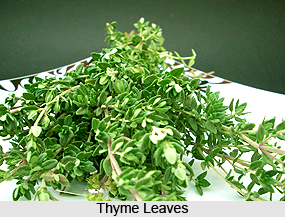
 Thyme leaves are popular for their strong flavour. It belongs to the family named Labiatae. The botanical name of thyme is "Thymus vulgaris Linn" (Thyme) and "Thymus serpyllum Linn" (Wild Thyme). In India, thyme is known in various names depending upon the particular language. In Hindi language it is called Banajwain, In Punjabi language it is Marizha, Masho and Rangsbur and in Urdu language it is known as Hasha.
Dried leaves and flowering tops of both the species are known as Thyme, though commercially the cultivated variety that is the first variety is important and globally popular. Though it is not traditionally popular spice in India; it is gaining popularity during recent past due to impact of globalization. The dried leaves are curled and brownish green colour, usually not longer than 6 to 7 mm and marketed in whole or ground form. The flavour is aromatic, warm and pungent. Thyme is cultivated in any hot and sunny location on well drained soil. The seeds are planted during the spring season, and then it grows as a perennial.
History of Thyme Leaves
Ancient Egyptians used the herb for embalming and ancient Greeks used it in their bath and they also burnt it as incense in the temples. The use of Thyme was influenced by the Romans in Europe, who used them to purify their rooms and to give it a nice aroma. During middle ages in Europe, thyme was placed under pillows to have a good sleep and ward off nightmares. Thyme was also used as incense to place on coffins during funerals.
Composition Of Thyme Leaves
Chemical composition of Thyme leaves is:
Moisture:7.1%
Protein:6.8%
Fat:4.6%
Fiber:24.3%
Carbohydrates:44.0%
Total ash:13.2%
Calcium:2.1%
Phosphorus:0.20%
Iron:0.14 mg/100 gram
Sodium:0.08%
Potassium:0.9%
Vitamin A (carotene):175 I.U./100 gram
Vitamin B1:51 mg/100 gram
Vitamin B2:0.4 mg/100 gram
Vitamin C (ascorbic acid):12 mg/100 gram
Niacin: 4.9 mg/100 gram.
Calorific value: 340 calories/100 grams.
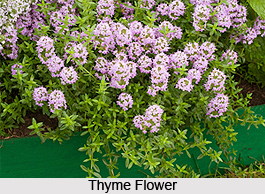 Thymol Oil of Thyme
Crushed thyme on steam distillation yields about 2.5% volatile oil, which is yellowish-reddish liquid with a pleasant smell and a sharp taste. The chief constituent of the oil is thymol (about 45%). In the pure state, thymol consists of colourless, translucent crystals possessing aromatic thyme like smell and a pungent taste. Thymol is in great demand in India and a lot of thymol is being imported. The wild thyme yields 0.5% essential oil, as compared to 2.5% in cultivated thyme, which contains phenol etc.
Uses of Thyme Leaves
The herb is used to season tomato soups, clam chowder and juice, fish and meat dishes and poultry dressings. It is also used in liver sausage, pork sausage, headcheese, cottage cheese and cream cheese. The oil of thyme is also popularly used for flavouring purposes. It is preferred in food industry than the spice itself because the oil can be appropriately dosed.
The oil is well recognized for its medicinal properties. It is employed in preparations for treatment of bronchitis and whooping cough. The oil of wild thyme is applied to tooth ache. In Punjab, the herb of wild thyme is given in weak vision, complaints of stomach and liver, suppression of urine and menstruation. The herb Thyme has capacity to thin phlegm and blood, thus acts as expectorant and reduces serum cholesterol. In Europe, it was traditionally used as part of home remedy. Thus, it can be used for manufacture of herbal medicinal preparations. Some other benefits of Thyme are as follows:
It over powers on other herbs
It helps in digestion of fat
Thyme tea is excellent for cough and cold
It induces appetite
`Thymol ` has antiseptic properties. It is used in ointments, bath, toothpaste and mouth washes.
It is effective in mucous membranes in lungs and stomach